Applied Biostatistics and Data Analytics for Pharmaceutical Sciences
[ Bpharm (Bachelor of Pharmacy) ]
Under Class: | 2nd Semester (Bpharm) |
Applied Biostatistics and Data Analytics for Pharmaceutical Sciences - Question Papers, Lecture Notes, Study Material Download PDF
Pharmacy - Bachelor of Pharmacy (Bpharm) - 2nd Semester - 1st Year - Name of Subject: Applied Biostatistics and Data Analytics for Pharmaceutical Sciences (BP201T) - Lecture Notes, Study Material, Question Papers Download PDF
BP201T:
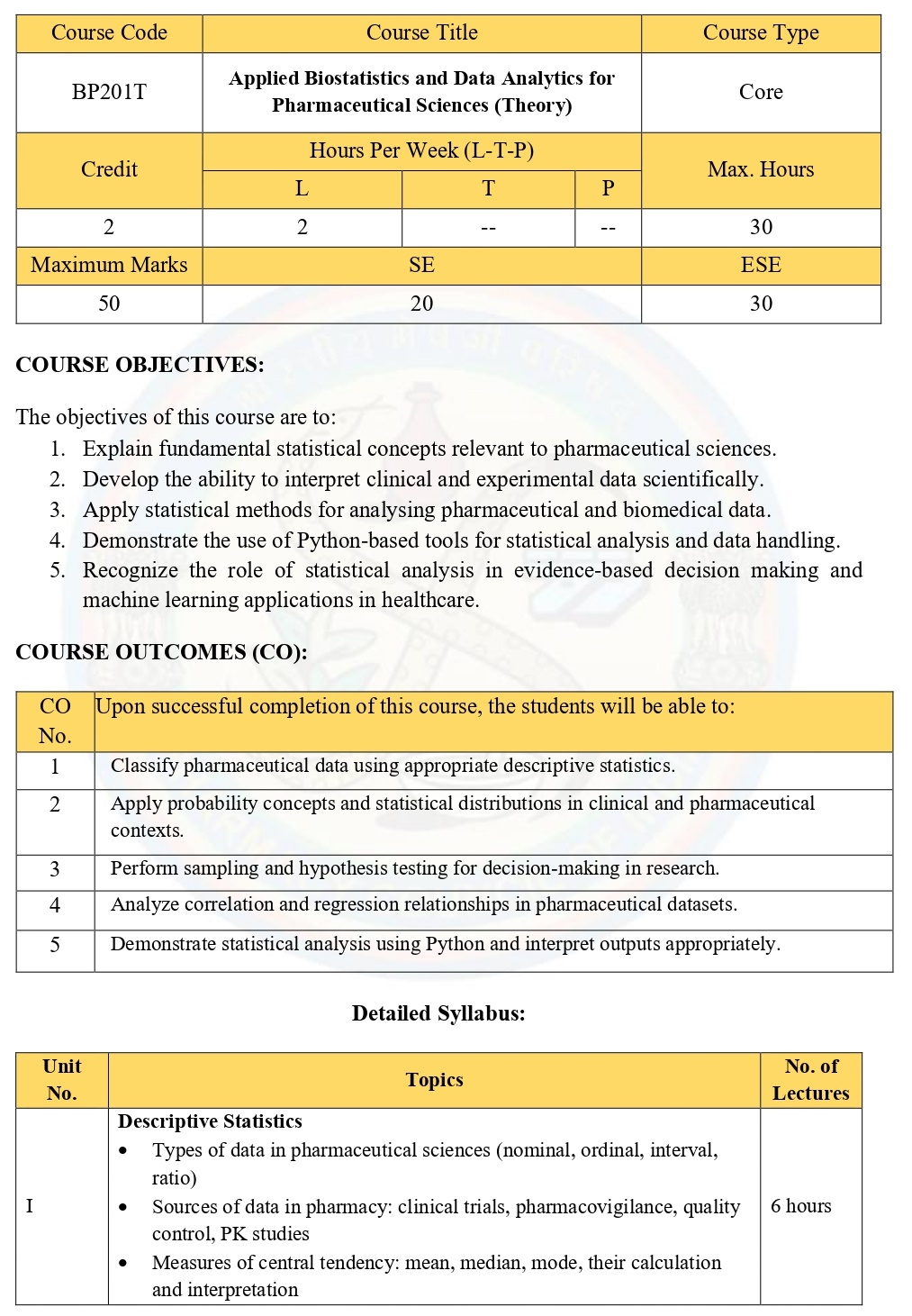
Applied
Biostatistics and Data Analytics for Pharmaceutical Sciences (Theory)
COURSE OBJECTIVES:
The objectives of
this course are to:
1. Explain
fundamental statistical concepts relevant to pharmaceutical sciences.
2. Develop the
ability to interpret clinical and experimental data scientifically.
3. Apply statistical
methods for analysing pharmaceutical and biomedical data.
4. Demonstrate the
use of Python-based tools for statistical analysis and data handling.
5. Recognize the role
of statistical analysis in evidence-based decision making and machine learning
applications in healthcare.
COURSE OUTCOMES
(CO):
Upon successful
completion of this course, the students will be able to:
1. Classify
pharmaceutical data using appropriate descriptive statistics.
2. Apply probability
concepts and statistical distributions in clinical and pharmaceutical contexts.
3. Perform sampling
and hypothesis testing for decision-making in research.
4. Analyze
correlation and regression relationships in pharmaceutical datasets.
5. Demonstrate
statistical analysis using Python and interpret outputs appropriately.
Detailed Syllabus:
Unit I
Descriptive
Statistics
• Types of data
in pharmaceutical sciences (nominal, ordinal, interval, ratio)
• Sources of
data in pharmacy: clinical trials, pharmacovigilance, quality control, PK
studies
• Measures of
central tendency: mean, median, mode, their calculation and interpretation
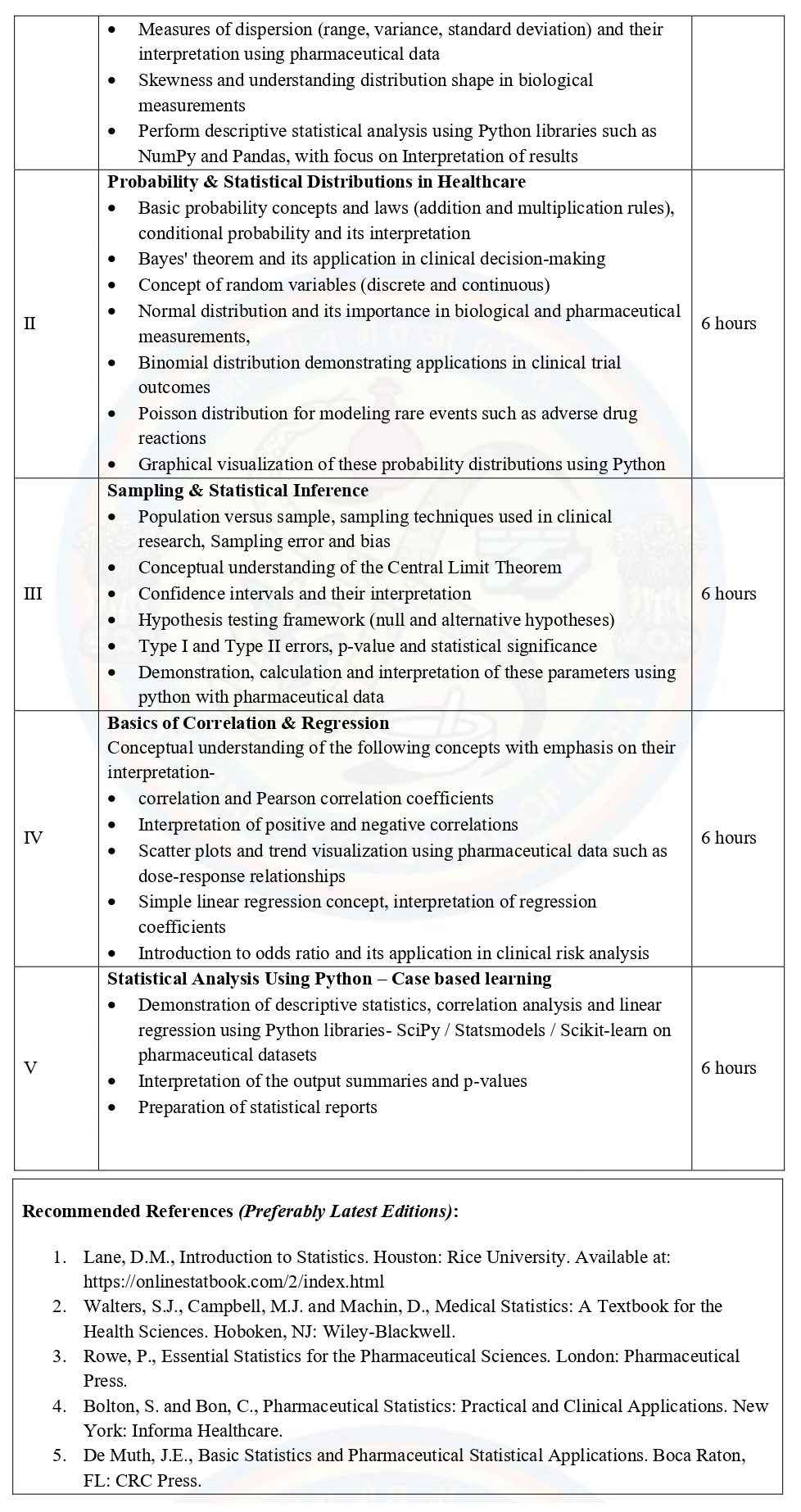
• Measures of
dispersion (range, variance, standard deviation) and their interpretation using
pharmaceutical data
• Skewness and
understanding distribution shape in biological measurements
• Perform
descriptive statistical analysis using Python libraries such as NumPy and
Pandas, with focus on Interpretation of results
Unit II
Probability &
Statistical Distributions in Healthcare
• Basic
probability concepts and laws (addition and multiplication rules), conditional
probability and its interpretation
• Bayes'
theorem and its application in clinical decision-making
• Concept of
random variables (discrete and continuous)
• Normal
distribution and its importance in biological and pharmaceutical measurements,
• Binomial
distribution demonstrating applications in clinical trial outcomes
• Poisson
distribution for modeling rare events such as adverse drug reactions
• Graphical
visualization of these probability distributions using Python
Unit III
Sampling &
Statistical Inference
• Population
versus sample, sampling techniques used in clinical research, Sampling error
and bias
• Conceptual
understanding of the Central Limit Theorem
• Confidence
intervals and their interpretation
• Hypothesis
testing framework (null and alternative hypotheses)
• Type I and
Type II errors, p-value and statistical significance
• Demonstration,
calculation and interpretation of these parameters using python with
pharmaceutical data
Unit IV
Basics of
Correlation & Regression
Conceptual
understanding of the following concepts with emphasis on their interpretation-
• correlation
and Pearson correlation coefficients
•
Interpretation of positive and negative correlations
• Scatter plots
and trend visualization using pharmaceutical data such as dose-response
relationships
• Simple linear
regression concept, interpretation of regression coefficients
• Introduction
to odds ratio and its application in clinical risk analysis
Unit V
Statistical
Analysis Using Python – Case based learning
• Demonstration
of descriptive statistics, correlation analysis and linear regression using
Python libraries- SciPy / Statsmodels / Scikit-learn on pharmaceutical datasets
•
Interpretation of the output summaries and p-values
• Preparation
of statistical reports
Recommended
References (Preferably Latest Editions):
1. Lane, D.M.,
Introduction to Statistics. Houston: Rice University. Available at:
https://onlinestatbook.com/2/index.html
2. Walters, S.J.,
Campbell, M.J. and Machin, D., Medical Statistics: A Textbook for the Health
Sciences. Hoboken, NJ: Wiley-Blackwell.
3. Rowe, P.,
Essential Statistics for the Pharmaceutical Sciences. London: Pharmaceutical
Press.
4. Bolton, S. and
Bon, C., Pharmaceutical Statistics: Practical and Clinical Applications. New
York: Informa Healthcare.
5. De Muth, J.E.,
Basic Statistics and Pharmaceutical Statistical Applications. Boca Raton, FL:
CRC Press.