Basics of Python Programming for Pharmaceutical Sciences
[ Bpharm (Bachelor of Pharmacy) ]
Under Class: | 1st Semester (Bpharm) |
Basics of Python Programming for Pharmaceutical Sciences - Question Papers, Lecture Notes, Study Material Download PDF
Pharmacy - Bachelor of Pharmacy (Bpharm) - 1st Semester - 1st Year - Name of Subject: Basics of Python Programming for Pharmaceutical Sciences - BP101T - Lecture Notes, Study Material, Question Papers Download PDF
UNIT I : Data Expressions Statements:
• Introduction to Python
• Python interpreter
• Modes of Python Interpreter
• Values and Data Types
• Variables - Python
• Keywords - Python
• Identifiers - Python
• Statements and Expressions - Python
• Input and Output - Python
• Comments - Python
• Docstring - Python
• Lines and Indentation - Python
• Quotation in Python
• Tuple Assignment - Python
• Operators and Types of Operators - Python
• Operator Precedence - Python
• Functions - Python
• Types of function
• Function definition(Sub program) - Python
• Flow of Execution - Python
• Function Prototypes
• Parameters and Arguments - Python
• Modules - Python
• Python Programs - Data, Expressions, Statements
• Python Data, Expressions, Statements: short important questions and answers
• Python Data, Expressions, Statements: brief important questions and answers
UNIT II : Control Flow Functions:
• Boolean Values
• Conditionals - Python
• Iteration/Control Statements - Python
• Fruitful Function - Python
• Strings - Python
• List as array - Python
• Example Python Programs: Control Flow, Functions
• Python Control Flow, Functions: short important questions and answers
• Python Control Flow, Functions: brief important questions and answers
UNIT IIIa : Lists Tuples Dictionaries:
• Lists - Python
• Tuple - Python
• Dictionaries - Python
• Difference between List, Tuples and dictionary
• Advanced list processing - Python
• Python Programs on matrix
• Python Programs on Lists, Tuples, Dictionaries
• Python Lists, Tuples, Dictionaries: short important questions and answers
• Python Lists, Tuples, Dictionaries: brief important questions and answers
UNIT I : Data Expressions Statements:
• What is a program?
• Python programming language
• Values and types - Python
• Expressions and statements - Python
• Python Tuple
• Python Strings
• Comments - Python
• Python Output Using print() function
• Modules - Python
• Python Import
• Operators and operands
• Type of operators in Python
• Functions - Python
• Flow of execution - Python
• Parameters and arguments - Python
• Python Basic Programs
UNIT II : Control Flow Functions:
• Conditionals - Python
• Recursion - Python
• Iteration - Python
• Fruitful Functions - Python
• Strings - Python
• Example Python Programs on Control Flow, Functions
UNIT IIIa : Lists Tuples Dictionaries:
• Lists - Python
• Tuples - Python
• Python dictionary
• Python Advanced list processing
• Example Python Programs on Lists, Tuples, Dictionaries
UNIT IIIb : Files Modules Packages:
• Files - Python
• Exception - Python
• Modules - Python
• Package - Python
• Python Files, Modules, Packages: short important questions and answers
• Example Python Programs on Files, Modules, Packages
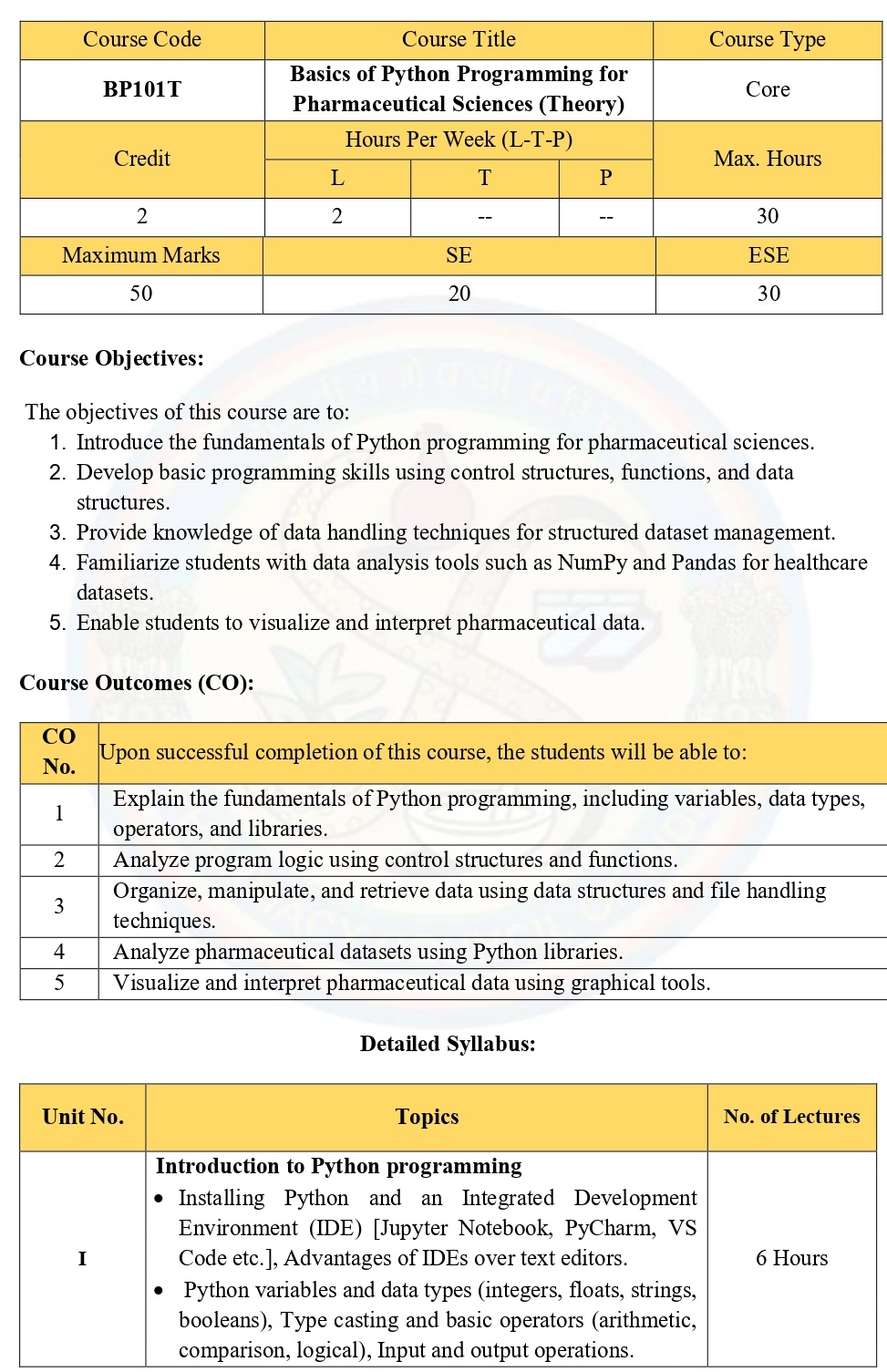
BP101T : Basics of
Python Programming for Pharmaceutical Sciences (Theory) core
Course Objectives:
The objectives of
this course are to:
1. Introduce the
fundamentals of Python programming for pharmaceutical sciences.
2. Develop basic
programming skills using control structures, functions, and data structures.
3. Provide knowledge
of data handling techniques for structured dataset management.
4. Familiarize
students with data analysis tools such as NumPy and Pandas for healthcare datasets.
5. Enable students to
visualize and interpret pharmaceutical data.
Course Outcomes
(CO):
Upon successful
completion of this course, the students will be able to:
1. Explain the
fundamentals of Python programming, including variables, data types, operators, and
libraries.
2. Analyze program
logic using control structures and functions.
3. Organize,
manipulate, and retrieve data using data structures and file handling techniques.
4. Analyze
pharmaceutical datasets using Python libraries.
5. Visualize and
interpret pharmaceutical data using graphical tools.
Detailed Syllabus:
Unit I
Introduction to
Python programming
• Installing
Python and an Integrated Development Environment (IDE) [Jupyter Notebook,
PyCharm, VS Code etc.], Advantages of IDEs over text editors.
• Python
variables and data types (integers, floats, strings, booleans), Type casting
and basic operators (arithmetic, comparison, logical), Input and output
operations.
• Basic string
operations and manipulation techniques. Introduction to standard libraries and
third-party libraries, installing and uninstalling libraries.
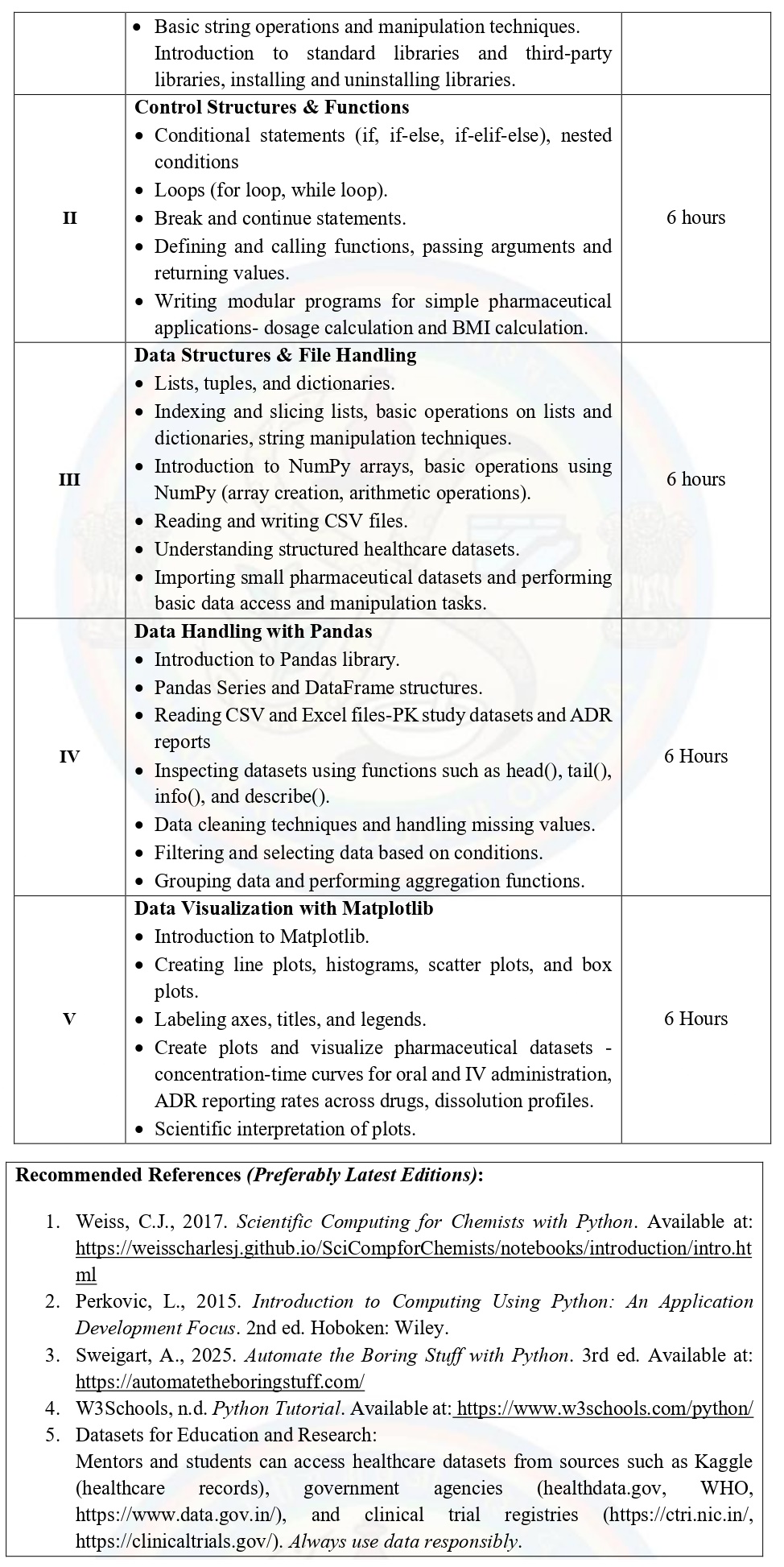
Unit II
Control Structures
& Functions
• Conditional
statements (if, if-else, if-elif-else), nested conditions
• Loops (for
loop, while loop).
• Break and
continue statements.
• Defining and
calling functions, passing arguments and returning values.
• Writing
modular programs for simple pharmaceutical applications- dosage calculation and
BMI calculation.
Unit III
Data Structures
& File Handling
• Lists,
tuples, and dictionaries.
• Indexing and
slicing lists, basic operations on lists and dictionaries, string manipulation
techniques.
• Introduction
to NumPy arrays, basic operations using NumPy (array creation, arithmetic
operations).
• Reading and writing
CSV files.
• Understanding
structured healthcare datasets.
• Importing
small pharmaceutical datasets and performing basic data access and manipulation
tasks.
Unit IV
Data Handling with
Pandas
• Introduction
to Pandas library.
• Pandas Series
and DataFrame structures.
• Reading CSV
and Excel files-PK study datasets and ADR reports
• Inspecting
datasets using functions such as head(), tail(), info(), and describe().
• Data cleaning
techniques and handling missing values.
• Filtering and
selecting data based on conditions.
• Grouping data
and performing aggregation functions.
Unit V
Data Visualization
with Matplotlib
• Introduction
to Matplotlib.
• Creating line
plots, histograms, scatter plots, and box plots.
• Labeling
axes, titles, and legends.
• Create plots
and visualize pharmaceutical datasets - concentration-time curves for oral and
IV administration, ADR reporting rates across drugs, dissolution profiles.
• Scientific
interpretation of plots.
Recommended
References (Preferably Latest Editions):
1. Weiss, C.J., 2017. Scientific Computing for Chemists with Python. Available at:
https://weisscharlesj.github.io/SciCompforChemists/notebooks/introduction/intro.ht
ml
2. Perkovic, L.,
2015. Introduction to Computing Using Python: An Application Development Focus.
2nd ed. Hoboken: Wiley.
3. Sweigart, A.,
2025. Automate the Boring Stuff with Python. 3rd ed. Available at:
https://automatetheboringstuff.com/
4. W3Schools, n.d.
Python Tutorial. Available at: https://www.w3schools.com/python/
5. Datasets for
Education and Research:
Mentors and students
can access healthcare datasets from sources such as Kaggle (healthcare
records), government agencies (healthdata.gov, WHO, https://www.data.gov.in/), and clinical trial registries
(https://ctri.nic.in/,
https://clinicaltrials.gov/).
Always use data responsibly.