Healthcare Psychology and Communication Skills
[ Bpharm (Bachelor of Pharmacy) ]
Under Class: | 1st Semester (Bpharm) |
Healthcare Psychology and Communication Skills - Question Papers, Lecture Notes, Study Material Download PDF
Pharmacy - Bachelor of Pharmacy (Bpharm) - 1st Semester - 1st Year - Name of Subject: Healthcare Psychology and Communication Skills (BP103T) - Lecture Notes, Study Material, Question Papers Download PDF
Psychology
Prologue What Is Psychology:
• Prologue: What Is Psychology?
• Psychology�s Diverse Methods and Perspectives
• The Neural Basis of Emotional Memory
• The Evolutionary Basis for Emotional Remembering
• Cognitive Influences on Emotional Memory
• Social Influences on Emotional Memory
• The Cultural Setting of Emotional Memory
• A Developmental Perspective on Emotional Memory
• Disorders of Emotional Memory
• What Unites Psychology?
Research Methods:
• Psychology: Research Methods
• Psychology: Making Observations
• Making Observations: Defining the Question
• Making Observations: Systematically Collecting Data
• Making Observations: Defining the Sample
• Making Observations: Assessing External Validity
• Making Observations: Monitoring Demand Characteristics
• Psychology: Working With Data
• Working With Data: Descriptive Statistics
• Working With Data: Inferential Statistics
• Psychology: Observational Studies
• Establishing Cause and Effect: the Power of Experiments
• Experimental Groups versus Control Groups
• Random Assignment
• Within-Subject Comparisons
• Internal Validity
• Beyond the Single Experiment
• Research Ethics
• The Power of Science
• Some Final Thoughts: Methodological Eclecticism
The Genetic and Evolutionary Roots of Behavior:
• The Genetic and Evolutionary Roots of Behavior
• Genetics and DNA
• Evolution by Natural Selection
• The Principles of Natural Selection
• Genes and Evolution
• Evidence for Evolution by Natural Selection
• The Unity of Life
• The Genetics and Evolution of Behavior
• The Biological Roots of Smiling
• The Genetics of Intelligence
• The Evolution of Mating Patterns
The Brain and the Nervous System:
• The Brain and the Nervous System
• The Organism as a Machine
• Building Blocks of the Nervous System
• Communication among Neurons
• Activity and Communication within the Neuron
• Explaining the Action Potential
• Propagation of the Action Potential
• All-or-None Law - Communication among Neurons
• The Synapse - Communication among Neurons
• The Synaptic Mechanism
• Neurotransmitters
• Drugs and Neurotransmitters
• Communication through the Bloodstream
• Methods for Studying the Nervous System
• Methods for Studying the Nervous System: Recording from Individual Neurons
• Methods for Studying the Nervous System: Studying the Effects of Brain Damage
• Methods for Studying the Nervous System: Recording from the Whole Brain
• The Power of Combining Techniques
• The Architecture of the Nervous System
• The Central and Peripheral Nervous Systems
• The Anatomy of the Brain
• Lateralization
• The Cerebral Cortex
• The Cerebral Cortex: Projection Areas
• Cerebral Cortex: Association Areas
• The Results of Cortical Damage
• Plasticity
• Plasticity: Changes in Neuronal Connections
• Plasticity: Cortical Reorganization
• Plasticity: New Neurons
• Plasticity: Repairing Damage to the Nervous System
Sensation:
• Psychology: Sensation
• The Origins of Knowledge
• Psychophysics
• Psychophysics: Sensory Thresholds
• Psychophysics: Detection and Decision
• A Survey of the Senses
• A Survey of the Senses: Sensory Coding
• A Survey of the Senses: Sensory Adaptation
• A Survey of the Senses: The Vestibular Sense
• A Survey of the Senses: The Skin Senses
• A Survey of the Senses: Pain
• A Survey of the Senses: Smell
• A Survey of the Senses: Taste
• Hearing
• The Stimulus: Sound
• From Sound Waves to Hearing
• Vision
• The Stimulus: Light
• Gathering the Stimulus: The Eye
• The Visual Receptors
• Vision Contrast Effects
• Vision Color
• The Neural Basis of Color Vision
• Vision Perceiving Shapes
Perception:
• Psychology: Perception
• Form Perception: What Is It?: The Importance of Features
• Form Perception: What Is It?: The Importance of Organization
• Network Models of Perception
• The Neuroscience of Vision
• Perceptual Constancy
• Distance Perception: Where Is It?
• Motion Perception: What Is It Doing?
• Perceptual Selection: Attention
• Perception: Other Modalities
Consciousness:
• Consciousness
• Introspection and the Functions of Consciousness
• Consciousness: Translating Thoughts into Words
• Consciousness: The Cognitive Unconscious
• Consciousness: Brain Damage and Unconscious Functioning
• Consciousness: Unconscious Attributions
• Consciousness: Mistaken Introspections
• The Function of Consciousness
• Neural Basis for Consciousness
• Neural Basis for Consciousness: The Mind-Body Problem
• The Many Brain Areas Needed for Consciousness
• Neural Correlates of Consciousness
• The Global Workspace Hypothesis
• Varieties of Consciousness
• Consciousness: Sleep
• Consciousness: Sleep and Wake Cycles
• Consciousness: The Need For Sleep
• Consciousness: The Function of Sleep
• Consciousness: Dreams
• Why Do We Dream ?
• Sleep, Dreams, and Consciousness
• Consciousness: Hypnosis
• Consciousness: Religious States(Meditation)
• Drug-Induced Changes in Consciousness
• Drug-Induced Changes in Consciousness: Depressants
• Drug-Induced Changes in Consciousness: Stimulants
• Drug-Induced Changes in Consciousness: Marijuana
• Drug-Induced Changes in Consciousness: Hallucinogens
• Drug-Induced Changes in Consciousness: Addiction
Learning:
• Psychology: Learning
• The Perspective of Learning Theory
• Habituation
• Classical Conditioning
• Classical Conditioning: Pavlov and the Conditioned Response
• The Major Phenomena of Classical Conditioning
• Classical Conditioning: Acquisition of Conditioned Responses
• Classical Conditioning: Extinction
• Classical Conditioning: Generalization
• Classical Conditioning: Discrimination
• Classical Conditioning: The CS as a �Signal�
• Classical Conditioning: Contingency
• Classical Conditioning: The Absence of Contingency
• Classical Conditioning: Role of Surprise
• Classical Conditioning: The Relationship between the CR and the UR
• Instrumental Conditioning
• Instrumental Conditioning: Thorndike and the Law of Effect
• Instrumental Conditioning: Skinner and Operant Behavior
• Instrumental Conditioning: The Major Phenomena of Instrumental Conditioning
• Instrumental Conditioning: Changing Behaviors or Acquiring Knowledge?
• Observational Learning
• Varieties of Learning
• Biological Influences on Learning: Belongingness
• Different Types of Learning
• Similarities in How Different Species Learn
• The Neural Basis for Learning
Memory:
• Psychology: Memory
• Acquisition, Storage, Retrieval
• Acquisition
• Acquisition: Working Memory, Long-Term Memory
• Acquisition: Establishing Long-Term Memories
• Psychology: Storage
• Psychology: Retrieval
• Psychology: Memory Gaps, Memory Errors
• Memory Gaps, Memory Errors: Forgetting
• Psychology: Memory Intrusions
• Psychology: Memory: An Overall Assessment
• Psychology: Varieties of Memory
• Psychology: Episodic and Semantic Memory
• Psychology: Possible Subdivisions of Episodic Memory
• Psychology: Explicit and Implicit Memory
Thinking:
• Psychology: Thinking
• Mental Representations
• Judgment: Drawing Conclusions from Experience
• Judgment: The Availability Heuristic
• Judgment: The Representativeness Heuristic
• Judgment: Thinking Dual-Process Theories
• Reasoning: Drawing Implications from Our Beliefs
• Reasoning: Confirmation Bias
• Reasoning: Faulty Logic
• Reasoning: Triggers for Good Reasoning
• Reasoning: Judgment and Reasoning: An Overview
• Decision Making: Choosing Among Options
• Decision Making: Framing Effects
• Decision Making: Affective Forecasting
• Decision Making: Too Many Options
• Decision Making: Reason-Based Choice
• Decision Making: An Overview
• Problem Solving: Finding a Path Toward a Goal
• Problem Solving: The Role of the Goal State
• Problem Solving: Hierarchical Organization
• Problem Solving: Automaticity
• Problem Solving: Obstacles to Problem Solving
• Problem Solving: Overcoming Obstacles to Solutions
• Problem Solving: Restructuring
• Problem Solving: Creative Thinking
• Problem Solving: Experts
Language:
• Psychology: Language
• Building Blocks of Language
• Building Blocks of Language: The Sound Units
• Building Blocks of Language: Morphemes and Words
• Building Blocks of Language: Phrases and Sentences
• How Language Conveys Meaning
• Psychology Language: Meanings of Words
• Psychology Language: The Meanings of Sentences
• Psychology Language: How We Understand
• How We Learn a Language
• The Social Origins of Language Learning
• Discovering the Building Blocks of Language
• The Growth of Word Meaning
• The Progression to Adult Language
• Language Learning in Changed Environments
• Wild Children
• Isolated Children
• Language without Sound
• Language without a Model
• Children Deprived of Access to Some of the Meanings
• Children Exposed to More Than One Language: The Case of Bilingualism
• Language Learning with Changed Endowments
• The Sensitive Period Hypothesis
• Language in Nonhumans
• Language and Thought
• How Language Connects to Thought
• Do People Who Talk Differently Come to Understand the World Differently?
• How Can We Study Language and Thought?
Intelligence:
• Intelligence
• Intelligence Testing
• What Is Intelligence? The Psychometric Approach
• The Logic of Psychometrics
• Factor Analysis and the Idea of General Intelligence
• A Hierarchical Model of Intelligence
• Intelligence: Fluid and Crystallized G
• The Building Blocks of Intelligence
• Intelligence Beyond the IQ Test
• The Roots of Intelligence
• The Roots of Intelligence: The Politics of IQ Testing
• The Roots of Intelligence: The Problems with �Nature vs. Nurture�
• The Roots of Intelligence: Genetics and Individual IQ
• The Roots of Intelligence: Environment and Individual IQ
• The Roots of Intelligence: Heritability Ratios
• The Roots of Intelligence: Group Differences in IQ
• Group Differences in IQ: Between - Group and Within � Group Differences
• Group Differences in IQ: Comparisons Between Men And Women
• Group Differences in IQ: Stereo Type Threat
Motivation and Emotion:
• Motivation and Emotion
• Motivational States
• Thermoregulation
• Hunger, Eating, and Obesity
• Physiological Aspects of Hunger and Eating
• Cultural and Cognitive Aspects of Hunger and Eating
• Obesity
• Threat and Aggression
• Physiological Aspects of Threat and Aggression
• Cultural and Cognitive Aspects of Threat and Aggression
• Sexual Behavior
• Physiological Aspects of Sexuality
• Cultural and Cognitive Aspects of Sexuality
• Sexual Orientation
• Motives Beyond Drives
• The Diversity of Motives
• Emotion and Emotion Regulation
• The Many Facets of Emotion
• The Functions of Emotion
• Emotion Regulation
Social Psychology:
• Social Psychology
• Social Cognition
• Social Cognition: Attribution
• Social Cognition: Person Perception
• Social Cognition: Attitudes
• Social Influence
• Social Influence: Conformity
• Social Influence: Obedience
• Social Influence: Compliance
• Social Influence: Group Dynamics
• Social Relations
• Social Relations: Helping and Altruism
• Social Relations: Attraction
• Social Relations: Love
Development:
• Psychology: Development
• Prenatal Development
• Infancy and Childhood
• Physical and Sensorimotor Development in Infancy and Childhood
• Cognitive Development in Infancy and Childhood
• Piaget �S Stage Theory
• Beyond Piaget
• Early Conceptions of the Physical World
• Number and Mathematical Reasoning
• Social Cognition and Theory of Mind
• Socioemotional Development in Infancy and Childhood
• The Earliest Interactions - Socioemotional Development in Infancy and Childhood
• Attachment - Socioemotional Development in Infancy and Childhood
• Differences in Attachment - Socioemotional Development in Infancy and Childhood
• The Role of Temperament - Socioemotional Development in Infancy and Childhood
• The Role of Culture - Socioemotional Development in Infancy and Childhood
• The Role of Parenting Styles - Socioemotional Development in Infancy and Childhood
• The Impact of Child Care - Socioemotional Development in Infancy and Childhood
• The Effects of Domestic Conflict and Divorce - Socioemotional Development in Infancy and Childhood
• What Happens When there is No Attachment ? - Socioemotional Development in Infancy and Childhood
• Peer Relationships - Socioemotional Development in Infancy and Childhood
• Development of Moral Thinking - Socioemotional Development in Infancy and Childhood
• Conscience and Moral Feeling - Socioemotional Development in Infancy and Childhood
• Adolescence
• Physical Development in Adolescence
• Cognitive Development in Adolescence
• Socioemotional Development in Adolescence
• Adulthood and Older Age
• Physical and Sensorimotor Changes in Adulthood
• Cognitive Changes in Adulthood
• Socioemotional Development in Adulthood
Personality:
• Personality
• The Trait Approach: Defining Our Differences
• The Trait Approach: The Big Five
• The Trait Approach: The Consistency Controversy
• The Trait Approach: Traits and Biology
• The Trait Approach: Traits and the Environment
• The Trait Approach: Contributions of the Trait Approach
• Psychodynamic Approach: Probing the Depths
• Psychodynamic Approach: Psychoanalysis: Theory and Practice
• Psychodynamic Approach: Psychological Defenses and Development
• Psychodynamic Approach: The Empirical Basis of Freud�s Claims
• Psychodynamic Approach: Psychodynamic Formulations after Freud
• Psychodynamic Approach: Contributions of the Psychodynamic Approach
• The Humanistic Approach: Appreciating Our Potential
• The Humanistic Approach: Phenomenology and Self-actualization
• The Humanistic Approach: The Self
• The Humanistic Approach: Positive Psychology
• Contributions of the Humanistic Approach
• The Social-Cognitive Approach: The Power of Beliefs
• Origins of the Social-Cognitive Approach
• Key Social-Cognitive Concepts
• Contributions of the Social-Cognitive Approach
Psychopathology:
• Psychopathology
• Conceptions of Mental Disorders
• Defining Mental Disorders
• Assessing Mental Disorders
• Psychopathology: Making Diagnoses Using the DSM
• Psychopathology: The Costs and Benefits of Labeling
• Anxiety Disorders
• Anxiety Disorders: Phobias
• Anxiety Disorders: Panic Disorder and Agoraphobia
• Generalized Anxiety Disorder
• Obsessive-Compulsive Disorder
• Stress Disorders
• Roots of the Anxiety Disorders
• Mood Disorders
• Mood Disorders: Depression
• Mood Disorders: Bipolar Disorder
• The Roots of Mood Disorders
• Schizophrenia
• Schizophrenia: Signs and Symptoms
• The Roots of Schizophrenia
• Developmental Disorders
• Eating Disorders
• Dissociative Disorders
• Personality Disorders
Treatment of Mental Disorders:
• Treatment of Mental Disorders
• Treatments Past and Present
• Early Treatments for Mental Disorders
• Current Treatments for Mental Disorders
• Psychological Treatments
• Psychological Treatments: Psychodynamic Approaches
• Psychological Treatments: Humanistic Approaches
• Psychological Treatments: Behavioral Approaches
• Psychological Treatments: Cognitive-Behavioral Approaches
• Psychological Treatments: Integrated Treatments and Eclecticism
• Psychological Treatments: Beyond One-on-One Therapy
• Biomedical Treatment of Mental Disorders
• Pharmacological Treatments of Mental Disorders
• Nonpharmacological Treatments of Mental Disorders
• Common Factors and Combined Treatments of Mental Disorders
• The Importance of Empirically Supported Treatments of Mental Disorders
• Logic of Outcome Research - Evaluating Treatment of Mental Disorders
• Evaluating Psychological vs. Biomedical Treatments of Mental Disorders
• Efficacy vs. Utility - Treatments of Mental Disorders
• Meta-Analyses of Therapy Outcome - Treatment of Mental Disorders
• Does One Size Fit All? - Treatment of Mental Disorders
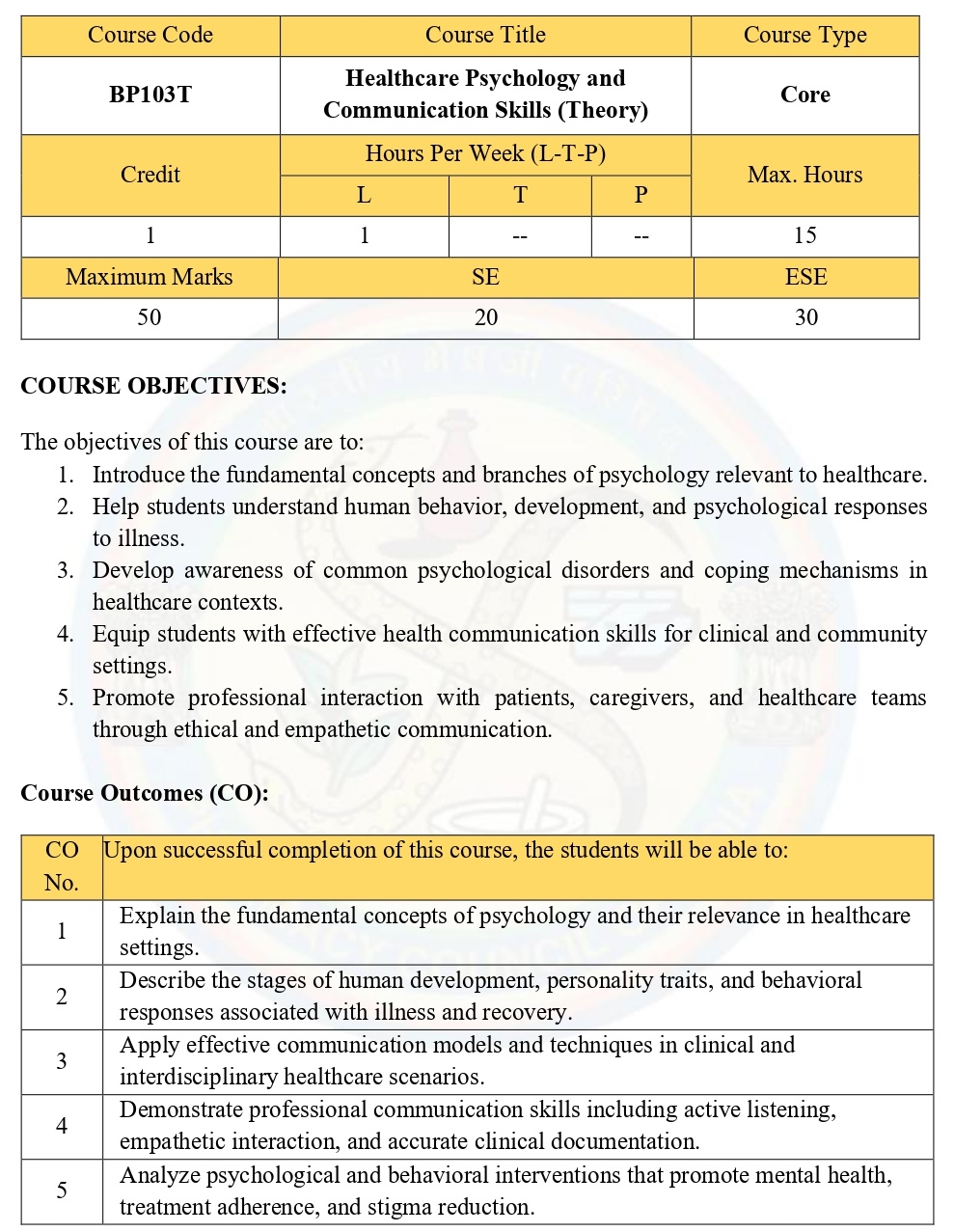
BP103T:
Healthcare
Psychology and Communication Skills (Theory)
Course Objectives:
The objectives of
this course are to:
1. Introduce the
fundamental concepts and branches of psychology relevant to healthcare.
2. Help students
understand human behavior, development, and psychological responses to illness.
3. Develop awareness
of common psychological disorders and coping mechanisms in healthcare contexts.
4. Equip students
with effective health communication skills for clinical and community settings.
5. Promote
professional interaction with patients, caregivers, and healthcare teams
through ethical and empathetic communication.
Course Outcomes
(CO):
Upon successful
completion of this course, the students will be able to:
1. Explain the
fundamental concepts of psychology and their relevance in healthcare settings.
2. Describe the
stages of human development, personality traits, and behavioral responses
associated with illness and recovery.
3. Apply effective
communication models and techniques in clinical and interdisciplinary
healthcare scenarios.
4. Demonstrate
professional communication skills including active listening, empathetic
interaction, and accurate clinical documentation.
5. Analyze
psychological and behavioral interventions that promote mental health,
treatment adherence, and stigma reduction.
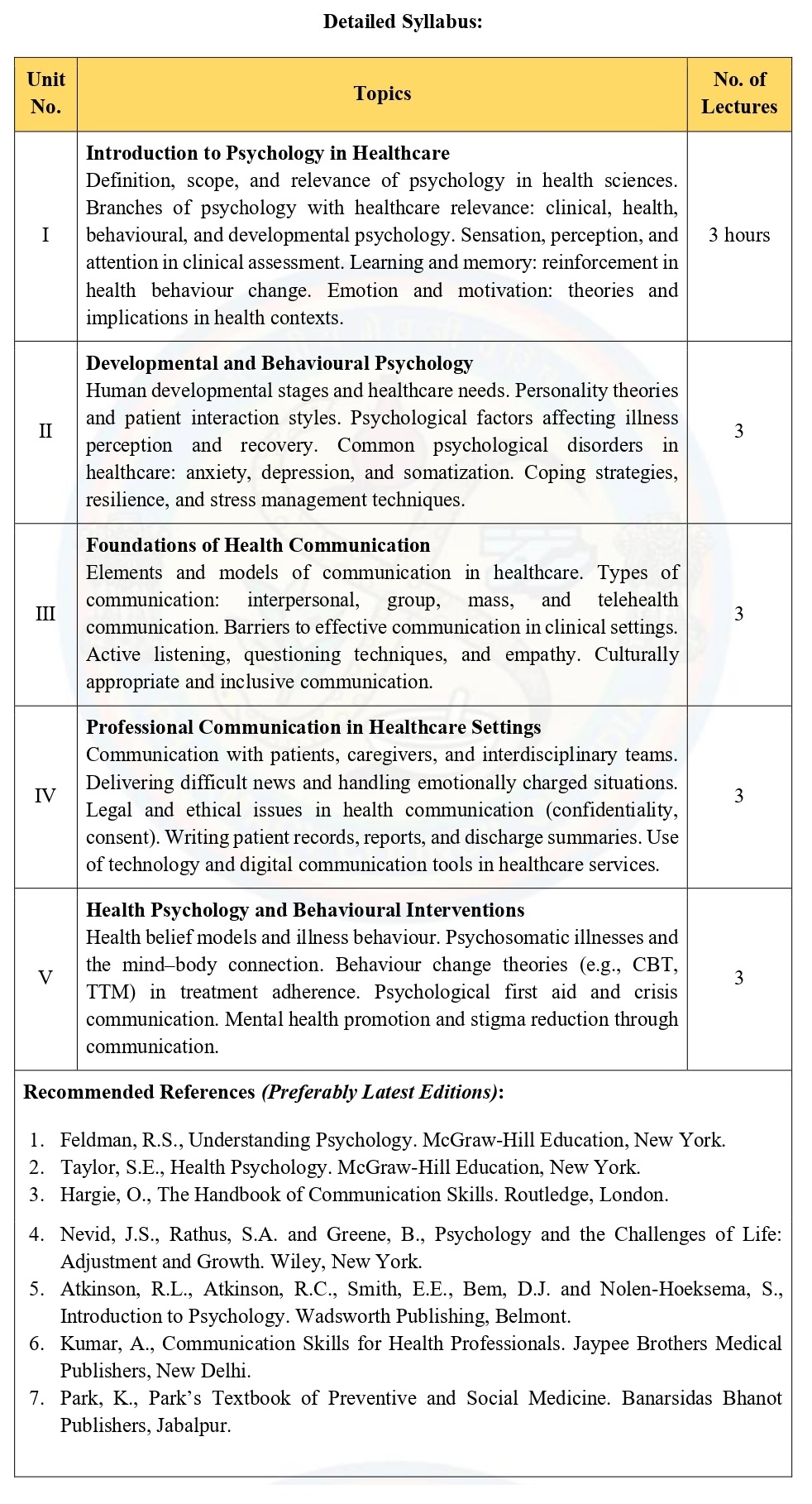
Detailed Syllabus:
Unit I
Introduction to
Psychology in Healthcare
Definition, scope,
and relevance of psychology in health sciences. Branches of psychology with
healthcare relevance: clinical, health, behavioural, and developmental
psychology. Sensation, perception, and attention in clinical assessment.
Learning and memory: reinforcement in health behaviour change. Emotion and
motivation: theories and implications in health contexts.
Unit II
Developmental and
Behavioural Psychology
Human developmental
stages and healthcare needs. Personality theories and patient interaction
styles. Psychological factors affecting illness perception and recovery. Common
psychological disorders in healthcare: anxiety, depression, and somatization.
Coping strategies, resilience, and stress management techniques.
Unit III
Foundations of
Health Communication
Elements and models
of communication in healthcare. Types of communication: interpersonal, group,
mass, and telehealth communication. Barriers to effective communication in
clinical settings. Active listening, questioning techniques, and empathy.
Culturally appropriate and inclusive communication.
Unit IV
Professional
Communication in Healthcare Settings
Communication with
patients, caregivers, and interdisciplinary teams. Delivering difficult news
and handling emotionally charged situations. Legal and ethical issues in health
communication (confidentiality, consent). Writing patient records, reports, and
discharge summaries. Use of technology and digital communication tools in
healthcare services.
Unit V
Health Psychology
and Behavioural Interventions
Health belief models
and illness behaviour. Psychosomatic illnesses and the mind–body connection.
Behaviour change theories (e.g., CBT, TTM) in treatment adherence.
Psychological first aid and crisis communication. Mental health promotion and
stigma reduction through communication.
Recommended
References (Preferably Latest Editions):
1. Feldman, R.S.,
Understanding Psychology. McGraw-Hill Education, New York.
2. Taylor, S.E.,
Health Psychology. McGraw-Hill Education, New York.
3. Hargie, O., The
Handbook of Communication Skills. Routledge, London.
4. Nevid, J.S.,
Rathus, S.A. and Greene, B., Psychology and the Challenges of Life: Adjustment
and Growth. Wiley, New York.
5. Atkinson, R.L.,
Atkinson, R.C., Smith, E.E., Bem, D.J. and Nolen-Hoeksema, S., Introduction to
Psychology. Wadsworth Publishing, Belmont.
6. Kumar, A.,
Communication Skills for Health Professionals. Jaypee Brothers Medical
Publishers, New Delhi.
7. Park, K., Park’s
Textbook of Preventive and Social Medicine. Banarsidas Bhanot Publishers,
Jabalpur.