Pharmaceutics
[ Dpharm (Diploma in Pharmacy) ]
Under Class: | 1st Year (Dpharm) |
Pharmaceutics - Question Papers, Lecture Notes, Study Material Download PDF
Pharmacy - Dpharm (Diploma in Pharmacy) - 1st Year - Name of Subject: Pharmaceutics - Lecture Notes, Study Material, Question Papers Download PDF
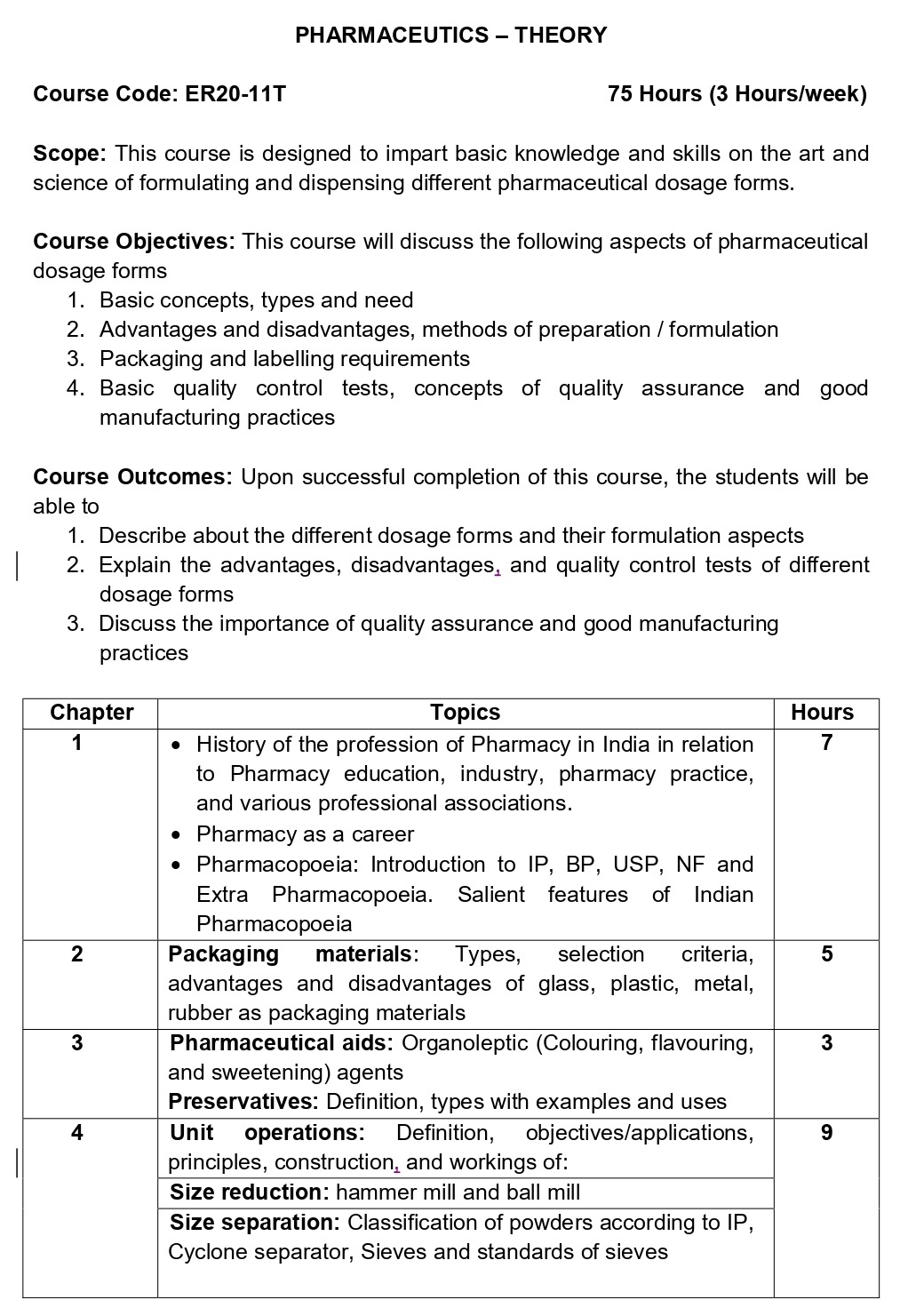
PHARMACEUTICS –
THEORY
Course Code: ER20-11T
Scope:
This course is designed to impart basic knowledge and skills on the art and
science of formulating and dispensing different pharmaceutical dosage forms.
Course Objectives:
This course will discuss the following aspects of pharmaceutical dosage forms
1.
Basic concepts, types and need
2.
Advantages and disadvantages, methods of preparation / formulation
3.
Packaging and labelling requirements
4.
Basic quality control tests, concepts of quality assurance and good
manufacturing practices
Course Outcomes:
Upon successful completion of this course, the students will be able to
1.
Describe about the different dosage forms and their formulation aspects
2.
Explain the advantages, disadvantages, and quality control tests of different
dosage forms
3.
Discuss the importance of quality assurance and good manufacturing practices
1.
•
History of the profession of Pharmacy in India in relation to Pharmacy
education, industry, pharmacy practice,
and various professional associations.
•
Pharmacy as a career
•
Pharmacopoeia: Introduction to IP, BP, USP, NF and Extra Pharmacopoeia. Salient
features of Indian Pharmacopoeia
2.
Packaging materials:
Types, selection criteria, advantages and disadvantages of glass, plastic,
metal, rubber as packaging materials
3.
Pharmaceutical aids:
Organoleptic (Colouring, flavouring, and sweetening) agents
Preservatives:
Definition, types with examples and uses
4.
Unit operations:
Definition, objectives/applications, principles, construction, and workings of:
Size reduction:
hammer mill and ball mill
Size separation:
Classification of powders according to IP, Cyclone separator, Sieves and
standards of sieves
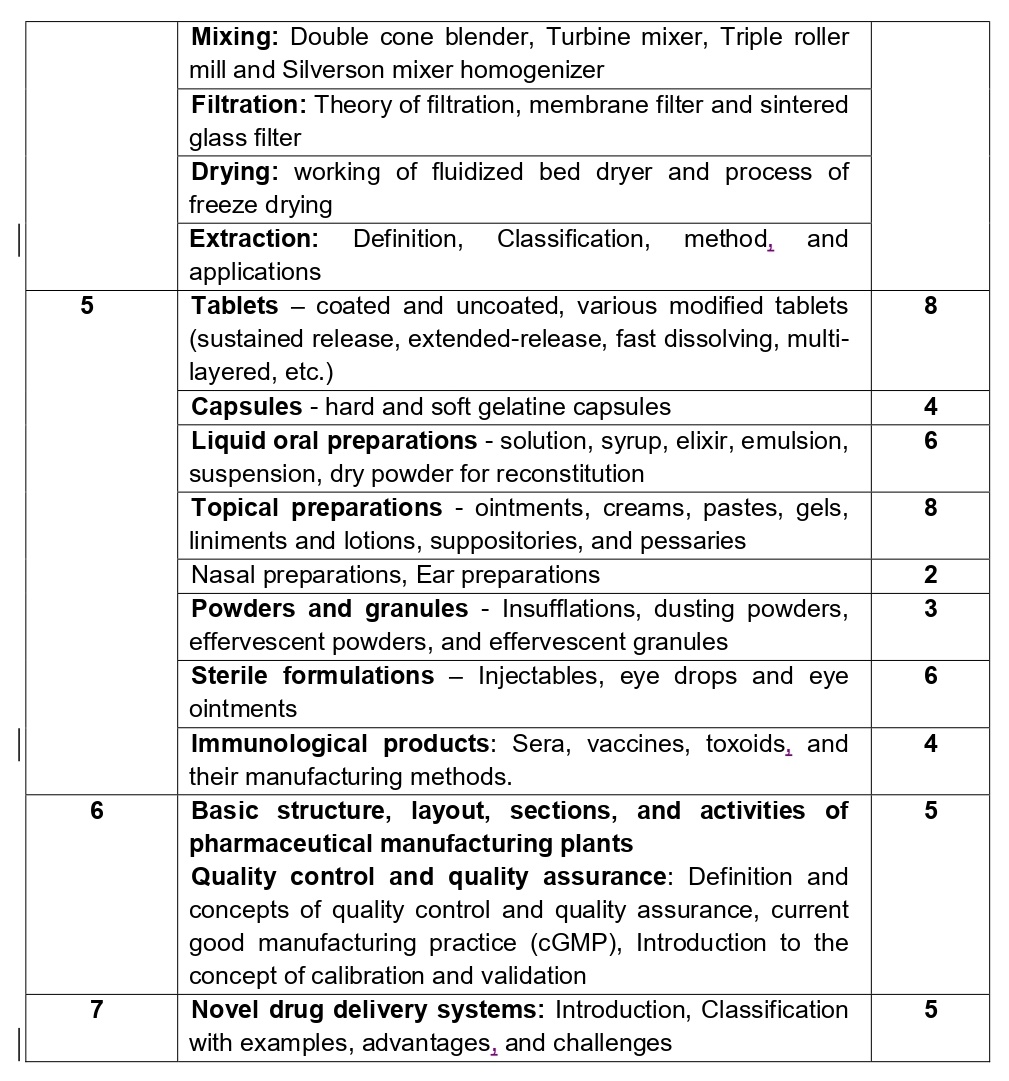
Mixing: Double cone blender, Turbine mixer,
Triple roller mill and Silverson mixer homogenizer
Filtration:
Theory of filtration, membrane filter and sintered glass filter
Drying:
working of fluidized bed dryer and process of freeze drying
Extraction:
Definition, Classification, method, and applications
5.
Tablets –
coated and uncoated, various modified tablets (sustained release,
extended-release, fast dissolving, multi-layered, etc.)
Capsules -
hard and soft gelatine capsules
Liquid oral
preparations - solution, syrup, elixir, emulsion, suspension,
dry powder for reconstitution
Topical preparations -
ointments, creams, pastes, gels, liniments and lotions, suppositories, and
pessaries
Nasal
preparations, Ear preparations
Powders and granules -
Insufflations, dusting powders, effervescent powders, and effervescent granules
Sterile formulations –
Injectables, eye drops and eye ointments
Immunological
products: Sera, vaccines, toxoids, and their manufacturing
methods.
6.
Basic structure,
layout, sections, and activities of pharmaceutical manufacturing plants
Quality control and
quality assurance: Definition and concepts of quality
control and quality assurance, current good manufacturing practice (cGMP),
Introduction to the concept of calibration and validation 5
7.
Novel drug delivery
systems: Introduction, Classification with examples,
advantages, and challenges