Pharmaceutical Inorganic and Analytical Chemistry
[ Bpharm (Bachelor of Pharmacy) ]
Under Class: | 1st Semester (Bpharm) |
Pharmaceutical Inorganic and Analytical Chemistry - Question Papers, Lecture Notes, Study Material Download PDF
Pharmacy - Bachelor of Pharmacy (Bpharm) - 1st Semester - 1st Year - Name of Subject: Pharmaceutical Inorganic and Analytical Chemistry (BP106T) - Lecture Notes, Study Material, Question Papers Download PDF
Radioactive Compounds and Their Clinical Application:
• Radioactive Compounds and Their Clinical Application
• What is radioactivity?
• Radiopharmacy: dispensing and protection
• Therapeutic use of radiopharmaceuticals
• Radiopharmaceuticals for imaging
• Exercises and Case studies
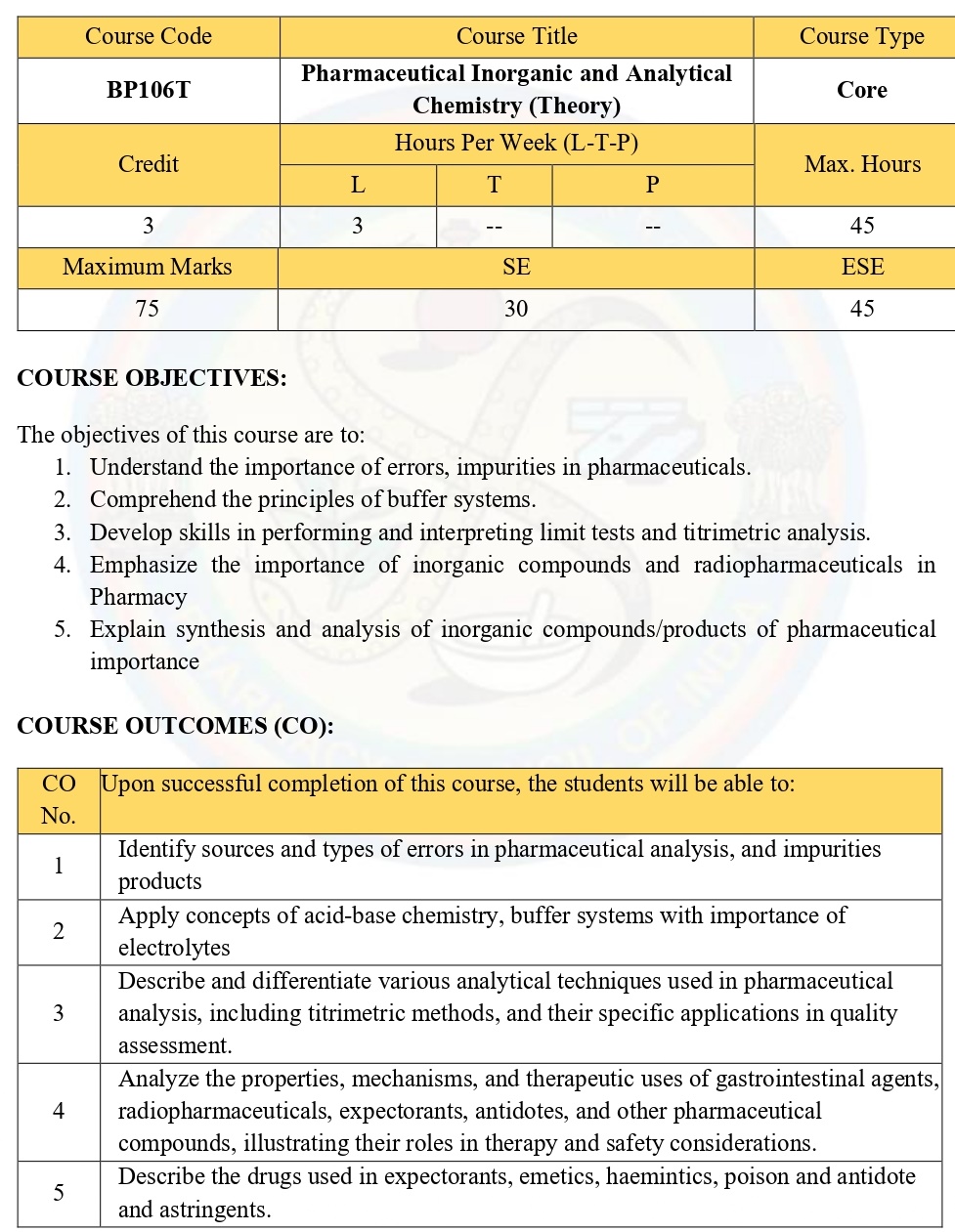
BP106T:
Pharmaceutical
Inorganic and Analytical Chemistry (Theory)
COURSE OBJECTIVES:
The objectives of
this course are to:
1. Understand the
importance of errors, impurities in pharmaceuticals.
2. Comprehend the
principles of buffer systems.
3. Develop skills in
performing and interpreting limit tests and titrimetric analysis.
4. Emphasize the
importance of inorganic compounds and radiopharmaceuticals in Pharmacy
5. Explain synthesis
and analysis of inorganic compounds/products of pharmaceutical importance
COURSE OUTCOMES
(CO):
Upon successful
completion of this course, the students will be able to:
1. Identify sources
and types of errors in pharmaceutical analysis, and impurities products
2. Apply concepts of acid-base
chemistry, buffer systems with importance of electrolytes
3. Describe and
differentiate various analytical techniques used in pharmaceutical analysis,
including titrimetric methods, and their specific applications in quality
assessment.
4. Analyze the
properties, mechanisms, and therapeutic uses of gastrointestinal agents, radiopharmaceuticals,
expectorants, antidotes, and other pharmaceutical compounds, illustrating their
roles in therapy and safety considerations.
5. Describe the drugs
used in expectorants, emetics, haemintics, poison and antidote and astringents.
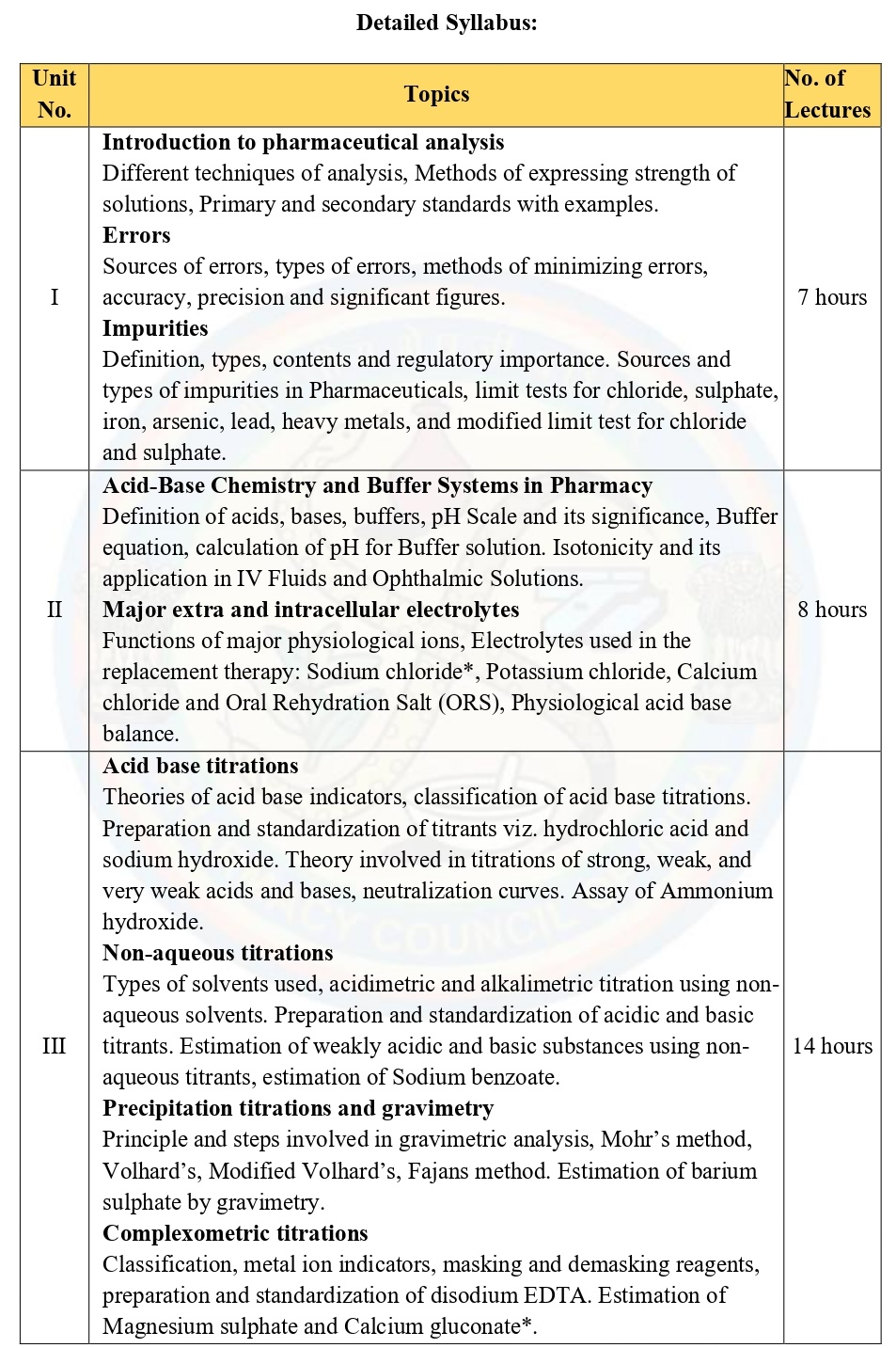
Detailed Syllabus:
Unit I
Introduction to
pharmaceutical analysis
Different techniques
of analysis, Methods of expressing strength of solutions, Primary and secondary
standards with examples.
Errors
Sources of errors,
types of errors, methods of minimizing errors, accuracy, precision and
significant figures.
Impurities
Definition, types,
contents and regulatory importance. Sources and types of impurities in
Pharmaceuticals, limit tests for chloride, sulphate, iron, arsenic, lead, heavy
metals, and modified limit test for chloride and sulphate.
Unit II
Acid-Base Chemistry
and Buffer Systems in Pharmacy
Definition of acids,
bases, buffers, pH Scale and its significance, Buffer equation, calculation of
pH for Buffer solution. Isotonicity and its application in IV Fluids and
Ophthalmic Solutions.
Major extra and
intracellular electrolytes
Functions of major
physiological ions, Electrolytes used in the replacement therapy: Sodium
chloride*, Potassium chloride, Calcium chloride and Oral Rehydration Salt
(ORS), Physiological acid base balance.
Unit III
Acid base
titrations
Theories of acid base
indicators, classification of acid base titrations. Preparation and
standardization of titrants viz. hydrochloric acid and sodium hydroxide. Theory
involved in titrations of strong, weak, and very weak acids and bases,
neutralization curves. Assay of Ammonium hydroxide.
Non-aqueous
titrations
Types of solvents
used, acidimetric and alkalimetric titration using non-aqueous solvents.
Preparation and standardization of acidic and basic titrants. Estimation of
weakly acidic and basic substances using non-aqueous titrants, estimation of
Sodium benzoate.
Precipitation
titrations and gravimetry
Principle and steps
involved in gravimetric analysis, Mohr’s method, Volhard’s, Modified Volhard’s,
Fajans method. Estimation of barium sulphate by gravimetry.
Complexometric
titrations
Classification, metal
ion indicators, masking and demasking reagents, preparation and standardization
of disodium EDTA. Estimation of Magnesium sulphate and Calcium gluconate*.
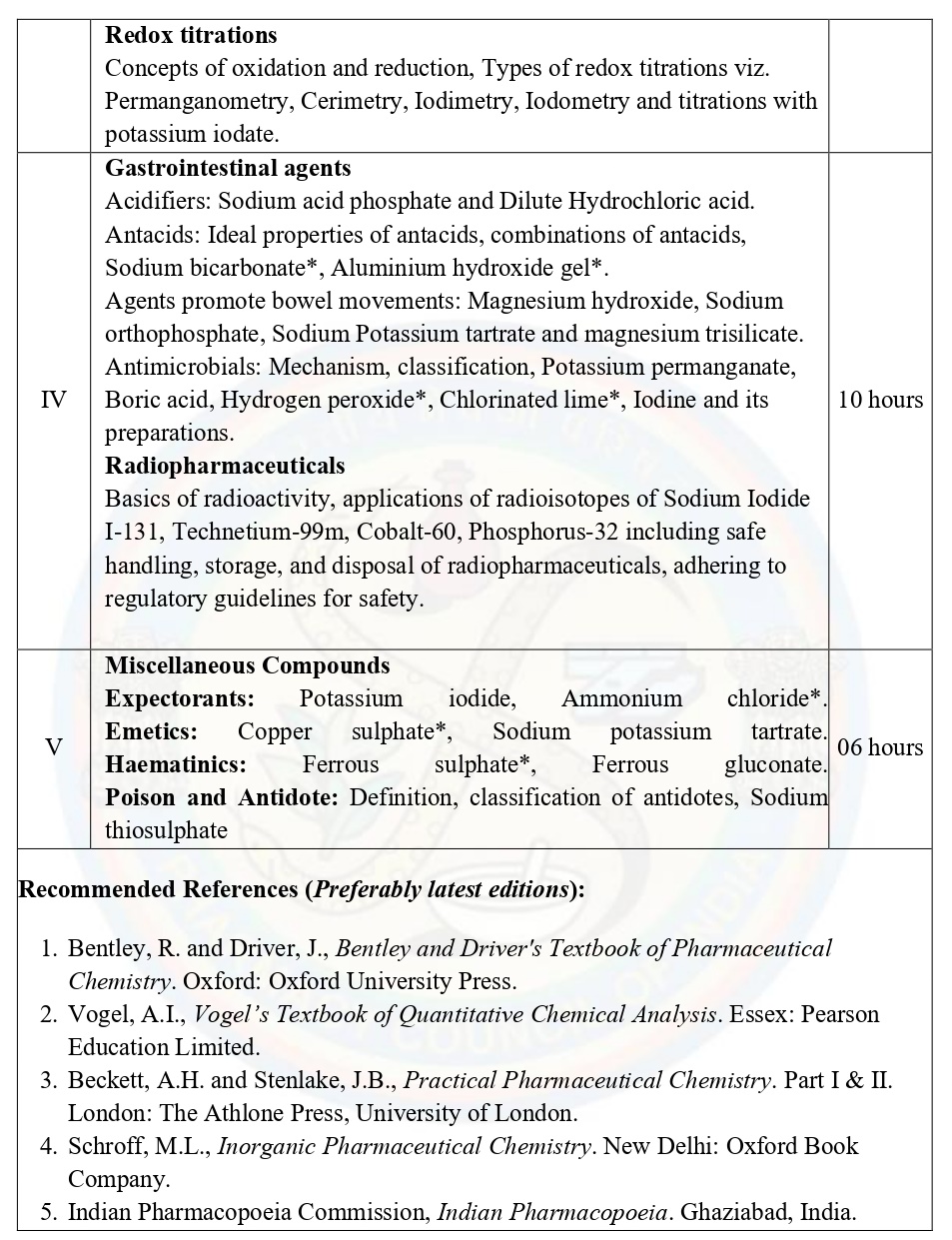
Redox titrations
Concepts of oxidation
and reduction, Types of redox titrations viz. Permanganometry, Cerimetry,
Iodimetry, Iodometry and titrations with potassium iodate.
Unit IV
Gastrointestinal
agents
Acidifiers: Sodium
acid phosphate and Dilute Hydrochloric acid. Antacids: Ideal properties of
antacids, combinations of antacids, Sodium bicarbonate*, Aluminium hydroxide
gel*.
Agents promote bowel
movements: Magnesium hydroxide, Sodium orthophosphate, Sodium Potassium
tartrate and magnesium trisilicate. Antimicrobials: Mechanism, classification,
Potassium permanganate, Boric acid, Hydrogen peroxide*, Chlorinated lime*,
Iodine and its preparations.
Radiopharmaceuticals
Basics of
radioactivity, applications of radioisotopes of Sodium Iodide I-131,
Technetium-99m, Cobalt-60, Phosphorus-32 including safe handling, storage, and
disposal of radiopharmaceuticals, adhering to regulatory guidelines for safety.
Unit V
Miscellaneous
Compounds
Expectorants: Potassium iodide, Ammonium chloride*.
Emetics: Copper sulphate*, Sodium potassium tartrate.
Haematinics: Ferroussulphate*,Ferrousgluconate.
Poison and Antidote: Definition, classification of antidotes, Sodium thiosulphate
Recommended
References (Preferably latest editions):
1. Bentley, R. and
Driver, J., Bentley and Driver's Textbook of Pharmaceutical Chemistry. Oxford:
Oxford University Press.
2. Vogel, A.I.,
Vogel’s Textbook of Quantitative Chemical Analysis. Essex: Pearson Education
Limited.
3. Beckett, A.H. and
Stenlake, J.B., Practical Pharmaceutical Chemistry. Part I & II. London:
The Athlone Press, University of London.
4. Schroff, M.L.,
Inorganic Pharmaceutical Chemistry. New Delhi: Oxford Book Company.
5. Indian Pharmacopoeia
Commission, Indian Pharmacopoeia. Ghaziabad, India.