Physical Pharmaceutics - Practical
[ Bpharm (Bachelor of Pharmacy) ]
Under Class: | 2nd Semester (Bpharm) |
Physical Pharmaceutics - Practical - Experimental laboratory pdf record
Pharmacy - Bachelor of Pharmacy (Bpharm) - 2nd Semester - 1st Year - Subject/Practical Laboratory: Physical Pharmaceutics - Practical (BP211P) - laboratory Experimental Note Download PDF
PHYSICOCHEMICAL PRINCIPLES:
Complexation and protein binding:
• Complexation and protein binding
• Types of complexes
• Protein binding
• Review questions answers
Chemical kinetics and stability:
• Chemical kinetics and stability
• Reaction rate and order
• Factors affecting reaction kinetics
• Drug degradation pathways
• Stabilization strategies
• Review questions answers
Interfacial phenomena:
• Interfacial phenomena
• Liquid–liquid and liquid-gas interfaces
• Solid-gas interface: Adsorption
• Solid-Liquid interface
• Biological and pharmaceutical applications
• Review questions answers
Colloidal dispersions:
• Colloidal dispersions
• Types of colloidal systems
• Preparation of colloidal solutions
• Properties of colloidal solutions
• Physical stability of colloids
• Review questions answers
Surfactants and micelles:
• Surfactants and micelles
• Surfactants
• Types of surfactants
• Hydrophile-lipophile balance system
• Micelles
• Factors affecting critical micelle concentration and micellar size
• Micellar solubilization
• Review questions answers
Pharmaceutical polymers:
• Pharmaceutical polymers
• Definitions and architectures of polymers
• Polymer molecular weight and weight distribution
• Biodegradablity and biocompatibility
• Physicochemical properties and solubility
• Block copolymers
• Intelligent or stimuli-sensitive polymers
• Water-soluble polymers
• Bioadhesive/mucoadhesive polymers
• Review questions answers
Rheology:
• Rheology
• Newtonian flow
• Non-Newtonian flow
• Thixotropy
• Pharmaceutical applications of rheology
• Review questions answers
Powders and granules:
• Powders and granules
• Production of powders and granules
• Analyses of powders
• Particle shape and size - Analyses of powders
• Surface area - Analyses of powders
• Density and porosity - Analyses of powders
• Flow - Analyses of powders
• Compactibility - Analyses of powders
• Content uniformity - Analyses of powders
• Powder processing
• Powders as dosage forms
• Review questions answers
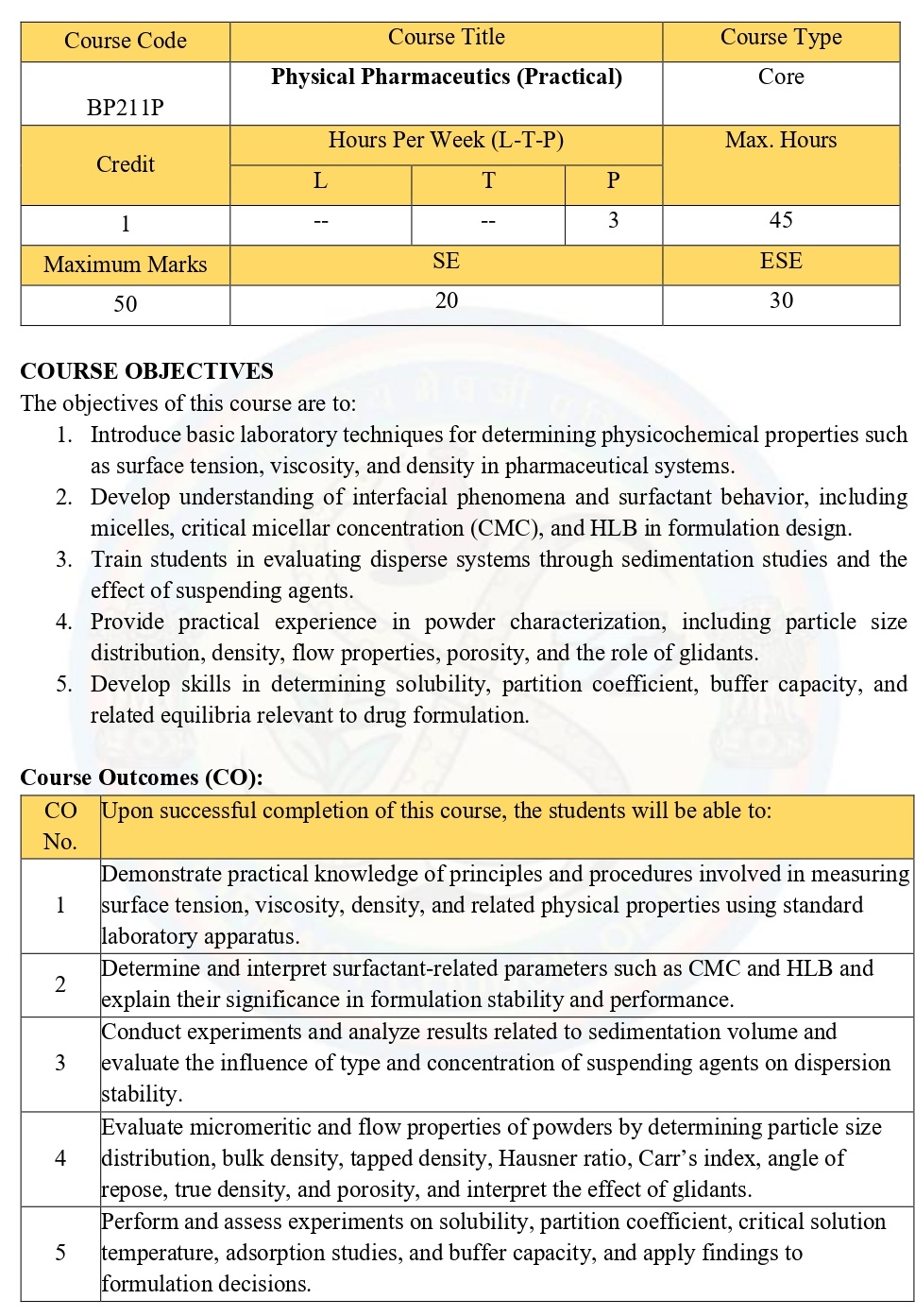
BP211P :
Physical
Pharmaceutics (Practical)
COURSE OBJECTIVES
The objectives of
this course are to:
1. Introduce basic
laboratory techniques for determining physicochemical properties such as
surface tension, viscosity, and density in pharmaceutical systems.
2. Develop
understanding of interfacial phenomena and surfactant behavior, including
micelles, critical micellar concentration (CMC), and HLB in formulation design.
3. Train students in
evaluating disperse systems through sedimentation studies and the effect of
suspending agents.
4. Provide practical
experience in powder characterization, including particle size distribution,
density, flow properties, porosity, and the role of glidants.
5. Develop skills in
determining solubility, partition coefficient, buffer capacity, and related
equilibria relevant to drug formulation.
Course Outcomes
(CO):
Upon successful
completion of this course, the students will be able to:
1. Demonstrate
practical knowledge of principles and procedures involved in measuring surface
tension, viscosity, density, and related physical properties using standard
laboratory apparatus.
2. Determine and
interpret surfactant-related parameters such as CMC and HLB and explain their
significance in formulation stability and performance.
3. Conduct
experiments and analyze results related to sedimentation volume and evaluate
the influence of type and concentration of suspending agents on dispersion
stability.
4. Evaluate
micromeritic and flow properties of powders by determining particle size
distribution, bulk density, tapped density, Hausner ratio, Carr’s index, angle
of repose, true density, and porosity, and interpret the effect of glidants.
5. Perform and assess
experiments on solubility, partition coefficient, critical solution
temperature,
adsorption studies, and buffer capacity, and apply findings to formulation
decisions.
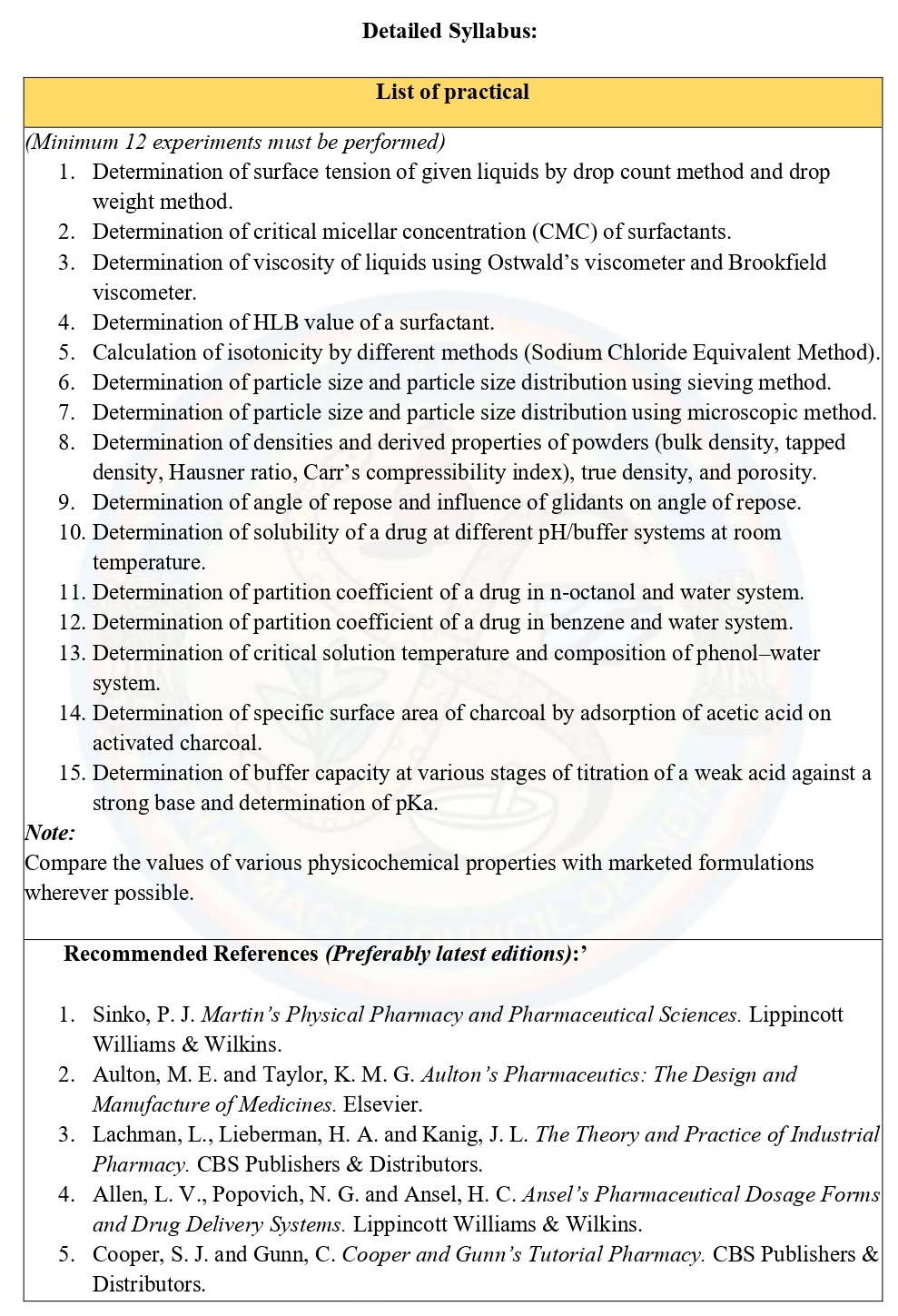
Detailed Syllabus:
List of practical
(Minimum 12
experiments must be performed)
1. Determination of
surface tension of given liquids by drop count method and drop weight method.
2. Determination of
critical micellar concentration (CMC) of surfactants.
3. Determination of
viscosity of liquids using Ostwald’s viscometer and Brookfield viscometer.
4. Determination of
HLB value of a surfactant.
5. Calculation of
isotonicity by different methods (Sodium Chloride Equivalent Method).
6. Determination of
particle size and particle size distribution using sieving method.
7. Determination of
particle size and particle size distribution using microscopic method.
8. Determination of
densities and derived properties of powders (bulk density, tapped density,
Hausner ratio, Carr’s compressibility index), true density, and porosity.
9. Determination of
angle of repose and influence of glidants on angle of repose.
10. Determination of
solubility of a drug at different pH/buffer systems at room temperature.
11. Determination of
partition coefficient of a drug in n-octanol and water system.
12. Determination of
partition coefficient of a drug in benzene and water system.
13. Determination of
critical solution temperature and composition of phenol–water system.
14. Determination of
specific surface area of charcoal by adsorption of acetic acid on activated
charcoal.
15. Determination of
buffer capacity at various stages of titration of a weak acid against a strong
base and determination of pKa.
Note:
Compare the values of
various physicochemical properties with marketed formulations wherever
possible.
Recommended
References (Preferably latest editions):
1. Sinko, P. J.
Martin’s Physical Pharmacy and Pharmaceutical Sciences. Lippincott Williams
& Wilkins.
2. Aulton, M. E. and
Taylor, K. M. G. Aulton’s Pharmaceutics: The Design and Manufacture of
Medicines. Elsevier.
3. Lachman, L.,
Lieberman, H. A. and Kanig, J. L. The Theory and Practice of Industrial
Pharmacy. CBS Publishers & Distributors.
4. Allen, L. V.,
Popovich, N. G. and Ansel, H. C. Ansel’s Pharmaceutical Dosage Forms and Drug
Delivery Systems. Lippincott Williams & Wilkins.
5. Cooper, S. J. and
Gunn, C. Cooper and Gunn’s Tutorial Pharmacy. CBS Publishers &
Distributors.