Physical Pharmaceutics
[ Bpharm (Bachelor of Pharmacy) ]
Under Class: | 2nd Semester (Bpharm) |
Physical Pharmaceutics - Question Papers, Lecture Notes, Study Material Download PDF
Pharmacy - Bachelor of Pharmacy (Bpharm) - 2nd Semester - 1st Year - Name of Subject: Physical Pharmaceutics (BP206T) - Lecture Notes, Study Material, Question Papers Download PDF
PHYSICOCHEMICAL PRINCIPLES:
Complexation and protein binding:
• Complexation and protein binding
• Types of complexes
• Protein binding
• Review questions answers
Chemical kinetics and stability:
• Chemical kinetics and stability
• Reaction rate and order
• Factors affecting reaction kinetics
• Drug degradation pathways
• Stabilization strategies
• Review questions answers
Interfacial phenomena:
• Interfacial phenomena
• Liquid–liquid and liquid-gas interfaces
• Solid-gas interface: Adsorption
• Solid-Liquid interface
• Biological and pharmaceutical applications
• Review questions answers
Colloidal dispersions:
• Colloidal dispersions
• Types of colloidal systems
• Preparation of colloidal solutions
• Properties of colloidal solutions
• Physical stability of colloids
• Review questions answers
Surfactants and micelles:
• Surfactants and micelles
• Surfactants
• Types of surfactants
• Hydrophile-lipophile balance system
• Micelles
• Factors affecting critical micelle concentration and micellar size
• Micellar solubilization
• Review questions answers
Pharmaceutical polymers:
• Pharmaceutical polymers
• Definitions and architectures of polymers
• Polymer molecular weight and weight distribution
• Biodegradablity and biocompatibility
• Physicochemical properties and solubility
• Block copolymers
• Intelligent or stimuli-sensitive polymers
• Water-soluble polymers
• Bioadhesive/mucoadhesive polymers
• Review questions answers
Rheology:
• Rheology
• Newtonian flow
• Non-Newtonian flow
• Thixotropy
• Pharmaceutical applications of rheology
• Review questions answers
Powders and granules:
• Powders and granules
• Production of powders and granules
• Analyses of powders
• Particle shape and size - Analyses of powders
• Surface area - Analyses of powders
• Density and porosity - Analyses of powders
• Flow - Analyses of powders
• Compactibility - Analyses of powders
• Content uniformity - Analyses of powders
• Powder processing
• Powders as dosage forms
• Review questions answers
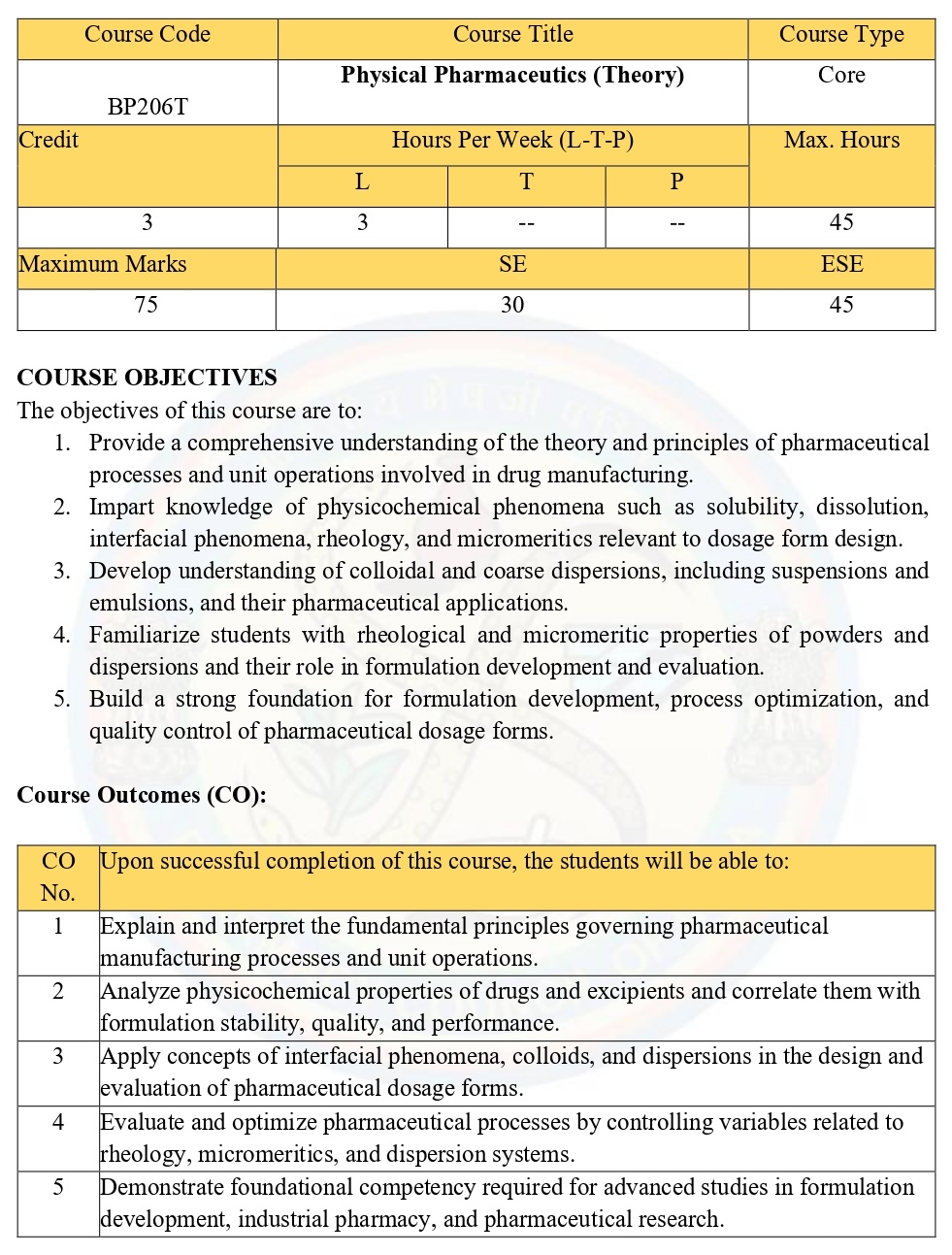
BP206T :
Physical
Pharmaceutics (Theory)
COURSE OBJECTIVES
The objectives of
this course are to:
1. Provide a
comprehensive understanding of the theory and principles of pharmaceutical
processes and unit operations involved in drug manufacturing.
2. Impart knowledge
of physicochemical phenomena such as solubility, dissolution, interfacial
phenomena, rheology, and micromeritics relevant to dosage form design.
3. Develop
understanding of colloidal and coarse dispersions, including suspensions and
emulsions, and their pharmaceutical applications.
4. Familiarize
students with rheological and micromeritic properties of powders and
dispersions and their role in formulation development and evaluation.
5. Build a strong
foundation for formulation development, process optimization, and quality
control of pharmaceutical dosage forms.
Course Outcomes
(CO):
Upon successful
completion of this course, the students will be able to:
1. Explain and
interpret the fundamental principles governing pharmaceutical manufacturing
processes and unit operations.
2. Analyze physicochemical
properties of drugs and excipients and correlate them with formulation
stability, quality, and performance.
3. Apply concepts of
interfacial phenomena, colloids, and dispersions in the design and evaluation
of pharmaceutical dosage forms.
4. Evaluate and
optimize pharmaceutical processes by controlling variables related to rheology,
micromeritics, and dispersion systems.
5. Demonstrate
foundational competency required for advanced studies in formulation
development,
industrial pharmacy, and pharmaceutical research.
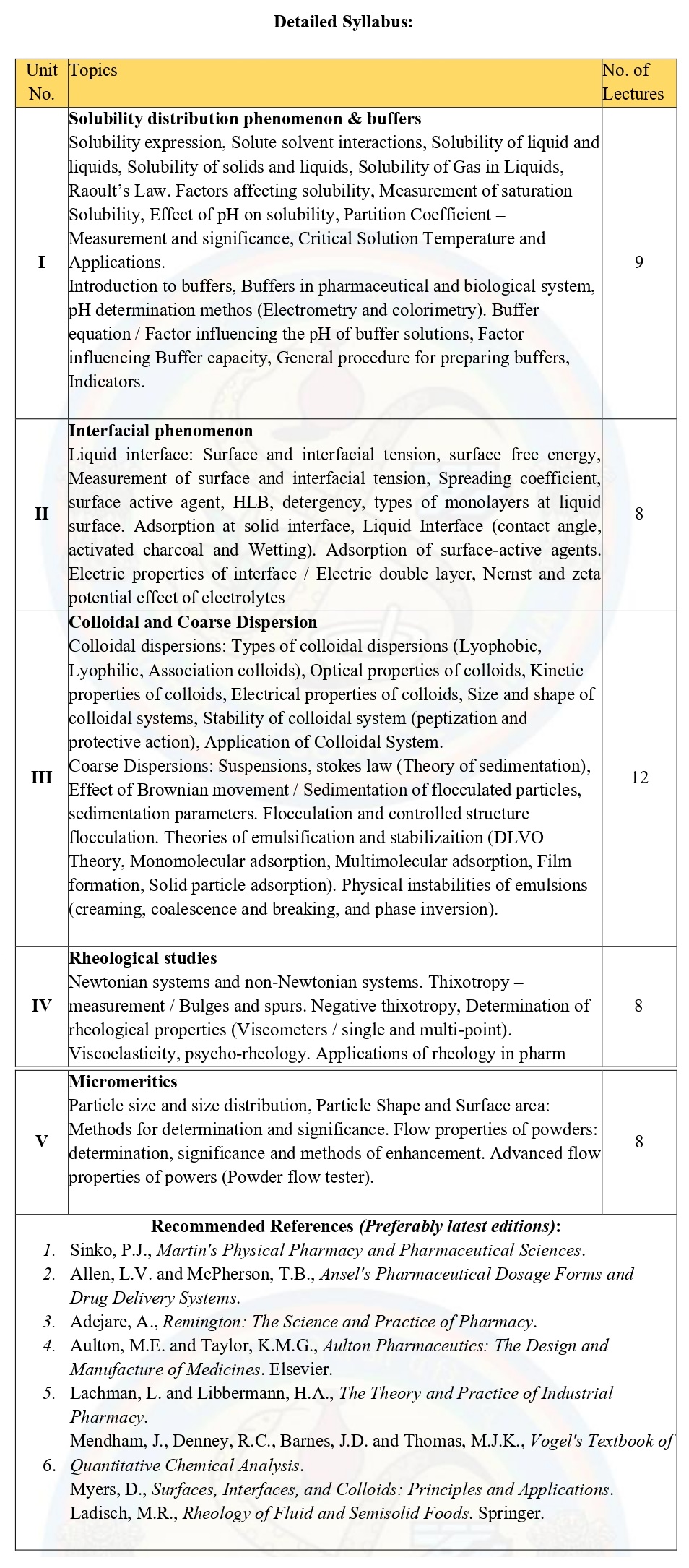
Detailed Syllabus:
Unit I
Solubility
distribution phenomenon & buffers
Solubility
expression, Solute solvent interactions, Solubility of liquid and liquids,
Solubility of solids and liquids, Solubility of Gas in Liquids, Raoult’s Law.
Factors affecting solubility, Measurement of saturation Solubility, Effect of
pH on solubility, Partition Coefficient – Measurement and significance,
Critical Solution Temperature and Applications.
Introduction to
buffers, Buffers in pharmaceutical and biological system, pH determination
methos (Electrometry and colorimetry). Buffer equation / Factor influencing the
pH of buffer solutions, Factor influencing Buffer capacity, General procedure
for preparing buffers, Indicators.
Unit II
Interfacial phenomenon
Liquid interface:
Surface and interfacial tension, surface free energy, Measurement of surface
and interfacial tension, Spreading coefficient, surface active agent, HLB,
detergency, types of monolayers at liquid surface. Adsorption at solid
interface, Liquid Interface (contact angle, activated charcoal and Wetting).
Adsorption of surface-active agents. Electric properties of interface /
Electric double layer, Nernst and zeta potential effect of electrolytes
Unit III
Colloidal and
Coarse Dispersion
Colloidal
dispersions: Types of colloidal dispersions (Lyophobic, Lyophilic, Association
colloids), Optical properties of colloids, Kinetic properties of colloids,
Electrical properties of colloids, Size and shape of colloidal systems,
Stability of colloidal system (peptization and protective action), Application
of Colloidal System.
Coarse Dispersions:
Suspensions, stokes law (Theory of sedimentation), Effect of Brownian movement
/ Sedimentation of flocculated particles, sedimentation parameters.
Flocculation and controlled structure flocculation. Theories of emulsification
and stabilizaition (DLVO Theory, Monomolecular adsorption, Multimolecular
adsorption, Film formation, Solid particle adsorption). Physical instabilities
of emulsions (creaming, coalescence and breaking, and phase inversion).
Unit IV
Rheological studies
Newtonian systems and
non-Newtonian systems. Thixotropy – measurement / Bulges and spurs. Negative
thixotropy, Determination of rheological properties (Viscometers / single and
multi-point).
Viscoelasticity,
psycho-rheology. Applications of rheology in pharm
Unit V
Micromeritics
Particle size and
size distribution, Particle Shape and Surface area: Methods for determination
and significance. Flow properties of powders: determination, significance and
methods of enhancement. Advanced flow properties of powers (Powder flow
tester).
Recommended
References (Preferably latest editions):
1. Sinko, P.J.,
Martin's Physical Pharmacy and Pharmaceutical Sciences.
2. Allen, L.V. and
McPherson, T.B., Ansel's Pharmaceutical Dosage Forms and Drug Delivery Systems.
3. Adejare, A.,
Remington: The Science and Practice of Pharmacy.
4. Aulton, M.E. and
Taylor, K.M.G., Aulton Pharmaceutics: The Design and Manufacture of Medicines.
Elsevier.
5. Lachman, L. and
Libbermann, H.A., The Theory and Practice of Industrial Pharmacy.
Mendham, J., Denney,
R.C., Barnes, J.D. and Thomas, M.J.K., Vogel's Textbook of
6. Quantitative
Chemical Analysis.
Myers, D., Surfaces,
Interfaces, and Colloids: Principles and Applications. Ladisch, M.R., Rheology
of Fluid and Semisolid Foods. Springer.