General Pharmacy - Practical
[ Bpharm (Bachelor of Pharmacy) ]
Under Class: | 1st Semester (Bpharm) |
General Pharmacy - Practical - Experimental laboratory pdf record
Pharmacy - Bachelor of Pharmacy (Bpharm) - 1st Semester - 1st Year - Subject/Practical Laboratory: General Pharmacy - Practical (BP107P) - laboratory Experimental Note Download PDF
DOSAGE FORMS:
Chapter 16: Suspensions:
• Suspensions
• Types of suspensions
• Powder for suspension
• Quality attributes
• Formulation considerations
• Manufacturing process
• Review questions answers
Chapter 17: Emulsions:
• Emulsions
• Types of emulsions
• Quality attributes
• Formulation considerations
• Emulsification
• Manufacturing process
• Stability
• Review questions answers
Chapter 18: Pharmaceutical solutions:
• Pharmaceutical solutions
• Types of solutions
• Quality attributes
• Formulation components and manufacturing process
• Solubility
• Stability
• Review questions answers
Chapter 19: Powders and granules:
• Powders and granules
• Production of powders and granules
• Analyses of powders
• Particle shape and size - Analyses of powders
• Surface area - Analyses of powders
• Density and porosity - Analyses of powders
• Flow - Analyses of powders
• Compactibility - Analyses of powders
• Content uniformity - Analyses of powders
• Powder processing
• Powders as dosage forms
• Review questions answers
Chapter 20: Tablets:
• Tablets
• Types of tablets
• Tablet formulation
• Manufacturing of tablets
• Evaluation of tablets
• Relationship among disintegration, dissolution, and absorption
• Review questions answers
Chapter 21: Capsules:
• Capsules
• Hard gelatin capsules
• Soft gelatin capsules
• Evaluation of capsule drug products
• Shelf-life tests
• Review questions answers
Chapter 22: Parenteral drug products:
• Parenteral drug products
• Parenteral routes of administration
• Types of parenteral dosage forms
• Quality attributes and evaluation
• Formulation components
• Sterilization
• Review questions answers
Chapter 23: Semisolid dosage forms:
• Semisolid dosage forms
• Ointments and Types of ointment bases
• Creams
• Gels and jellies
• Lotions
• Pastes
• Foams
• Manufacturing processes
• Analysis of semisolid dosage forms
• Review questions answers
Chapter 24: Inserts, implants, and devices:
• Inserts, implants, and devices
• Ocular inserts, Suppositories, Vaginal rings
• Implants and Types of implants
• Devices
• Review questions answers
Chapter 25: Protein and peptide drug delivery:
• Protein and peptide drug delivery
• Structure of Proteins and peptides
• Types of protein and peptide therapeutics
• Protein characterization
• Instability
• Antigenicity and immunogenicity
• Drug product formulation and process
• Review questions answers
Chapter 26: Biotechnology-based drugs:
• Biotechnology-based drugs
• Gene and gene expression
• Gene silencing
• Gene silencing technologies
• Gene therapy
• Review questions answers
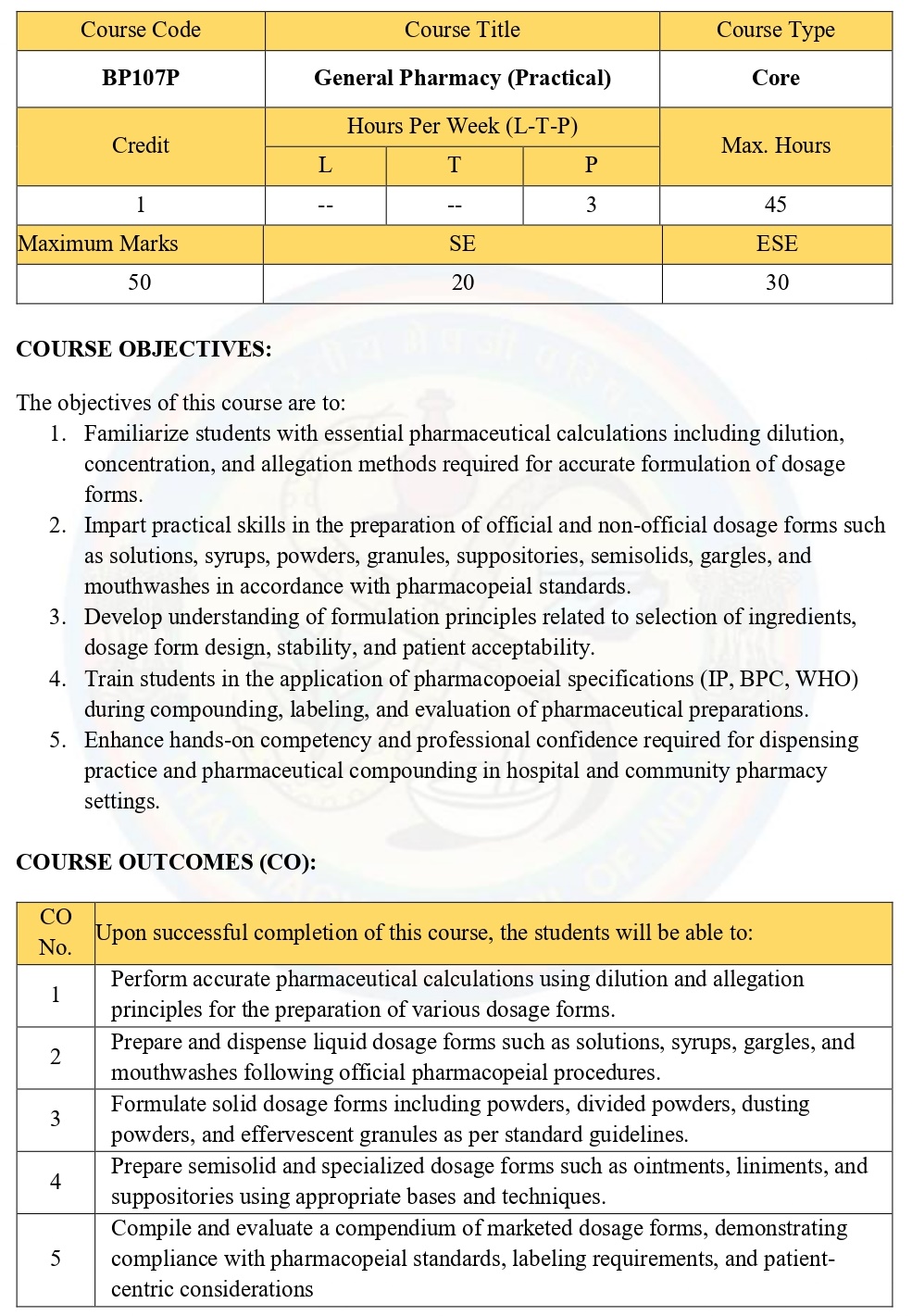
BP107P :
General Pharmacy (Practical)
COURSE OBJECTIVES:
The objectives of
this course are to:
1. Familiarize
students with essential pharmaceutical calculations including dilution,
concentration, and allegation methods required for accurate formulation of
dosage forms.
2. Impart practical
skills in the preparation of official and non-official dosage forms such as
solutions, syrups, powders, granules, suppositories, semisolids, gargles, and
mouthwashes in accordance with pharmacopeial standards.
3. Develop
understanding of formulation principles related to selection of ingredients,
dosage form design, stability, and patient acceptability.
4. Train students in
the application of pharmacopoeial specifications (IP, BPC, WHO) during
compounding, labeling, and evaluation of pharmaceutical preparations.
5. Enhance hands-on
competency and professional confidence required for dispensing practice and
pharmaceutical compounding in hospital and community pharmacy settings.
COURSE OUTCOMES
(CO):
Upon successful
completion of this course, the students will be able to:
1. Perform accurate
pharmaceutical calculations using dilution and allegation principles for the
preparation of various dosage forms.
2. Prepare and
dispense liquid dosage forms such as solutions, syrups, gargles, and
mouthwashes following official pharmacopeial procedures.
3. Formulate solid
dosage forms including powders, divided powders, dusting powders, and
effervescent granules as per standard guidelines.
4. Prepare semisolid
and specialized dosage forms such as ointments, liniments, and
suppositories using
appropriate bases and techniques.
5. Compile and
evaluate a compendium of marketed dosage forms, demonstrating
compliance with
pharmacopeial standards, labeling requirements, and patient-centric
considerations
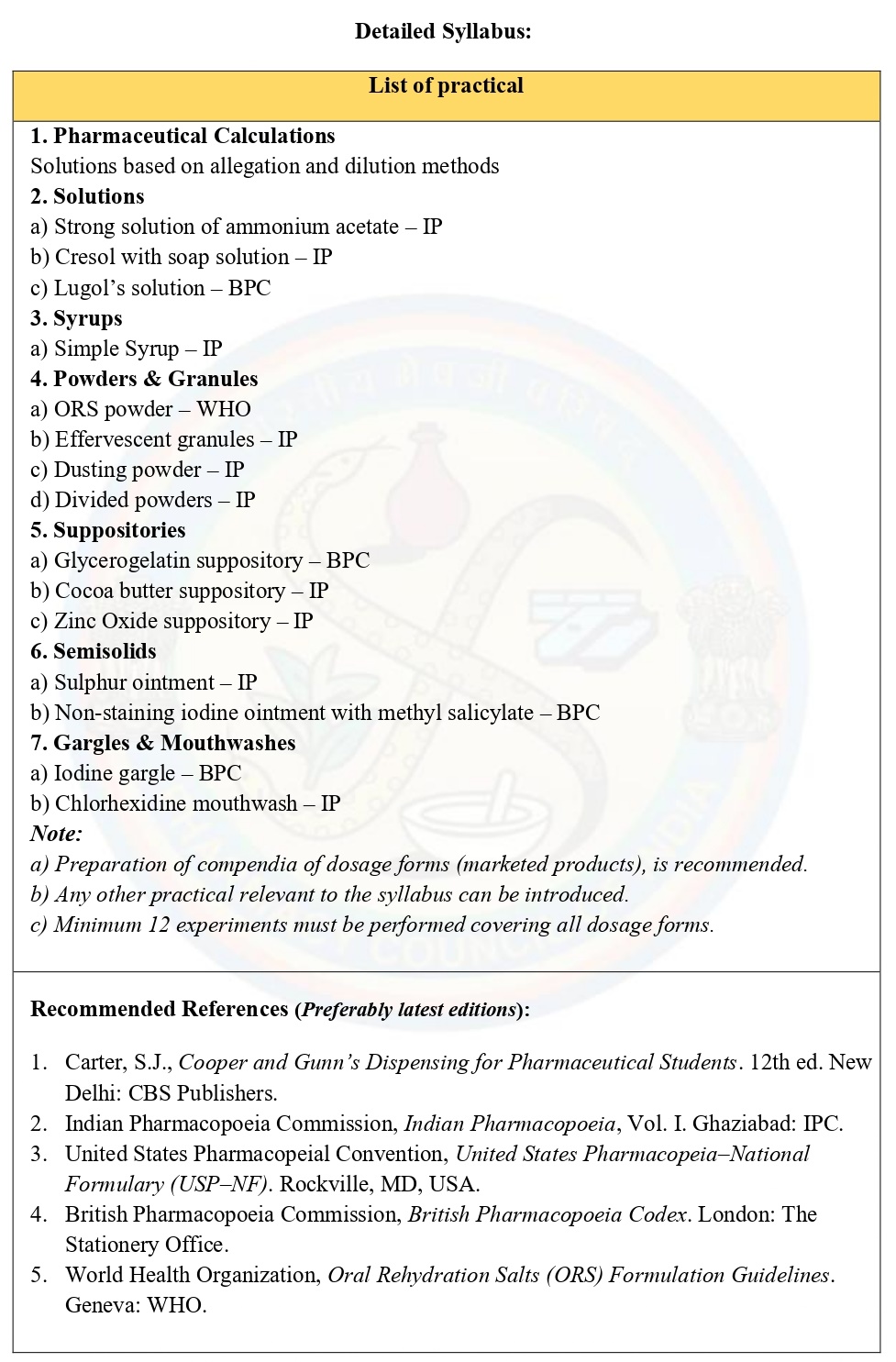
Detailed Syllabus:
List of practical
1. Pharmaceutical
Calculations
Solutions based on
allegation and dilution methods
2. Solutions
a) Strong solution of
ammonium acetate – IP
b) Cresol with soap
solution – IP
c) Lugol’s solution –
BPC
3. Syrups
a) Simple Syrup – IP
4. Powders &
Granules
a) ORS powder – WHO
b) Effervescent
granules – IP
c) Dusting powder –
IP
d) Divided powders –
IP
5. Suppositories
a) Glycerogelatin
suppository – BPC
b) Cocoa butter
suppository – IP
c) Zinc Oxide
suppository – IP
6. Semisolids
a) Sulphur ointment –
IP
b) Non-staining
iodine ointment with methyl salicylate – BPC
7. Gargles &
Mouthwashes
a) Iodine gargle –
BPC
b) Chlorhexidine
mouthwash – IP
Note:
a) Preparation of
compendia of dosage forms (marketed products), is recommended.
b) Any other
practical relevant to the syllabus can be introduced.
c) Minimum 12
experiments must be performed covering all dosage forms.
Recommended
References (Preferably latest editions):
1. Carter, S.J.,
Cooper and Gunn’s Dispensing for Pharmaceutical Students. 12th ed. New Delhi:
CBS Publishers.
2. Indian
Pharmacopoeia Commission, Indian Pharmacopoeia, Vol. I. Ghaziabad: IPC.
3. United States
Pharmacopeial Convention, United States Pharmacopeia–National Formulary
(USP–NF). Rockville, MD, USA.
4. British
Pharmacopoeia Commission, British Pharmacopoeia Codex. London: The Stationery
Office.
5. World Health
Organization, Oral Rehydration Salts (ORS) Formulation Guidelines. Geneva: WHO.