General Pharmacy
[ Bpharm (Bachelor of Pharmacy) ]
Under Class: | 1st Semester (Bpharm) |
General Pharmacy - Question Papers, Lecture Notes, Study Material Download PDF
Pharmacy - Bachelor of Pharmacy (Bpharm) - 1st Semester - 1st Year - Name of Subject: General Pharmacy (BP102T) - Lecture Notes, Study Material, Question Papers Download PDF
DOSAGE FORMS:
Chapter 16: Suspensions:
• Suspensions
• Types of suspensions
• Powder for suspension
• Quality attributes
• Formulation considerations
• Manufacturing process
• Review questions answers
Chapter 17: Emulsions:
• Emulsions
• Types of emulsions
• Quality attributes
• Formulation considerations
• Emulsification
• Manufacturing process
• Stability
• Review questions answers
Chapter 18: Pharmaceutical solutions:
• Pharmaceutical solutions
• Types of solutions
• Quality attributes
• Formulation components and manufacturing process
• Solubility
• Stability
• Review questions answers
Chapter 19: Powders and granules:
• Powders and granules
• Production of powders and granules
• Analyses of powders
• Particle shape and size - Analyses of powders
• Surface area - Analyses of powders
• Density and porosity - Analyses of powders
• Flow - Analyses of powders
• Compactibility - Analyses of powders
• Content uniformity - Analyses of powders
• Powder processing
• Powders as dosage forms
• Review questions answers
Chapter 20: Tablets:
• Tablets
• Types of tablets
• Tablet formulation
• Manufacturing of tablets
• Evaluation of tablets
• Relationship among disintegration, dissolution, and absorption
• Review questions answers
Chapter 21: Capsules:
• Capsules
• Hard gelatin capsules
• Soft gelatin capsules
• Evaluation of capsule drug products
• Shelf-life tests
• Review questions answers
Chapter 22: Parenteral drug products:
• Parenteral drug products
• Parenteral routes of administration
• Types of parenteral dosage forms
• Quality attributes and evaluation
• Formulation components
• Sterilization
• Review questions answers
Chapter 23: Semisolid dosage forms:
• Semisolid dosage forms
• Ointments and Types of ointment bases
• Creams
• Gels and jellies
• Lotions
• Pastes
• Foams
• Manufacturing processes
• Analysis of semisolid dosage forms
• Review questions answers
Chapter 24: Inserts, implants, and devices:
• Inserts, implants, and devices
• Ocular inserts, Suppositories, Vaginal rings
• Implants and Types of implants
• Devices
• Review questions answers
Chapter 25: Protein and peptide drug delivery:
• Protein and peptide drug delivery
• Structure of Proteins and peptides
• Types of protein and peptide therapeutics
• Protein characterization
• Instability
• Antigenicity and immunogenicity
• Drug product formulation and process
• Review questions answers
Chapter 26: Biotechnology-based drugs:
• Biotechnology-based drugs
• Gene and gene expression
• Gene silencing
• Gene silencing technologies
• Gene therapy
• Review questions answers
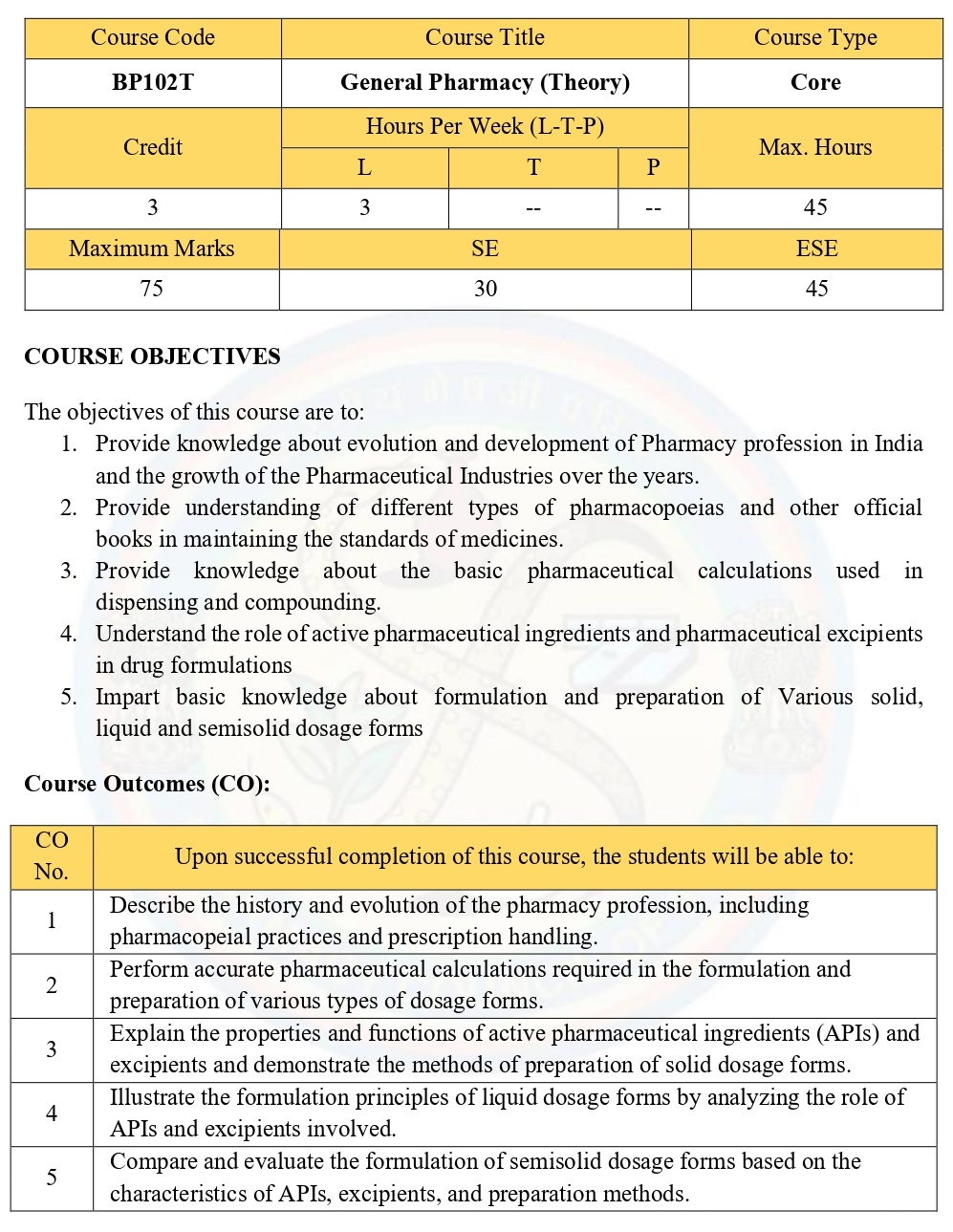
BP102T : General
Pharmacy (Theory)
Course Objectives:
The objectives of
this course are to:
1. Provide knowledge
about evolution and development of Pharmacy profession in India and the growth
of the Pharmaceutical Industries over the years.
2. Provide
understanding of different types of pharmacopoeias and other official books in
maintaining the standards of medicines.
3. Provide knowledge
about the basic pharmaceutical calculations used in dispensing and compounding.
4. Understand the
role of active pharmaceutical ingredients and pharmaceutical excipients in drug
formulations
5. Impart basic knowledge
about formulation and preparation of Various solid, liquid and semisolid dosage
forms
Course Outcomes
(CO):
Upon successful
completion of this course, the students will be able to:
1. Describe the history and evolution of the pharmacy profession, including pharmacopeial practices and prescription handling.
2. Perform accurate
pharmaceutical calculations required in the formulation and preparation of
various types of dosage forms.
3. Explain the
properties and functions of active pharmaceutical ingredients (APIs) and
excipients and
demonstrate the methods of preparation of solid dosage forms.
4. Illustrate the
formulation principles of liquid dosage forms by analyzing the role of APIs and excipients
involved.
5. Compare and
evaluate the formulation of semisolid dosage forms based on the characteristics of
APIs, excipients, and preparation methods.
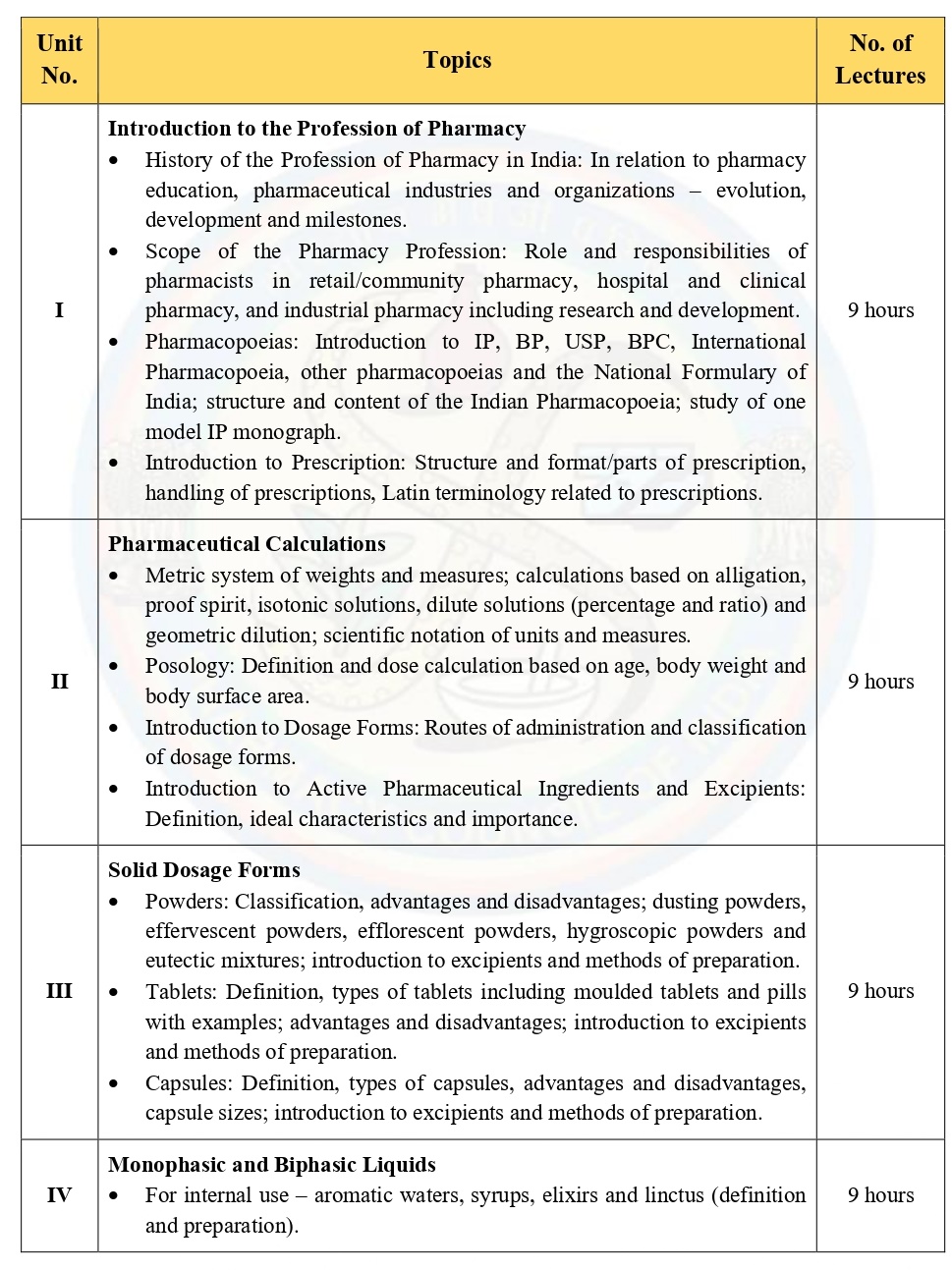
Detailed Syllabus:
Unit I
Introduction to the
Profession of Pharmacy
• History of
the Profession of Pharmacy in India: In relation to pharmacy education,
pharmaceutical industries and organizations – evolution, development and
milestones.
• Scope of the
Pharmacy Profession: Role and responsibilities of pharmacists in
retail/community pharmacy, hospital and clinical pharmacy, and industrial
pharmacy including research and development.
•
Pharmacopoeias: Introduction to IP, BP, USP, BPC, International Pharmacopoeia,
other pharmacopoeias and the National Formulary of India; structure and content
of the Indian Pharmacopoeia; study of one model IP monograph.
• Introduction
to Prescription: Structure and format/parts of prescription, handling of
prescriptions, Latin terminology related to prescriptions.
Unit II
Pharmaceutical
Calculations
• Metric system
of weights and measures; calculations based on alligation, proof spirit,
isotonic solutions, dilute solutions (percentage and ratio) and geometric
dilution; scientific notation of units and measures.
• Posology:
Definition and dose calculation based on age, body weight and body surface
area.
• Introduction
to Dosage Forms: Routes of administration and classification of dosage forms.
• Introduction
to Active Pharmaceutical Ingredients and Excipients: Definition, ideal
characteristics and importance.
Unit III
Solid Dosage Forms
• Powders:
Classification, advantages and disadvantages; dusting powders, effervescent
powders, efflorescent powders, hygroscopic powders and eutectic mixtures;
introduction to excipients and methods of preparation.
• Tablets:
Definition, types of tablets including moulded tablets and pills with examples;
advantages and disadvantages; introduction to excipients and methods of
preparation.
• Capsules:
Definition, types of capsules, advantages and disadvantages, capsule sizes;
introduction to excipients and methods of preparation.
Unit IV
Monophasic and
Biphasic Liquids
• For internal
use – aromatic waters, syrups, elixirs and linctus (definition and
preparation).
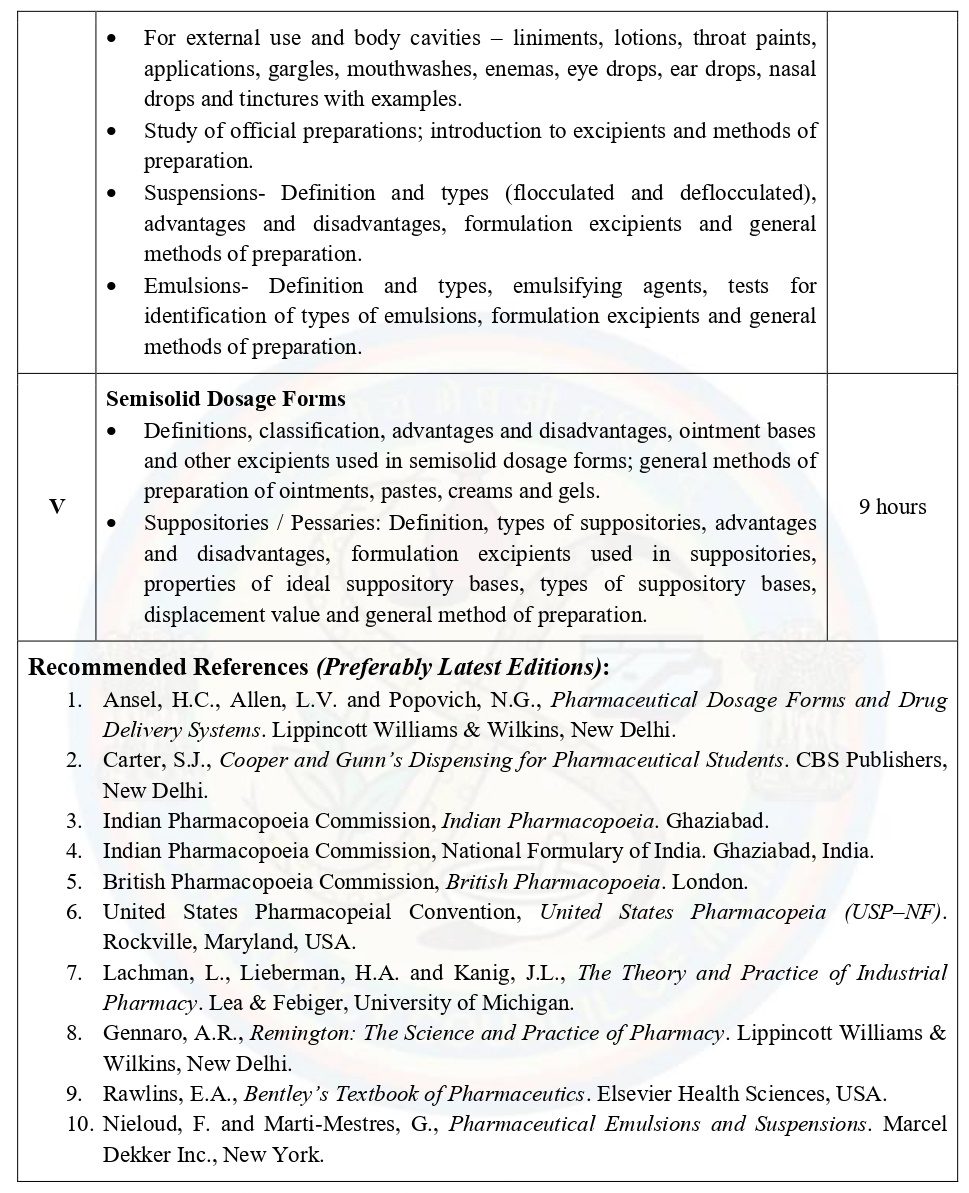
• For external
use and body cavities – liniments, lotions, throat paints, applications,
gargles, mouthwashes, enemas, eye drops, ear drops, nasal drops and tinctures
with examples.
• Study of
official preparations; introduction to excipients and methods of preparation.
• Suspensions-
Definition and types (flocculated and deflocculated), advantages and disadvantages,
formulation excipients and general methods of preparation.
• Emulsions-
Definition and types, emulsifying agents, tests for identification of types of
emulsions, formulation excipients and general methods of preparation.
Unit V
Semisolid Dosage
Forms
• Definitions,
classification, advantages and disadvantages, ointment bases and other
excipients used in semisolid dosage forms; general methods of preparation of
ointments, pastes, creams and gels.
• Suppositories
/ Pessaries: Definition, types of suppositories, advantages and disadvantages,
formulation excipients used in suppositories, properties of ideal suppository
bases, types of suppository bases, displacement value and general method
of preparation.
Recommended
References (Preferably Latest Editions):
1. Ansel, H.C.,
Allen, L.V. and Popovich, N.G., Pharmaceutical Dosage Forms and Drug Delivery
Systems. Lippincott Williams & Wilkins, New Delhi.
2. Carter, S.J.,
Cooper and Gunn’s Dispensing for Pharmaceutical Students. CBS Publishers, New
Delhi.
3. Indian
Pharmacopoeia Commission, Indian Pharmacopoeia. Ghaziabad.
4. Indian
Pharmacopoeia Commission, National Formulary of India. Ghaziabad, India.
5. British
Pharmacopoeia Commission, British Pharmacopoeia. London.
6. United States
Pharmacopeial Convention, United States Pharmacopeia (USP–NF). Rockville,
Maryland, USA.
7. Lachman, L.,
Lieberman, H.A. and Kanig, J.L., The Theory and Practice of Industrial
Pharmacy. Lea & Febiger, University of Michigan.
8. Gennaro, A.R.,
Remington: The Science and Practice of Pharmacy. Lippincott Williams &
Wilkins, New Delhi.
9. Rawlins, E.A.,
Bentley’s Textbook of Pharmaceutics. Elsevier Health Sciences, USA.
10. Nieloud, F. and
Marti-Mestres, G., Pharmaceutical Emulsions and Suspensions. Marcel Dekker
Inc., New York.