Pharmacognosy and Phytochemistry
[ Bpharm (Bachelor of Pharmacy) ]
Under Class: | 2nd Semester (Bpharm) |
Pharmacognosy and Phytochemistry - Question Papers, Lecture Notes, Study Material Download PDF
Pharmacy - Bachelor of Pharmacy (Bpharm) - 2nd Semester - 1st Year - Name of Subject: Pharmacognosy and Phytochemistry (BP205T) - Lecture Notes, Study Material, Question Papers Download PDF
Pharmacognosy
PART A - Introduction to Pharmacognosy:
Chapter 1: History, Definition and Scope of Pharmacognosy:
• Meaning of Pharmacognosy
• Origin of Pharmacognosy
• History of Pharmacognosy
• Scope of Pharmacognosy
• Future of Pharmacognosy
• Pharmacognostical Scheme
Chapter 2: Alternative System of Medicine:
• Alternative System of Medicine
• Traditional Chinese Medicine System
• Indian Systems of Medicine
• Siddha System of Medicine
• Unani System of Medicine
• Homeopathic System of Medicine
• Aromatherapy
• Bach Flower Remedies
• Tibetan System of Medicine
Chapter 3: Classification of Drugs of Natural Origin:
• Classification of Drugs of Natural Origin
• Classification of Crude Drugs
PART B - Pharmaceutical Botany:
Chapter 4: Morphology of Different Parts of Medicinal Plant:
• Morphology of Different Parts of Medicinal Plant
• Study of Different Tissue Systems
• Cell Contents
• Cell Division
• Morphological Study
Chapter 5: Study of Different Families:
• Study of Different Families
• Apocynaceae
• Compositae
• Convolulaceae
• Cruciferae
• Gramineae
• Labiatae
• Leguminosae
• Liliaceae
• Papaveraceae
• Rubiaceae
• Scrophulariaceae
• Solanaceae
• Umbelliferae
PART C - Cultivation, Collection, Production and Utilization of Herbal Drugs:
Chapter 6: Cultivation, Collection and Processing of Herbal Drugs:
• Cultivation, Collection and Processing of Herbal Drugs
• Soils, Seeds and Propagation Material
• Good Agricultural Practices
• Factors Affecting Cultivation
• Plant Hormones and Growth Regulators
• Collection of Crude Drugs
• Harvesting of Crude Drugs
• Drying of Crude Drugs
• Garbling (Dressing)
• Packing of Crude Drugs
• Storage of Crude Drugs
• Quality Management
• Documentation
Chapter 7: Indian Trade in Medicine and Aromatic Plants:
• Indian Trade in Medicine and Aromatic Plants
• Indian Herbal Trade in World Scenario
• Medicinal Plant-Based Industries In Indigenous System Of Medicine
• Export Potential of Indian Phyto-Pharmaceutical Products
• Indian Medicinal Plants Used in Cosmetic and Aromatherapy
• Indian Medicinal Plants in Crude Form
• Spices
• Export of Spices India
Chapter 8: Utilization of Aromatic Plants And Derived Products:
• Utilization of Aromatic Plants and Derived Products
• Impact of Industrialization
• Toxocity of Essential Oils
• Utilization of Aromatic Plants
Chapter 9: Role of Medicinal Plants on National Economy:
• Role of Medicinal Plants on National Economy
• Economic Growth Potential in Natural Health and Cosmetic Products
• Future Economic Growth
• Development of Herbal Medicinal Industry
• Contribution to Economy of the People
PART D - Analytical Pharmacognosy:
Chapter 10: Drug Adulteration:
• Drug Adulteration
• Adulteration
Chapter 11: Evaluation of Crude Drugs:
• Evaluation of Crude Drugs
• Organoleptic Evaluation
• Microscopical Evaluation
• Chemical Evaluation
• Physical Evaluation
• Biological Evaluation
Chapter 12: Biological Screening of Herbal Drugs:
• Biological Screening of Herbal Drugs
• Need for Phyto-Pharmacological Evaluation
• New Strategies for Evaluating Natural Products
• Errors in Screening Procedures
• Screening Methods for Analgesic Agents
• Screening Methods for Antidiabetic Agents
• Evaluation of Antidiarrhoeal Agents
• Screening Methods for Antifertility Agents
• Screening Methods for Antiinflammatory Agents
• Screening Methods for Antipyretic Agents
• Screening Methods for Antiulcer Agents
• Screening Methods for Diuretic Agents
• Screening Methods for Hepatoprotective Agents
• Screening Methods for Wound-Healing Agents
PART E - Biogenesis of Phytopharmaceuticals:
Chapter 13: General Biosynthetic Pathways of Secondary Metabolites:
• General Biosynthetic Pathways of Secondary Metabolites
• The Building Blocks
• Biosynthesis of Carbohydrates
• Biosynthesis of Glycosides
• Biosynthesis of Alkaloids
• Biosynthesis of Phenolic Compounds
PART F - Pharmacognostical Study of Crude Drugs:
Chapter 14: Drugs Containing Carbohydrates and Derived Products:
• Drugs Containing Carbohydrates and Derived Products
• Classification of Carbohydrates
• Tests for Carbohydrates
• Biosynthesis of Carbohydrates
• Acacia Gum
• Guar Gum
• Honey
• Tragacanth
• Sodium Alginate
• Pectin
• Karaya Gum
• Bael
• Agar
• Manna
• Xanthan Gum
• Ghatti Gum
• Ispaghula
• Tamarind
• Chitin
• Carrageenan
• Locust Bean Gum
• Starch
Chapter 15: Drugs Containing Alkaloids:
• Drugs Containing Alkaloids
• Definition - Drugs Containing Alkaloids
• History - Drugs Containing Alkaloids
• Classification - Drugs Containing Alkaloids
• Occurrence in Nature
• Properties
• Extraction
• Chemical Tests
• Tropane Alkaloids
• Belladonna
• Datura Herb
• Stramonium
• Hyoscyamus
• Coca Leaves
• Duboisia
• Indole Alkaloids
• Ergot
• Rauwolfia
• Nux Vomica
• Vinca
• Physostigma
• Pyridine And Piperidine Alkaloids
• Lobelia
• Tobacco
• Areca Nuts
• Imidazole Alkaloids
• Pilocarpus
• Quinoline Alkaloids
• Cinchona
• Isoquinoline Alkaloids
• Ipecac
• Opium
• Curare
• Steroidal Alkaloids
• Veratrum
• Kurchi Bark
• Ashwagandha
• Purine Alkaloids
• Coffee
• Tea
• Cocoa
• Diterpene Alkaloids
• Aconite
• Amino Alkaloids
• Ephedra
• Colchicum
Chapter 16: Drugs Containing Glycosides:
• Drugs Containing Glycosides
• Classification - Glycosides
• Distribution of Glycosides
• Chemical Tests of Glycosides
• Isolation - Drugs Containing Glycosides
• Anthracene Glycosides
• Senna Leaf
• Aloe
• Rhubarb
• Cascara Bark
• Sterol or Cardiac Glycosides
• Digitalis Leaves
• Digitalis Lanata
• Thevetia
• Squill
• Red Squill
• Indian Squill
• Strophanthus
• Oleander
• Saponin Glycosides
• Dioscorea
• Liquorice
• Shatavari
• Brahmi
• Ginseng
• Senega
• Quillaia
• Gokhru
• Sarsaparilla
• Cyanogenic Glycosides
• Almond
• Wild Cherry Bark
• Isothiocynate Glycosides
• Mustard
• Flavone Glycosides
• Ginkgo
• Coumarin and Furanocoumarin Glycosides
• Visnaga
• Ammi
• Psoralea
• Vanilla - Aldehyde Glycosides
• Phenol Glycosides - Bearberry
• Steroidal Glycosides - Solanum
• Bitter And Miscellaneous Glycosides
• Gentian
• Picrorhiza
• Chirata
• Quassia
• Kalmegh
Chapter 17: Drugs Containing Volatile Oils:
• Drugs Containing Volatile Oils
• Classification of Volatile Oils
• Extraction of Volatile Oils
• Terpenoids
• Classification of Terpenoids
• Evaluation of Volatile Oils
• Chemical Tests for Volatile Oils
• Storage of Volatile Oils
• Pharmaceutical Applications
• Volatile Oils Containing Hydrocarbons
• Turpentine Oil
• Volatile Oils Containing Alcohols
• Peppermint
• Pudina
• Sandalwood Oil
• Volatile Oils Containing Aldehydes
• Lemongrass Oil
• Lemon Peel
• Bitter Orange Peel
• Cinnamon
• Cassia Bark
• Citronella Oil
• Saffron
• Volatile Oils Containing Ketones
• Camphor
• Caraway
• Coriander
• Dill
• Fennel
• Jatamansi
• Anise
• Cummin/Cumin
• Volatile Oil Containing Phenol
• Ajowan
• Tulsi
• Clove
• Volatile Oil Containing Ether
• Nutmeg
• Calamus
• Volatile Oil Containing Oxides
• Chenopodium Oil
• Eucalyptus Oil
• Cardamom
• Volatile Oil Containing Ester
• Garlic
• Rosemary Oil
• Gaultheria Oil
• Valerian
Chapter 18: Drugs Containing Resins:
• Drugs Containing Resins
• Classification - Drugs Containing Resins
• Chemical Composition - Drugs Containing Resins
• Isolation - Drugs Containing Resins
• Asafoetida
• Balsam of Peru
• Balsam Of Tolu
• Cannabis
• Capsicum
• Colocynth
• Colophony
• Ginger
• Guggul
• Ipomoea
• Jalap
• Kaladana
• Male Fern
• Myrrh
• Podophyllum
• Indian Podophyllum
• Siam Benzoin
• Sumatra Benzoin
• Storex
• Turmeric
Chapter 19: Drugs Containing Lipids:
• Drugs Containing Lipids
• Fixed Oils And Fats
• Waxes
• Almond Oil
• Arachis Oil
• Castor Oil
• Chaulmoogra Oil
• Coconut Oil
• Cod Liver Oil
• Corn Oil
• Cottonseed Oil
• Linseed Oil
• Mustard Oil
• Olive Oil
• Rice Bran Oil
• Safflower Oil
• Sesame Oil
• Shark Liver Oil
• Beeswax
• Carnauba Wax
• Cocoa Butter
• Kokum
• Lanolin
• Lard
Chapter 20: Drugs Containing Tannins:
• Drugs Containing Tannins
• Classification - Drugs Containing Tannins
• Characteristics of Tannins
• Biosynthesis of Tannins
• Chemical Tests - For Tannins
• Isolation of Tannins
• Medicinal Properties and Uses of Tannins
• Hydrolysable Tannins - Myrobalan
• Bahera
• Arjuna
• Amla
• Nutgalls
• Tannic Acid
• Condensed Tannins - Ashoka
• Pale Catechu
• Black Catechu
• Pterocarpus
Chapter 21: Enzymes and Protein Drugs:
• Enzymes and Protein Drugs
• Diastase
• Pepsin
• Pancreatin
• Trypsin
• Hyaluronidase
• Urokinase
• Streptokinase
• Bromelin
• Serratiopeptidase
• Papain
• Proteins
• Malt Extract
• Gelatin
• Casein
• Collagen
• Ficin
Chapter 22: Fibres, Sutures and Surgical Dressings:
• Fibres, Sutures and Surgical Dressings - Introduction
• Fibres, Sutures and Surgical Dressings - History
• Classification and Properties of Fibres
• Cotton - Vegetable Fibres
• Jute
• Flax
• Hemp
• Silk - Animal Fibres
• Wool
• Viscose
• Alginate Fibres
• Nylon
• Terylene (Dacron)
• Orlon
• Surgical Dressings
• Sutures and Ligatures
Chapter 23: Drugs of Mineral Origin:
• Drugs of Mineral Origin - Introduction
• Kaolin
• Asbestos
• Talc
• Bentonite
• Fuller’s Earth
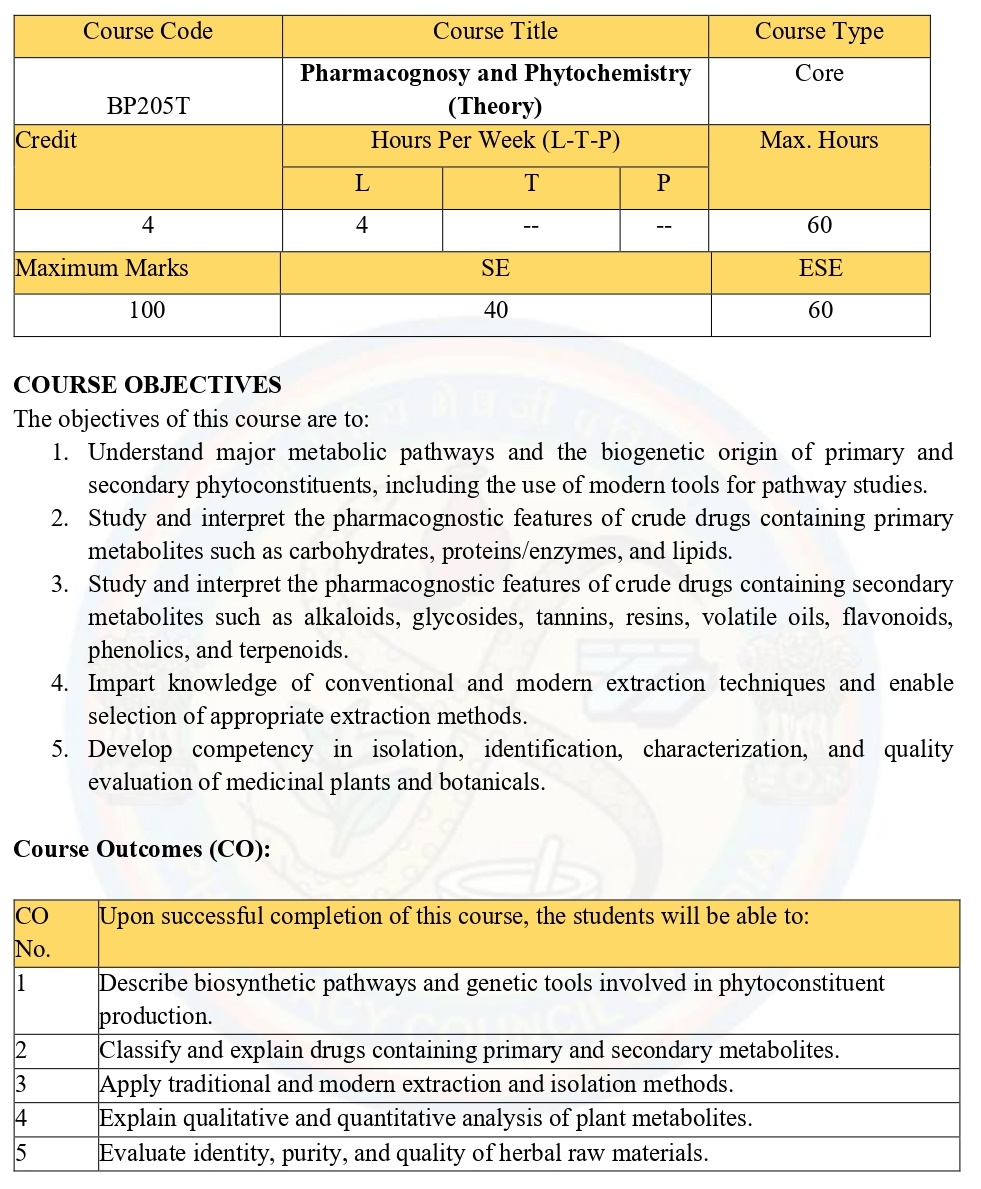
BP205T:
Pharmacognosy and
Phytochemistry (Theory)
COURSE OBJECTIVES
The objectives of
this course are to:
1. Understand major
metabolic pathways and the biogenetic origin of primary and secondary
phytoconstituents, including the use of modern tools for pathway studies.
2. Study and
interpret the pharmacognostic features of crude drugs containing primary
metabolites such as carbohydrates, proteins/enzymes, and lipids.
3. Study and
interpret the pharmacognostic features of crude drugs containing secondary
metabolites such as alkaloids, glycosides, tannins, resins, volatile oils,
flavonoids, phenolics, and terpenoids.
4. Impart knowledge of
conventional and modern extraction techniques and enable selection of
appropriate extraction methods.
5. Develop competency
in isolation, identification, characterization, and quality evaluation of
medicinal plants and botanicals.
Course Outcomes
(CO):
Upon successful
completion of this course, the students will be able to:
1. Describe
biosynthetic pathways and genetic tools involved in phytoconstituent
production.
2. Classify and
explain drugs containing primary and secondary metabolites.
3. Apply traditional
and modern extraction and isolation methods.
4. Explain
qualitative and quantitative analysis of plant metabolites.
5. Evaluate identity,
purity, and quality of herbal raw materials.
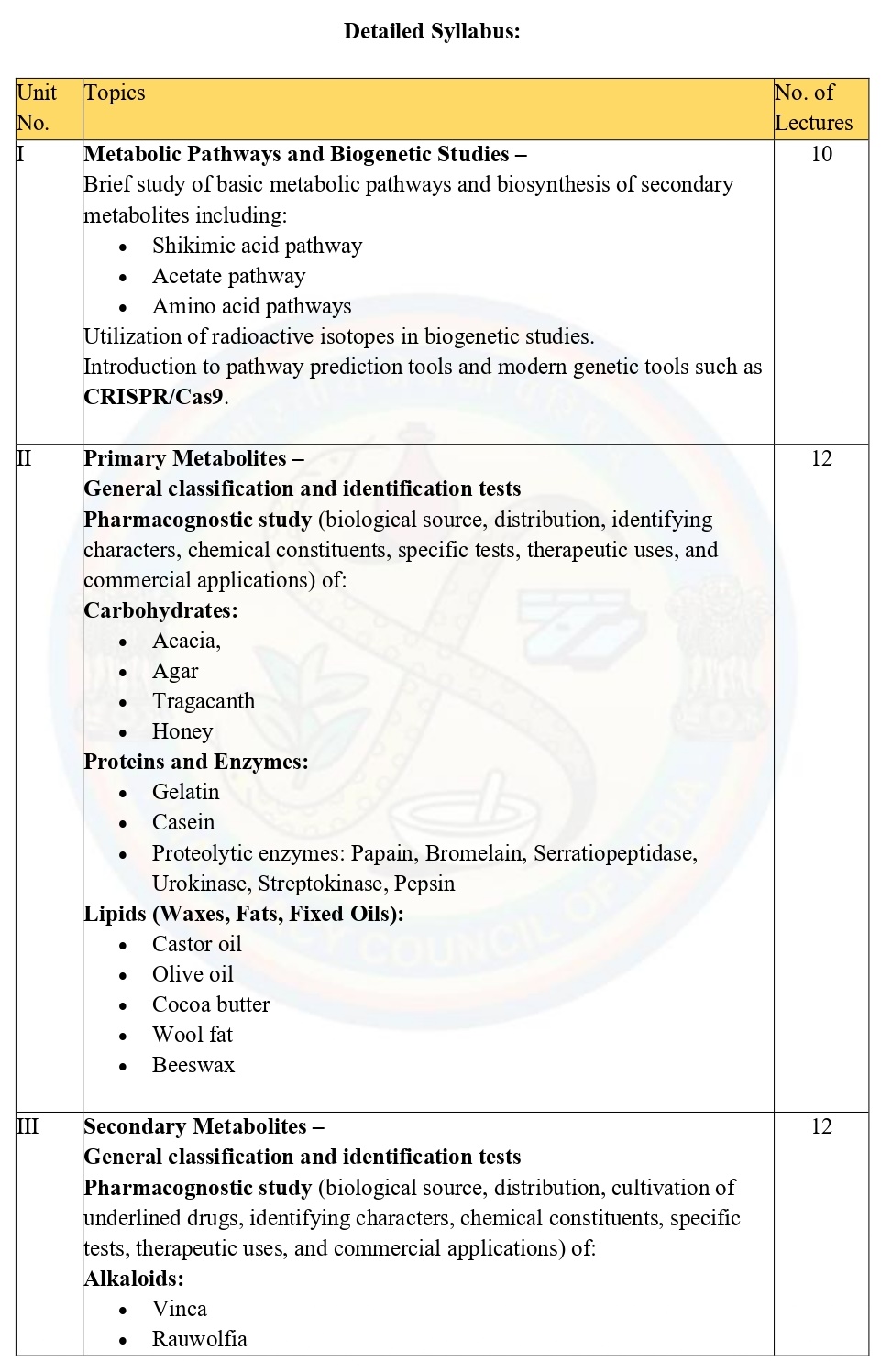
Detailed Syllabus:
Unit I
Metabolic Pathways
and Biogenetic Studies –
Brief study of basic
metabolic pathways and biosynthesis of secondary metabolites including:
• Shikimic acid
pathway
• Acetate
pathway
• Amino acid
pathways
Utilization of
radioactive isotopes in biogenetic studies.
Introduction to
pathway prediction tools and modern genetic tools such as CRISPR/Cas9.
Unit II
Primary Metabolites
–
General
classification and identification tests
Pharmacognostic study (biological source, distribution, identifying characters,
chemical constituents, specific tests, therapeutic uses, and commercial
applications) of:
Carbohydrates:
• Acacia,
• Agar
• Tragacanth
• Honey
Proteins and Enzymes:
• Gelatin
• Casein
• Proteolytic
enzymes: Papain, Bromelain, Serratiopeptidase, Urokinase, Streptokinase, Pepsin
Lipids (Waxes, Fats,
Fixed Oils):
• Castor oil
• Olive oil
• Cocoa butter
• Wool fat
• Beeswax
Unit III
Secondary
Metabolites –
General
classification and identification tests
Pharmacognostic study (biological source, distribution, cultivation of underlined drugs,
identifying characters, chemical constituents, specific tests, therapeutic
uses, and commercial applications) of:
Alkaloids:
• Vinca
• Rauwolfia
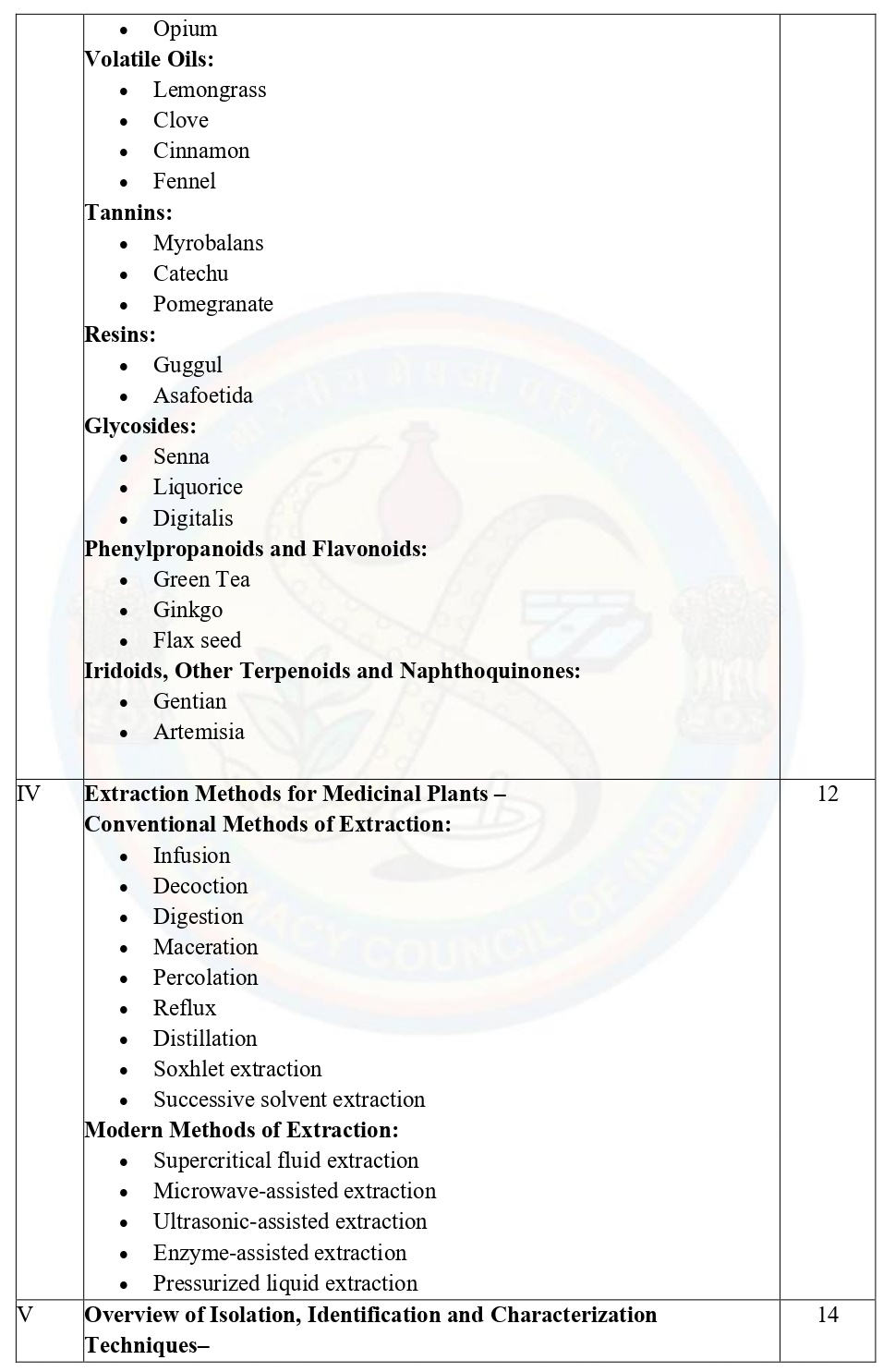
• Opium
Volatile Oils:
• Lemongrass
• Clove
• Cinnamon
• Fennel
Tannins:
• Myrobalans
• Catechu
• Pomegranate
Resins:
• Guggul
• Asafoetida
Glycosides:
• Senna
• Liquorice
• Digitalis
Phenylpropanoids and
Flavonoids:
• Green Tea
• Ginkgo
• Flax seed
Iridoids, Other
Terpenoids and Naphthoquinones:
• Gentian
• Artemisia
Unit IV
Extraction Methods
for Medicinal Plants –
Conventional
Methods of Extraction:
• Infusion
• Decoction
• Digestion
• Maceration
• Percolation
• Reflux
• Distillation
• Soxhlet
extraction
• Successive
solvent extraction
Modern Methods of
Extraction:
• Supercritical
fluid extraction
•
Microwave-assisted extraction
•
Ultrasonic-assisted extraction
•
Enzyme-assisted extraction
• Pressurized
liquid extraction12
Unit V
Overview of
Isolation, Identification and Characterization Techniques–
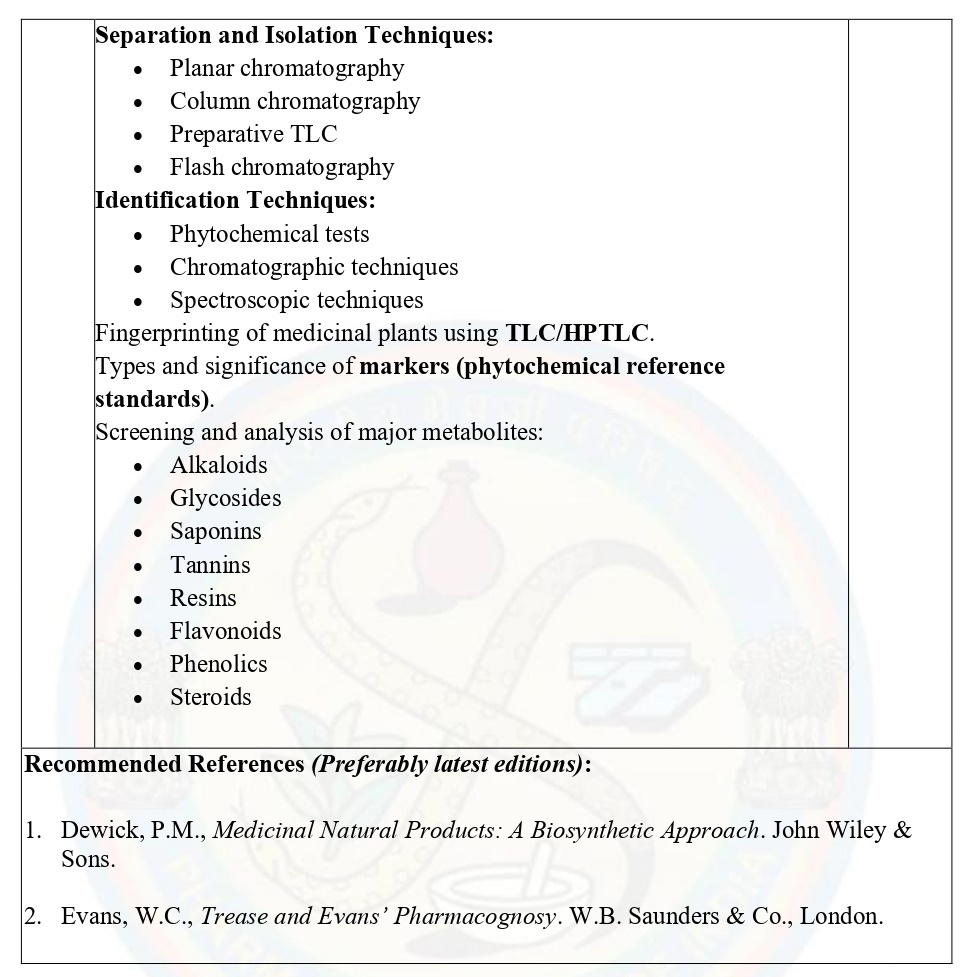
Separation and
Isolation Techniques:
• Planar
chromatography
• Column
chromatography
• Preparative
TLC
• Flash
chromatography
Identification
Techniques:
• Phytochemical
tests
•
Chromatographic techniques
• Spectroscopic
techniques
Fingerprinting of
medicinal plants using TLC/HPTLC.
Types and
significance of markers (phytochemical reference standards).
Screening and
analysis of major metabolites:
• Alkaloids
• Glycosides
• Saponins
• Tannins
• Resins
• Flavonoids
• Phenolics
• Steroids
Recommended
References (Preferably latest editions):
1. Dewick, P.M.,
Medicinal Natural Products: A Biosynthetic Approach. John Wiley & Sons.
2. Evans, W.C.,
Trease and Evans’ Pharmacognosy. W.B. Saunders & Co., London.