Pharmaceutical Organic Chemistry - Practical
[ Bpharm (Bachelor of Pharmacy) ]
Under Class: | 2nd Semester (Bpharm) |
Pharmaceutical Organic Chemistry - Practical - Experimental laboratory pdf record
Pharmacy - Bachelor of Pharmacy (Bpharm) - 2nd Semester - 1st Year - Subject/Practical Laboratory: Pharmaceutical Organic Chemistry - Practical (BP209P) - laboratory Experimental Note Download PDF
Organic Chemistry
Structure and bonding:
• Atomic structure of carbon
• Covalent bonding and hybridization
• sp3 Hybridization
• sp2 Hybridization
• sp Hybridization
• Bonds and hybridized centers
Alkanes and cycloalkanes:
• Alkanes and cycloalkanes
• Alkanes and cycloalkanes: Drawing structures
• Alkanes and cycloalkanes: Nomenclature
Functional groups:
• Organic Chemistry: Recognition of functional groups
• Aliphatic and aromatic functional groups
• Intermolecular bonding
• Functional groups: Properties and reactions
• Nomenclature of compounds with functional groups
• Primary, secondary, tertiary and quaternary nomenclature
Stereochemistry:
• Constitutional isomers
• Configurational isomers � alkenes and cycloalkanes
• Configurational isomers - optical isomers
• Conformational isomers
Nucleophiles and electrophiles:
• Nucleophiles and electrophiles: Definition
• Nucleophiles and electrophiles: Charged species
• Nucleophiles and electrophiles: Neutral inorganic species
• Nucleophiles and electrophiles: Organic structures
Reactions and mechanisms:
• Organic Chemistry Reactions
• Organic Chemistry Mechanisms
Acidbase reactions:
• Br�nsted�Lowry acids and bases
• Acid strength
• Base strength
• Lewis acids and bases
• Enolates
Alkenes and alkynes:
• Preparation of alkenes and alkynes
• Properties of alkenes and alkynes
• Electrophilic addition to symmetrical alkenes
• Electrophilic addition to unsymmetrical alkenes
• Carbocation stabilization
• Reduction and oxidation of alkenes
• Hydroboration of alkenes
• Electrophilic additions to alkynes
• Reduction of alkynes
• Alkylation of terminal alkynes
• Conjugated dienes
Aromatic chemistry:
• Aromaticity
• Aromatic chemistry: Preparation and properties
• Electrophilic substitutions of benzene
• Synthesis of mono-substituted benzenes
• Electrophilic substitutions of mono-substituted aromatic rings
• Synthesis of di- and tri-substituted benzenes
• Aromatic chemistry: Oxidation and reduction
Aldehydes and ketones:
• Preparation of Aldehydes and ketones
• Properties of Aldehydes and ketones
• Nucleophilic addition - Aldehydes and ketones
• Nucleophilic addition � charged nucleophiles
• Aldehydes and ketones: Electronic and steric effects
• Nucleophilic addition - nitrogen nucleophiles
• Nucleophilic addition - oxygen and sulfur nucleophiles
• Aldehydes and ketones: Reactions of enolate ions
• Aldehydes and ketones: ?-Halogenation
• Aldehydes and ketones: Reduction and oxidation
• Aldehydes and ketones: ?,?-Unsaturated aldehydes and ketones
Carboxylic acids and carboxylic acid derivatives:
• Structure and properties of Carboxylic acids and carboxylic acid derivatives
• Nucleophilic substitution - Carboxylic acids
• Reactivity of Carboxylic acids and carboxylic acid derivatives
• Preparations of carboxylic acids
• Preparations of carboxylic acid derivatives
• Reactions of Carboxylic acids and carboxylic acid derivatives
• Enolate reactions - Carboxylic acids and carboxylic acid derivatives
Alkyl halides:
• Preparation and physical properties of alkyl halides
• Alkyl halides: Nucleophilic substitution
• Alkyl halides: Factors affecting SN2 versus SN1 reactions
• Alkyl halides: Elimination
• Alkyl halides: Elimination versus substitution
• Reactions of alkyl halides
• Alkyl halides: Organometallic reactions
Alcohols phenols and thiols:
• Preparation of alcohols
• Preparation of phenols
• Properties of alcohols and phenols
• Reactions of alcohols
• Reactions of phenols
• Chemistry of thiols
Ethers epoxides and thioethers:
• Preparation of ethers, epoxides, and thioethers
• Properties of ethers, epoxides, and thioethers
• Reactions of ethers, epoxides, and thioethers
Amines and nitriles:
• Preparation of amines
• Properties of amines
• Reactions of amines
• Chemistry of nitriles
Organic spectroscopy and analysis:
• Spectroscopy
• Visible and ultra violet spectroscopy
• Infra-red spectroscopy
• Proton nuclear magnetic resonance spectroscopy: Introduction
• Proton nuclear magnetic resonance spectroscopy
• Proton nuclear magnetic resonance spectroscopy: Spin-spin coupling
• 13C nuclear magnetic resonance spectroscopy
• Mass spectroscopy
Organic Chemistry
Chapter 1: Functional Groups and Chemical Bonding:
• Functional Groups
• Orbitals
• Bonding Schemes
• Antibonding Orbitals
• Resonance
• Conjugated Π Systems
• Aromaticity
• Problems on Functional Groups and Chemical Bonding
Chapter 2: Oxidation States of Organic Compounds:
• Oxidation Levels
• Oxidation States in Alkanes
• Oxidation States In Alkenes
• Oxidation States in Common Functional Groups
• Oxidation Level Changes During Reactions
• Problems on Oxidation States of Organic Compounds
Chapter 3: Acidity and Basicity:
• Bronsted and Lewis Acids and Bases
• Acid Strength
• Acid-Base Equilibria
• Amphoteric Compounds
• Structural Effects on Acidity
• Solved Problems on Acidity and Basicity
Chapter 4: Curved-Arrow Notation:
• Electron Movement
• Heterolytic Bond Cleavages
• Heterolytic Bond Formation
• Homolytic Bond Making and Bond Breaking
• Resonance Structures
• Depiction of Mechanism
• Solved Problems on Curved-Arrow Notation
Chapter 5: Mechanisms of Organic Reactions:
• Mechanisms of Organic Reactions
• Activation Energy
• Activated Complex
• Reaction Energetics
• Structure of the Activated Complex
• Hammond Postulate
• Reaction Kinetics
• Determining Activation Energies
• Isotope Effects
• Electronic Effects
• Hammett Equation
• Solved Problems on Mechanisms of Organic Reactions
Chapter 6: Stereochemical and Conformational Isomerism:
• Stereochemical and Conformational Isomerism
• Stereochemical Structures
• Chirality
• Configuration of Chiral Centers
• Multiple Stereocenters
• Optical Activity
• Absolute Configuration
• Physical Properties of Enantiomers
• Resolution of Enantiomers
• Stereoselective Reactions
• Formation of Enantiomers
• Formation of Diastereomers
• Stereochemistry to Deduce Mechanism
• Conformational Analysis
• Conformational Energies
• A Values
• Strain in Ring Systems
• Stereoelectronic Effects
• Solved Problems on Stereochemical and Conformational Isomerism
Chapter 7: Functional Group Synthesis:
• Functional Group Manipulation
• Carboxylic Acids
• Esters
• Amides
• Acid Chlorides
• Aldehydes
• Ketones
• Imines and Imine Derivatives
• Alcohols
• Amines
• Alkenes
• Alkanes
• Solved Problems on Functional Group Synthesis
Chapter 8: Carbon-Carbon Bond Formation Between Carbon Nucleophiles and Carbon Electrophiles:
• Synthetic Strategy
• Nucleophilic Carbon
• Electrophilic Carbon
• Reactivity Matching
• Generation of Nucleophilic Carbon Reagents
• Generation of Electrophilic Carbon Reagents
• Matching Nucleophiles with Electrophiles
• Enolates
• Enolate Regioisomers
• Diastereoselection in Aldol Reactions
• Organometallic Compounds
• Neutral Carbon Nucleophiles
• C=C Formation
• Cyclopropanation Reactions
• Metal-Catalyzed Carbon-Carbon Bond Formation
• Pd(0)-Catalyzed Carbon-Carbon Bond Formation
• Olefin Metathesis
• Solved Problems on Carbon-Carbon Bond Formation Between Carbon Nucleophiles and Carbon Electrophiles
Chapter 9: Carbon-Carbon Bond Formation By Free-Radical Reactions:
• Free-Radical Reactions
• Free-Radical Polymerization
• Nonpolymerization Reactions
• Free-Radical Initiation
• Free-Radical Cyclization
• Solved Problems on Carbon-Carbon Bond Formation By Free-Radical Reactions
Chapter 10: Planning Organic Syntheses:
• Retrosynthetic Analysis
• Carbon Skeleton Synthesis
• Umpolung Synthons
• Acetylide Nucleophiles
• Ring Construction
• Robinson Annulation
• Diels-Alder Reaction
• Homo-Lumo Interactions
• Stereoelectronic Factors
• 1,3-Dipolar Cycloadditions
• Solved Problems on Planning Organic Syntheses
Chapter 11: Structure Determination of Organic Compounds:
• Structure Determination of Organic Compounds
• Chromatographic Purification
• Instrumental Methods
• Nuclear Magnetic Resonance
• Chemical Shift
• Spin-Spin Coupling
• Descriptions of Spin Systems
• Second-Order Splitting
• Structure Identification By 1h NMR
• Carbon-13 NMR
• Infrared Spectroscopy
• IR Stretching Frequencies
• Use of IR Spectroscopy for Structure Determination
• Mass Spectrometry
• Fragmentation Processes
• Solved Problems on Structure Determination of Organic Compounds
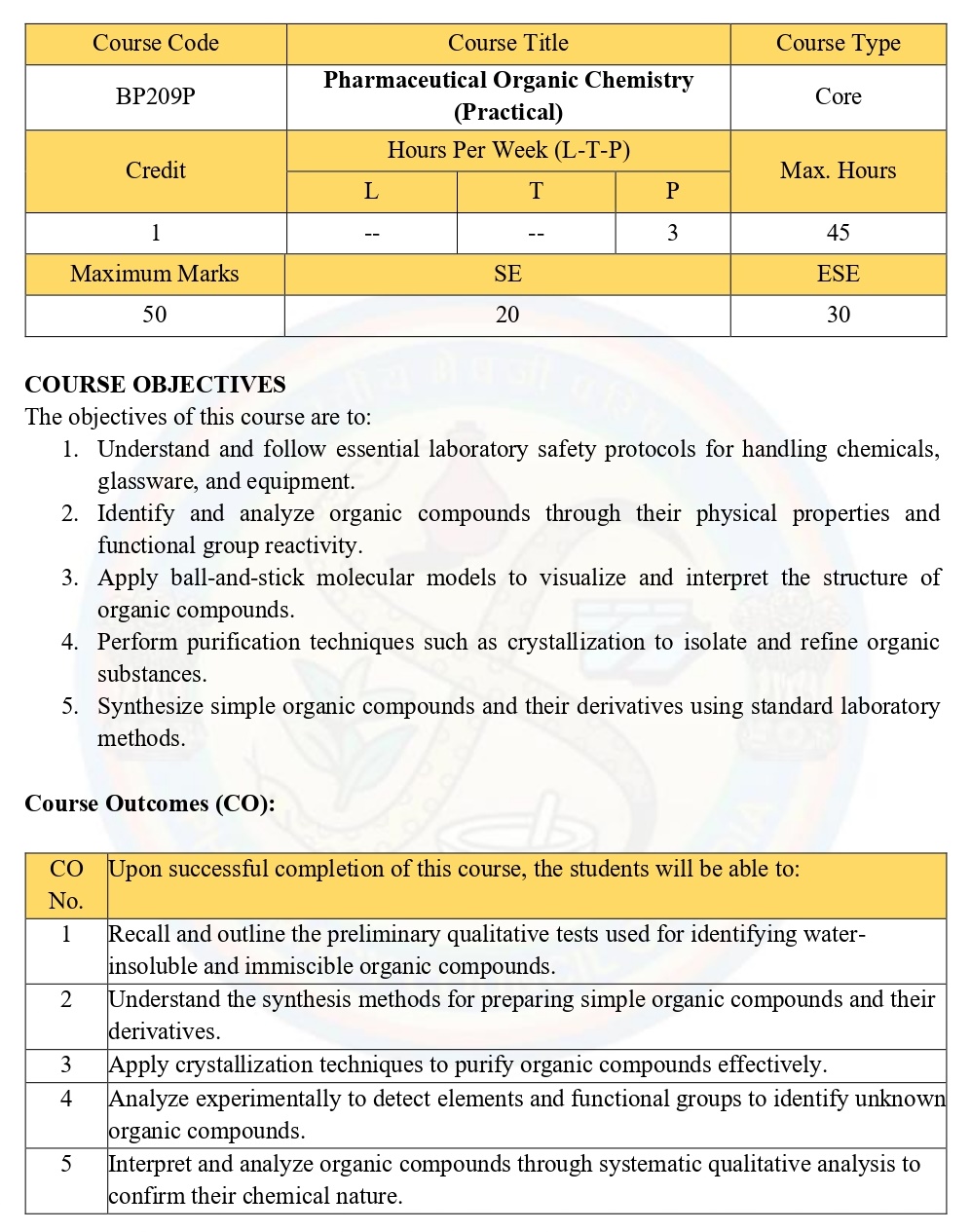
BP209P :
Pharmaceutical
Organic Chemistry (Practical)
COURSE OBJECTIVES
The objectives of
this course are to:
1. Understand and
follow essential laboratory safety protocols for handling chemicals, glassware,
and equipment.
2. Identify and
analyze organic compounds through their physical properties and functional
group reactivity.
3. Apply
ball-and-stick molecular models to visualize and interpret the structure of
organic compounds.
4. Perform
purification techniques such as crystallization to isolate and refine organic
substances.
5. Synthesize simple
organic compounds and their derivatives using standard laboratory methods.
Course Outcomes
(CO):
Upon successful
completion of this course, the students will be able to:
1. Recall and outline
the preliminary qualitative tests used for identifying water- insoluble and
immiscible organic compounds.
2. Understand the
synthesis methods for preparing simple organic compounds and their derivatives.
3. Apply
crystallization techniques to purify organic compounds effectively.
4. Analyze experimentally
to detect elements and functional groups to identify unknown organic compounds.
5. Interpret and
analyze organic compounds through systematic qualitative analysis to confirm
their chemical nature.
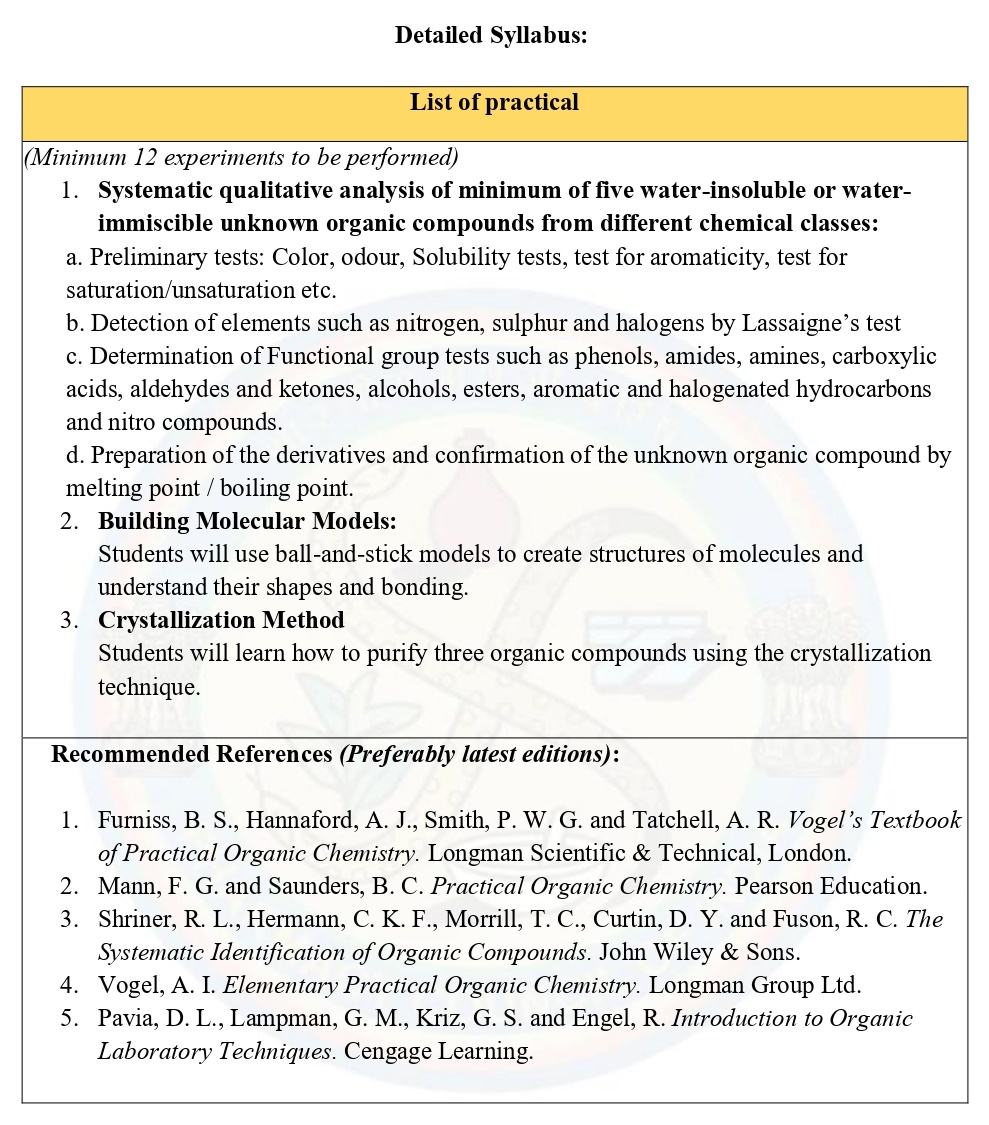
Detailed Syllabus:
List of practical
(Minimum 12 experiments
to be performed)
1. Systematic
qualitative analysis of minimum of five water-insoluble or water-immiscible
unknown organic compounds from different chemical classes:
a. Preliminary tests:
Color, odour, Solubility tests, test for aromaticity, test for
saturation/unsaturation etc.
b. Detection of
elements such as nitrogen, sulphur and halogens by Lassaigne’s test
c. Determination of
Functional group tests such as phenols, amides, amines, carboxylic acids,
aldehydes and ketones, alcohols, esters, aromatic and halogenated hydrocarbons
and nitro compounds.
d. Preparation of the
derivatives and confirmation of the unknown organic compound by melting point /
boiling point.
2. Building Molecular
Models:
Students will use
ball-and-stick models to create structures of molecules and understand their
shapes and bonding.
3. Crystallization
Method
Students will learn
how to purify three organic compounds using the crystallization technique.
Recommended
References (Preferably latest editions):
1. Furniss, B. S.,
Hannaford, A. J., Smith, P. W. G. and Tatchell, A. R. Vogel’s Textbook of
Practical Organic Chemistry. Longman Scientific & Technical, London.
2. Mann, F. G. and
Saunders, B. C. Practical Organic Chemistry. Pearson Education.
3. Shriner, R. L.,
Hermann, C. K. F., Morrill, T. C., Curtin, D. Y. and Fuson, R. C. The
Systematic Identification of Organic Compounds. John Wiley & Sons.
4. Vogel, A. I.
Elementary Practical Organic Chemistry. Longman Group Ltd.
5. Pavia, D. L.,
Lampman, G. M., Kriz, G. S. and Engel, R. Introduction to Organic Laboratory
Techniques. Cengage Learning.