Human Anatomy, Physiology and Pathophysiology I
[ Bpharm (Bachelor of Pharmacy) ]
Under Class: | 1st Semester (Bpharm) |
Human Anatomy, Physiology and Pathophysiology I - Question Papers, Lecture Notes, Study Material Download PDF
Pharmacy - Bachelor of Pharmacy (Bpharm) - 1st Semester - 1st Year - Name of Subject: Human Anatomy, Physiology and Pathophysiology I (BP104T) - Lecture Notes, Study Material, Question Papers Download PDF
Essentials of Anatomy and Physiology
The Human Organism:
• Anatomy
• Physiology
• Structural and Functional Organization of the Human Body
• Characteristics of Life
• Microbesin Your Body
• Homeostasis
• Terminology and the Body Plan
The chemical basis of life:
• Basic Chemistry
• Chemical reactions - Human Organism
• Acids and Bases
• Inorganic Molecules
• Organic Molecules
Cell Structures and their Functions:
• Cell Structure
• Function of the cell
• Structure of the Cell membrane
• Movement through the cell membrane
• Organelles - Cell Structures and their Functions
• Whole cell activity
• Cellular aspects of aging
Tissues:
• Tissues and Histology
• Epithelial Tissue
• Functions of Epithelia
• Classification of Epithelia
• Connective tissue
• Functions of Connective Tissue
• Muscle tissue
• Nervous tissue
• Tissue membranes
• Tissue damage and inflammation
• Tissue repair
• Effects of aging on tissues
Integumentary System:
• Functions of the Integumentary System
• Skin
• Subcutaneous Tissue
• Accessory skin structures
• Physiology of the integumentary system
• Integumentary system as a diagnostic Aid
• Burns: Classify burns on the basis of the amount of skin damage produced
• Skin Cancer
• Effects of Aging on the Integumentary System
Skeletal System Bones and Joints:
• Functions of the Skeletal System
• Extracellular Matrix
• General Features of Bone
• Bone and calcium homeostasis
• General Considerations of Bone Anatomy
• Axial Skeleton
• Appendicular Skeleton
• Joints
• Effects of Aging on the Skeletal System and Joints
Muscular System:
• Functions of the Muscular System
• Characteristics of Skeletal Muscle
• Skeletal Muscle Structure
• Excitability of Muscle Fibers
• Nerve Supply and Muscle fiber Stimulation
• Muscle Contraction
• Energy Requirements for Muscle Contraction
• Fatigue
• Effect of Fiber Type on Activity Level
• Smooth Muscle and Cardiac Muscle
• General Principles - Skeletal Muscle Anatomy
• Nomenclature - Skeletal Muscle Anatomy
• Muscles of the head and Neck
• Trunk Muscles
• Upper limb Muscles
• Lower Limb Muscles
• Effects of Aging on Skeletal Muscle
Nervous System:
• Functions of the Nervous System
• Divisions of the Nervous System
• Cells of the Nervous System
• Electrical Signals and Neural Pathways
• Resting Membrane Potential - Electrical Signals and Neural Pathways
• Action Potentials - Electrical Signals and Neural Pathways
• The Synapse - Electrical Signals and Neural Pathways
• Reflexes - Electrical Signals and Neural Pathways
• Neuronal Pathways - Electrical Signals and Neural Pathways
• Central and Peripheral Nervous Systems
• Spinal Cord and Spinal Cord Reflexes
• Spinal Nerves
• Brain Anatomy
• Sensory Functions
• Motor Functions: Motor Areas Of The Cerebral Cortex, Descending tracts, Cerebellum
• Communication Between the right and Left hemispheres - Brain Functions
• Speech - Brain Functions
• Brain waves and Consciousness - Brain Functions
• Memory - Brain Functions
• Limbic system and emotions - Brain Functions
• Meninges - Nervous System
• Ventricles - Nervous System
• Cerebrospinal fluid - Nervous System
• Cranial Nerves
• Autonomic Nervous System
• Enteric Nervous System
• Effects of Aging on the Nervous System
Senses:
• Sensation
• Sensory Receptors
• General Senses
• Special Senses
• Olfaction
• Taste
• Vision
• Accessory Structures of the Eye
• Anatomy of the Eye
• Functions of the Eye
• Neuronal Pathways for Vision
• Hearing and Balance
• Anatomy and function of the Ear
• Hearing - Ear
• Neuronal Pathways for Hearing
• Balance - Ear
• Neuronal Pathways for Balance - Ear
• Effects of Aging on the Senses
Endocrine System:
• Principles of Chemical Communication
• Functions of the Endocrine System
• Characteristics of the Endocrine System
• Chemical Nature of Hormones
• Control of Hormone Secretion
• Hormone Receptors and Mechanisms of Action
• Pituitary and hypothalamus - Endocrine Glands and Their Hormones
• Thyroid Gland - Endocrine Glands and Their Hormones
• Parathyroid Glands - Endocrine Glands and Their Hormones
• Adrenal Glands - Endocrine Glands and Their Hormones
• Pancreas, Insulin, and Diabetes - Endocrine Glands and Their Hormones
• Testes and Ovaries - Endocrine Glands and Their Hormones
• Thymus and Pineal Gland - Endocrine Glands and Their Hormones
• Other Hormones
• Effects of Aging on the Endocrine System
Blood:
• Functions of Blood
• Composition of Blood
• Plasma
• Formed Elements - Blood
• Preventing Blood Loss
• Blood Grouping
• ABO Blood Group
• Rh Blood Group
• Diagnostic Blood Tests
Heart:
• Functions of the Heart
• Size, Form, and Location of the Heart
• Anatomy of the Heart
• Heart valves
• Route of Blood Flow Through the Heart
• Blood Supply to the Heart
• Histology of the Heart
• Electrical Activity of the Heart
• Cardiac Cycle
• Heart Sounds
• Regulation of Heart Function
• Effects of Aging on the Heart
Blood Vessels and Circulation:
• Functions of the Circulatory System
• General Features of Blood Vessel Structure
• Blood Vessels of the Pulmonary Circulation
• Blood Vessels of the Systemic Circulation: Arteries
• Blood Vessels of the Systemic Circulation: Veins
• Physiology of Circulation
• Control of Blood Flow in Tissues
• Regulation of Arterial Pressure
• Effects of Aging on the Blood Vessels
Lymphatic System and Immunity:
• Functions of the Lymphatic System
• Anatomy of the Lymphatic System
• Immunity
• Innate Immunity
• Adaptive Immunity
• Origin and Development of Lymphocytes
• Activation and Multiplication of Lymphocytes
• Antibody-mediated immunity
• Cell-Mediated Immunity
• Acquired Immunity
• Overview of Immune Interactions
• Immunotherapy
• Effects of Aging on the Lymphatic System and Immunity
Respiratory System:
• Functions of the Respiratory System
• Anatomy of the Respiratory System
• Nose - Anatomy of the Respiratory System
• Pharynx - Anatomy of the Respiratory System
• Larynx - Anatomy of the Respiratory System
• Trachea - Anatomy of the Respiratory System
• Bronchi - Anatomy of the Respiratory System
• Lungs - Anatomy of the Respiratory System
• Pleural Cavities - Anatomy of the Respiratory System
• Lymphatic Supply - Anatomy of the Respiratory System
• Ventilation and Respiratory Volumes
• Changing thoracic Volume
• Lung Recoil
• Changing Alveolar Volume
• Respiratory Volumes and Capacities
• Gas Exchange - Respiratory System
• Gas Transport in the Blood
• Rhythmic Breathing
• Generation of Rhythmic Breathing
• Nervous and Chemical Control of Breathing
• Effect of Exercise on Breathing
• Respiratory Adaptations to Exercise
• Effects of Aging on the Respiratory System
Digestive System:
• Functions of the Digestive System
• Anatomy and Histology of the Digestive System
• Anatomy of Oral Cavity, Pharynx, and Esophagus
• Anatomy of the oral Cavity
• Saliva
• Swallowing - Digestive System
• Stomach
• Anatomy of the Stomach
• Secretions of the Stomach
• Regulation of Stomach Secretions
• Movement in the Stomach
• Anatomy of the Small intestine
• Secretions of the Small intestine
• Movement and Absorption in the Small Intestine
• Anatomy of the liver
• Functions of the Liver
• Anatomy and Functions of the Pancreas
• Anatomy of the large intestine
• Functions of the Large Intestine
• Digestion, Absorption, and Transport in Digestive System
• Effects of Aging on the Digestive System
Nutrition Metabolism and body Temperature Regulation:
• Nutrition and Nutrients
• Kilocalories
• Carbohydrates - Human Nutrition
• Lipids - Human Nutrition
• Proteins - Human Nutrition
• Vitamins - Human Nutrition
• Minerals - Human Nutrition
• Daily Values - Human Nutrition
• Metabolism
• Regulation of Metabolism
• Carbohydrate Metabolism
• Lipid Metabolism
• Protein Metabolism
• Metabolic States
• Metabolic Rate
• Body Temperature Regulation
Urinary System and Fluid Balance:
• Functions of the Urinary System
• Anatomy of the Kidneys
• Urine Production
• Filtration - Urine Production
• Regulation of Filtration - Urine Production
• Tubular Reabsorption - Urine Production
• Tubular Secretion - Urine Production
• Regulation of Urine Concentration and Volume
• Urine Movement
• Body Fluid Compartments
• Regulation of Extracellular Fluid Composition
• Regulation of Acid-Base Balance in Human Body
Reproductive System:
• Functions of the Reproductive System
• Formation of Gametes
• Male Reproductive System
• Physiology of Male Reproduction
• Regulation of Reproductive Hormone Secretion
• Puberty In Males
• Effects of Testosterone
• Male Sexual Behavior and The Male Sex Act
• Infertility in Males
• Female Reproductive System
• Ovaries - Female Reproductive System
• Oogenesis and Fertilization - Female Reproductive System
• Uterine tubes - Female Reproductive System
• Uterus - Female Reproductive System
• Vagina - Female Reproductive System
• Mammary Glands and Anatomy of the Breast - Female Reproductive System
• Physiology of Female Reproduction
• Puberty in Females
• Menstrual Cycle
• Female sexual Behavior and the Female sex act
• Effects of Aging on the Reproductive System
Development Heredity and aging:
• Prenatal Development
• Formation of the Germ - Prenatal Development
• Neural tube and neural Crest Formation - Prenatal Development
• Formation of the General Body structure - Prenatal Development
• Development of the Organ Systems - Prenatal Development
• Growth of the Fetus - Prenatal Development
• Parturition
• The Newborn
• Lactation
• First Year Following Birth
• Life Stages
• Genetics
• Genes
• Genetic Disorders and Counseling
Anatomy and Physiology
SECTION I: LEVELS OF ORGANIZATION:
Chapter 1: Introduction to Human Anatomy and Physiology:
• Introduction to Human Anatomy and Physiology
• Organization Levels of the Body
• Essentials for Life
• Homeostasis
• Organization of the Body
• Summary
Chapter 2: Chemical Basics of Life:
• Chemical Basics of Life
• Basic Chemistry
• Atoms, Molecules, and Chemical Bonds
• Atomic Structure
• Molecules and Compounds
• Chemical Bonds
• Chemical Reactions
• Acids, Bases, and the pH Scale
• Biochemistry
• Inorganic Substances
• Organic Substances
• Proteins
• Nucleic Acids
• Enzymes and Enzyme Characteristics
• Adenosine Triphosphate
• Summary
Chapter 3: Cells:
• Cells
• Cell Membrane - Structure of the Cell
• Membrane Lipids and Membrane Proteins
• Cytoplasm (Cytosol, Organelles) Structure
• Structure of Endomembrane System and Cytoskeleton
• Structure of Nucleus
• Passive Cell Mechanisms
• Active Cell Mechanisms
• Cell Cycle
• Cell Cycle: Interphase
• Cell Cycle: Cell Division and Cytoplasmic Division
• Cell Cycle: Differentiation
• Cell Cycle: Cell Division and Cancer
• Summary
Chapter 4: Cellular Metabolism:
• Cellular Metabolism
• Metabolic Reactions
• Control of Metabolic Reactions
• Oxidation Reduction Reactions
• Chemical Energy
• Cellular Respiration and Metabolism of Carbohydrates
• Citric Acid Cycle (Krebs Cycle)
• Metabolic Pathways
• Glycogenesis
• Glycogenolysis
• Gluconeogenesis
• Metabolism of Lipids
• Metabolism of Proteins
• Summary
Chapter 5: Tissues:
• Tissues
• Types of Tissues
• Epithelial Tissues
• Connective Tissues
• Classifications of Connective Tissue
• Muscle Tissues
• Nervous or Neural Tissues
• Tissue Membranes
• Tissue Repair
• Effects of Aging on Various Tissues
• Summary on Tissues
SECTION II: SUPPORT AND MOVEMENT:
Chapter 6: Integumentary System:
• Integumentary System
• Skin
• Dermis - Skin
• Nails
• Hairs
• Glands in the Skin
• Functions of the Integumentary System
• Response of the Integument to Injuries and Wounds
• Effects of Aging on the Integumentary System
• Skin Cancer
• Burns
• Summary - Integumentary System
Chapter 7: Bone Tissues and the Skeletal System:
• Bone Tissues and the Skeletal System
• Classifications of Bones
• Structures of Bones
• Microscopic Anatomy (Bone Cells)
• Chemical Composition of Bone
• Growth and Development of Bones
• Functions of Bones
• Bone Homeostasis
• Bone Homeostatic Imbalance
• Axial Skeleton
• Pectoral Girdle - Appendicular Skeleton
• Pelvic Girdle - Appendicular Skeleton
• Effects of Aging on the Skeletal System
• Summary
Chapter 8: Articulations:
• Articulations
• Functional Classifications of Joints
• Fibrous Joints
• Cartilaginous Joints
• Synovial Joints
• Bursae and Tendon Sheaths
• Types of Synovial Joints
• Shoulder Joints
• Elbow Joints
• Hip Joints
• Knee Joints
• Temporomandibular Joints (TMJ)
• Types of Joint Movements
• Intervertebral Joints
• Intervertebral Ligaments
• Joint Injuries
• Effects of Aging on the Joints
• Summary
Chapter 9: Muscle Tissue:
• Muscle Tissue
• Classification of Muscle Tissues
• Characteristics of Muscle Tissue
• Functions of the Muscles
• Coverings of Connective Tissue
• Blood Supply and Nerve Attachments
• Structure of Skeletal Muscle Fibers
• Contraction Stimulus
• Neuromuscular Junction
• Action Potential
• Sarcoplasmic Reticulum and Transverse Tubules
• Somatic Motor Neurons
• Motor Units
• Muscle Twitch
• Energy Sources for Contraction
• Smooth Muscle
• Effects of Aging on Muscle Tissue
• Summary on Muscle Tissue
Chapter 10: Muscular System:
• Muscular System
• Classification of the Muscle Fibers
• Types of Fibers
• Lever Systems
• Effects of Aging on the Muscular System
• Summary
SECTION III: Control and Coordination:
Chapter 11: Neural Tissue:
• Neural Tissue
• Divisions of the Nervous System
• Cells of the Nervous System
• Classification of Nerve Fibers
• Cell Membrane Potential
• Nerve Impulses
• Synapses
• Processing of Impulses
• Effects of Aging on the Nervous System
• Summary
Chapter 12: Central Nervous System:
• Central Nervous System
• The Brain
• Higher Brain Functions
• Brain Protection
• Spinal Cord
• Spinal Neuronal Pathways
• Imbalances of the CNS
• Effects of Aging on the Brain
• Summary
Chapter 13: Peripheral Nervous System and Reflex Activity:
• Peripheral Nervous System and Reflex Activity
• Sensory Receptors
• General Senses
• Peripheral Nerves:Cranial, Spinal Nerves
• Cranial Nerves
• Spinal Nerves
• Peripheral Motor Endings
• Somatic Nervous System
• Imbalances of the PNS (Peripheral Nervous System)
• Effects of Aging on the PNS (Peripheral Nervous System)
• Summary
Chapter 14: Autonomic Nervous System (ANS):
• Autonomic Nervous System (ANS)
• Comparison of the Somatic Nervous System and Autonomic Nervous System
• Major ANS(Autonomic Nervous System) Neurotransmitters
• Autonomic Nerve Fibers
• Divisions of the Autonomic Nervous System (ANS)
• Differences Between the Sympathetic and Parasympathetic Divisions
• Cholinergic Receptors
• Adrenergic Receptors
• Control of Autonomic Activity
• Somatic and Autonomic Function Overlap
• Higher Levels of Autonomic Control
• Imbalances of the ANS (Autonomic Nervous System)
• Effects of Aging on the Autonomic Nervous System (ANS)
• Summary
Chapter 15: Special Senses:
• Special Senses
• Sense of Smell
• Sense of Taste
• Sense of Hearing
• Sense of Equilibrium
• Sense of Sight
• Effects of Aging on the Senses
• Summary
Chapter 16: Endocrine System:
• Endocrine System
• Hormones
• Control of Hormones
• Pituitary Gland
• Thyroid Gland
• Parathyroid Glands
• Adrenal Glands
• Pineal Gland
• Other Glands, Organs, or Tissues
• Stress
• Effects of Aging on the Endocrine System
• Summary
SECTION IV: Transport:
Chapter 17: Blood:
• Blood
• Blood Functions
• Blood Components
• Plasma
• Erythrocytes
• Disorders of Erythrocytes
• Leukocytes or white blood cells (WBCs)
• Platelets or thrombocytes
• Hemostasis
• Blood Types and Transfusions
• Diagnostic Blood Tests
• Effects of Aging on the Blood
• Summary
Chapter 18: The Heart:
• The Heart
• Blood Circulation
• Structures of the Heart
• Functions of the Heart
• Effects of Aging on the Cardiovascular System
• Summary
Chapter 19: Vascular System:
• Vascular System
• Blood Vessel Structure
• Arterial System
• Capillaries
• Venous System
• Vascular Anastomoses
• Blood Circulation
• Blood Pressure
• Neural Controls of Blood Vessels
• Blood Vessel Pathways and Divisions
• Aorta and Its Branches
• Veins and Their Branches
• Effects of Aging on the Vascular System
• Summary
Chapter 20: Lymphatic System and Immunity:
• Lymphatic System and Immunity
• Organization of the Lymphatic System
• Body Defenses and Fighting Infection
• Innate (Nonspecific) Defenses
• Adaptive (Specific) Defenses
• B and T Lymphocytes Related to the Adaptive Immune Response
• Humoral Immune Response
• Antibodies
• Cellular Immune Response
• Major Effector T Cells
• Imbalance of Immune System Homeostasis
• Hypersensitivities
• Effects of Aging on the Lymphatic System and Immunity
• Summary
SECTION V: Environmental Exchange:
Chapter 21: Respiratory System:
• Respiratory System
• Respiratory System Functions
• Organization of the Respiratory System
• Nose and Paranasal Sinuses
• Pharynx
• Larynx
• Trachea
• Gross Anatomy of the Lungs
• The Pleural Cavities and Pleural Membranes
• The Respiratory Muscles
• Gas Exchange
• Control of Breathing
• Factors of Respiratory Rate and Depth
• Effects of Aging on the Respiratory System
• Summary
Chapter 22: Urinary System:
• Urinary System
• Anatomy of the Kidneys
• Internal Kidney Anatomy
• Structures of the Nephron
• Formation of Urine
• Glomerular Filtration
• Tubular Reabsorption
• Tubular Secretion
• Composition of Urine
• Ureters
• Urinary Bladder
• Urethra
• Effects of Aging on the Urinary System
• Summary
Chapter 23: Fluid, Electrolyte, and Acid Base Balance:
• Fluid, Electrolyte, and Acid Base Balance
• Body Fluid Distribution
• Fluid Balance
• Fluid Intake and Output
• Electrolyte Balance
• Acid-Base Balance
• Acid-Base Imbalances
• Effects of Aging on Water, Electrolyte, and Acid-Base Balance
• Summary
Chapter 24: Digestive System:
• Digestive System
• Alimentary Canal
• Functions of the Digestive System
• Movement of Digestive Materials
• Mouth
• Salivary Glands
• Teeth
• Esophagus
• Stomach
• Small Intestine
• Liver
• Gallbladder
• Pancreas
• Large Intestine
• Digestion and Absorption of Nutrients
• Effects of Aging on the Digestive System
• Summary
SECTION VI: Continuity of Life:
Chapter 25: Reproductive System:
• Reproductive System
• Anatomy of the Male Reproductive System
• Physiology of the Male Reproductive System
• Anatomy of the Female Reproductive System
• Physiology of the Female Reproductive System
• Sexually Transmitted Infections (STI)
• Effects of Aging on the Reproductive System
• Summary
Chapter 26: Pregnancy and Development:
• Pregnancy and Development
• Fertilization
• Prenatal Development
• Parturition (Birth)
• Postnatal Development: Lactation
• Summary
Chapter 27: Heredity:
• Heredity
• Genes
• Genetic Variation
• Patterns of Inheritance
• Heredity: Environmental Factors
• Heredity: Gender-Related Factors
• Genetic Screening
• Summary
Pathology
Fundamentals of Pathology:
• Overview of Pathology
Cellular Injury and Adaptation:
• Causes of Cellular Injury
• Cellular Changes During Injury
• Cell Death
• Cellular Adaptive Responses to Injury
• Other Cellular Alterations During Injury
Inflammation:
• Acute Inflammation
• Chronic Inflammation
• Tissue Responses to Infectious Agents
Tissue Repair:
• Regeneration and Healing
• Aberrations in Wound Healing
Circulatory Pathology:
• EDEMA
• Hemostasis and Bleeding Disorders
• Thrombosis
• Embolism
• Infarction
• Shock
Genetic Disorders:
• Disorders Involving an Extra Autosome
• Disorders Involving Chromosomal Deletions
• Disorders Involving Sex Chromosomes
• Disorders of Sexual Development (DSD)
• Mendelian Disorders
• Autosomal Recessive Disorders
• Autosomal Dominant Disorders
• X-Linked Recessive Conditions
• X-Linked Dominant Conditions
• Triplet Repeat Mutations
• Genomic Imprinting
• Mitochondrial DNA Disorders
• Multifactorial Inheritance
Immunopathology:
• Hypersensitivity Reactions
• Autoimmune Diseases
• Primary Immune Deficiency Syndromes
• Secondary Immune Deficiency Syndromes
• Acquired Immunodeficiency Syndrome (AIDS)
• Immunology of Transplant Rejection
Amyloidosis:
• Composition of Amyloid
• Systemic Types of Amyloid
• Localized Types of Amyloid
• Amyloidosis: Clinical Features
Principles of Neoplasia:
• Principles of Neoplasia: Definition, Epidemiology
• Carcinogenic Agents
• Carcinogenesis
• Diagnosis of Cancer
Skin Pathology:
• Disorders of Pigmentation
• Melanocytic Tumors
• Epidermal and Dermal Lesions
• Malignant Tumors
Red Blood Cell Pathology Anemias:
• Red Blood Cell Morphology
• Anemias
• Microcytic Anemias
• Normocytic Anemias
• Macrocytic Anemias
• Polycythemia Vera
Vascular Pathology:
• The Vasculitides
• Raynaud Disease Versus Phenomenon
• Arteriosclerosis
• Hypertension (HTN)
• Aneurysms and Arteriovenous Fistulas
• Venous Disease
• Vascular Neoplasms
Cardiac Pathology:
• Ischemic Heart Disease
• Congestive Heart Failure
• Valvular Heart Disease
• Myocarditis
• Congenital Heart Disease
• Primary Cardiomyopathies (Diagnosis of Exclusion)
• Carcinoid Heart Disease
• Cardiac Tumors
• Pericardial Disease
Respiratory Pathology:
• Congenital Cystic Lung Lesions
• Atelectasis
• Pulmonary Infections
• Sarcoidosis
• Obstructive Pulmonary Disease
• Infiltrative Restrictive Lung Diseases(Diffuse Interstitial Diseases)
• Vascular Disorders
• Pulmonary Neoplasia
• Laryngeal Cancer
• Diseases of the Pleural Cavity
Renal Pathology:
• Congenital Anomalies of the Kidney
• Cystic Disease
• Glomerular Diseases
• Primary Glomerulopathies (Nephritic Syndrome)
• Primary Glomerulopathies (Nephrotic)
• Secondary Glomerulonephritis
• Chronic Glomerulonephritis
• Tubulointerstitial Nephritis
• Acute Tubular Injury
• Urolithiasis
• Chronic Renal Failure
• Vascular Disorders of the Kidney
• Tumors of the Kidney
• Obstructive Disorders of the Urinary System
• Ureteral Disorders
• Urinary Bladder Pathology
Gastrointestinal Tract Pathology:
• Esophagus
• Pathology: Stomach
• Small and Large Intestines
Pancreatic Pathology:
• Congenital Anomalies of the Pancreas
• Inflammation of the Pancreas
• Pancreatic Tumors
Gallbladder and Biliary Tract Pathology:
• Gallstones (Cholelithiasis)
• Gallbladder: Inflammatory Conditions
• Gallbladder: Miscellaneous Conditions
• Biliary Tract Cancer
Liver Pathology:
• Liver Dysfunction
• Jaundice
• Cirrhosis
• Viral Hepatitis
• Amebic Liver Abscess
• Alcoholic Liver Disease
• Metabolic Liver Disease
• Hemodynamic Liver Diseases
• Liver Tumors
Central Nervous System Pathology:
• Infections - Central Nervous System
• Cerebrovascular Disease
• CNS Trauma And Herniations
• Developmental Abnormalities and Perinatal Brain Injury
• Demyelinating Disorders
• Degenerative and Dementing Disorders
• CNS Tumors
Hematopoetic Pathology White Blood Cell Disorders and Lymphoid and Myeloid Neoplasms:
• Reactive Changes in White Blood Cells
• Lymphoid Neoplasms
• Mature B-Cell Neoplasms
• Peripheral T-Cell and Natural Killer Cell Neoplasms
• Hodgkin Lymphoma
• Acute Leukemias
• B and T Lymphoblastic Lymphoma/Leukemia
• Myeloid Neoplasms
• Diseases of Histiocytes and Dendritic Cells
• Mast Cell Diseases
• Diseases of the Spleen and Thymus
Female Genital Pathology:
• Vulva - Pathology
• Vagina - Pathology
• Cervix - Pathology
• Uterus - Pathology
• Ovary - Pathology
• Placenta - Pathology
Breast Pathology:
• Mastitis
• Fibrocystic Changes
• Benign Neoplasms
• Malignant Neoplasms
• Gynecomastia - Pathology
Male Pathology:
• Penis - Pathology
• Testes - Pathology
• Testicular Cancer
• Prostate
Endocrine Pathology:
• Thyroid Gland - Pathology
• Parathyroid Glands - Pathology
• Pituitary Gland, Hypothalamus, and Pineal Gland - Pathology
• Adrenal Gland - Pathology
• Multiple Endocrine Neoplasia Syndromes
• Diabetes Mellitus
Bone Pathology:
• Normal Bone - Pathology
• Hereditary Bone Disorders
• Paget Disease
• Osteoporosis
• Osteomalacia and Rickets
• Osteomyelitis
• Miscellaneous Bone Disorders
• Benign Tumors of Bone
• Malignant Tumors of Bone
Joint Pathology:
• Osteoarthritis
• Rheumatoid Arthritis
• Seronegative Spondyloarthropathies
• Arthritis Related to Crystal Deposition
• Infectious Arthritis
• Neuropathic Arthropathy (Charcot Joint)
Skeletal Muscle and Peripheral Nerve Pathology:
• Inflammatory Myopathies
• Myasthenic Syndromes
• Muscular Dystrophy
• Inflammatory Neuropathy
• Soft Tissue and Peripheral Nerve Tumors
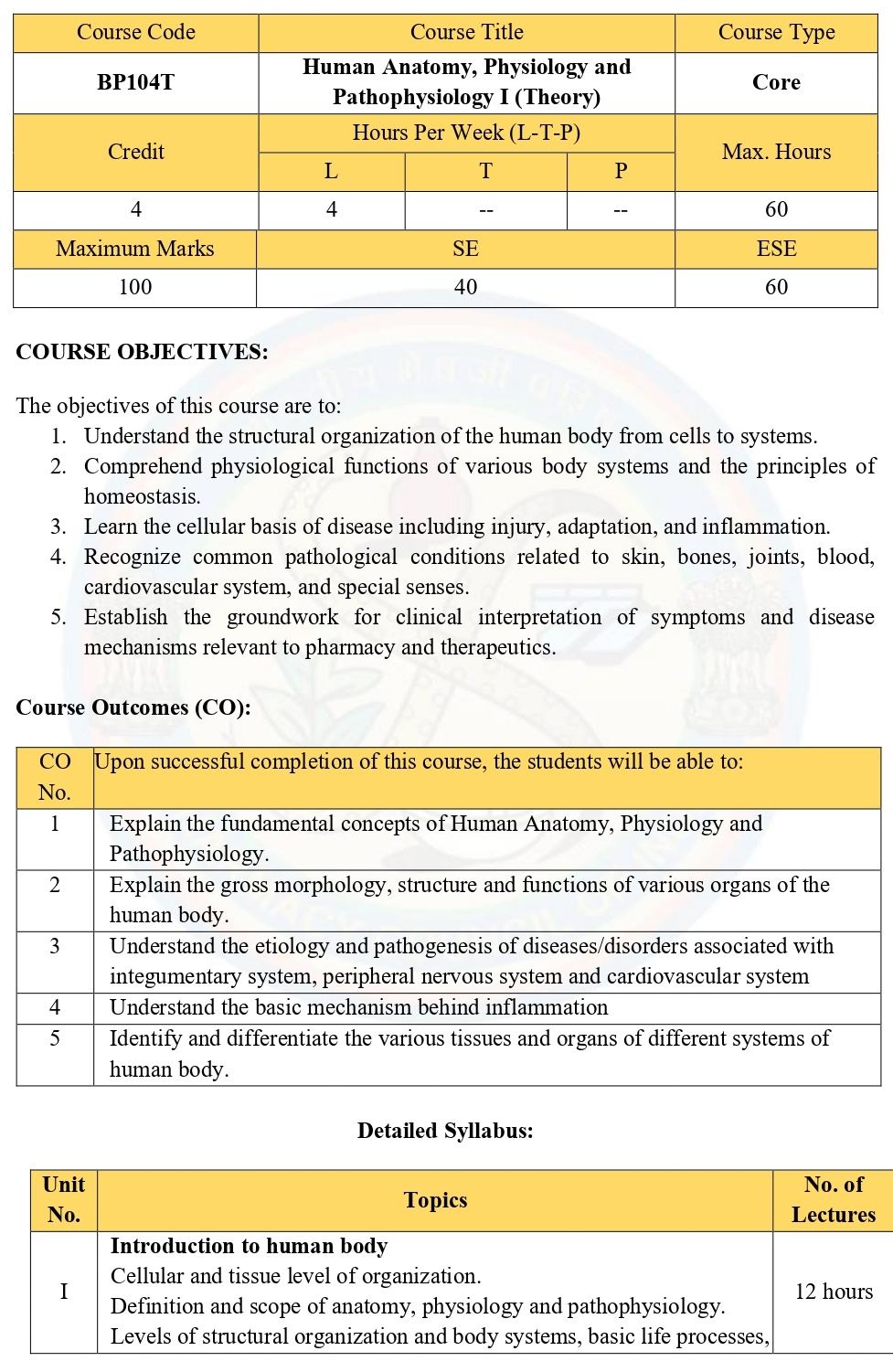
BP104T:
Human Anatomy,
Physiology and Pathophysiology I (Theory)
Course Objectives:
The objectives of
this course are to:
1. Understand the
structural organization of the human body from cells to systems.
2. Comprehend
physiological functions of various body systems and the principles of
homeostasis.
3. Learn the cellular
basis of disease including injury, adaptation, and inflammation.
4. Recognize common
pathological conditions related to skin, bones, joints, blood, cardiovascular
system, and special senses.
5. Establish the
groundwork for clinical interpretation of symptoms and disease mechanisms
relevant to pharmacy and therapeutics.
Course Outcomes
(CO):
Upon successful
completion of this course, the students will be able to:
1. Explain the
fundamental concepts of Human Anatomy, Physiology and Pathophysiology.
2. Explain the gross
morphology, structure and functions of various organs of the human body.
3. Understand the
etiology and pathogenesis of diseases/disorders associated with integumentary
system, peripheral nervous system and cardiovascular system
4. Understand the
basic mechanism behind inflammation
5. Identify and
differentiate the various tissues and organs of different systems of human
body.
Detailed Syllabus:
Unit I
Introduction to
human body
Cellular and tissue
level of organization.
Definition and scope
of anatomy, physiology and pathophysiology. Levels of structural organization
and body systems, basic life processes, homeostasis, basic anatomical
terminologies.
Structure and
functions of cell, transport across cell membrane, cell division, cell junctions.
General principles of cell communication, forms of intracellular signalling-
a) Contact-dependent,
b) Paracrine, c) Synaptic, d) Endocrine Classification of tissues, structure,
location and functions of epithelial, muscular and nervous and connective tissues.
Basic principles of
cell injury and adaptation
Components and types
of feedback systems, causes of cellular injury, pathogenesis (cell membrane
damage, mitochondrial damage, ribosome damage and nuclear damage), morphology
of cell injury – adaptive changes (atrophy, hypertrophy, hyperplasia,
metaplasia, dysplasia), cell swelling, intra cellular accumulation and cell
death.
Definitions of
commonly used relevant medical terminologies.
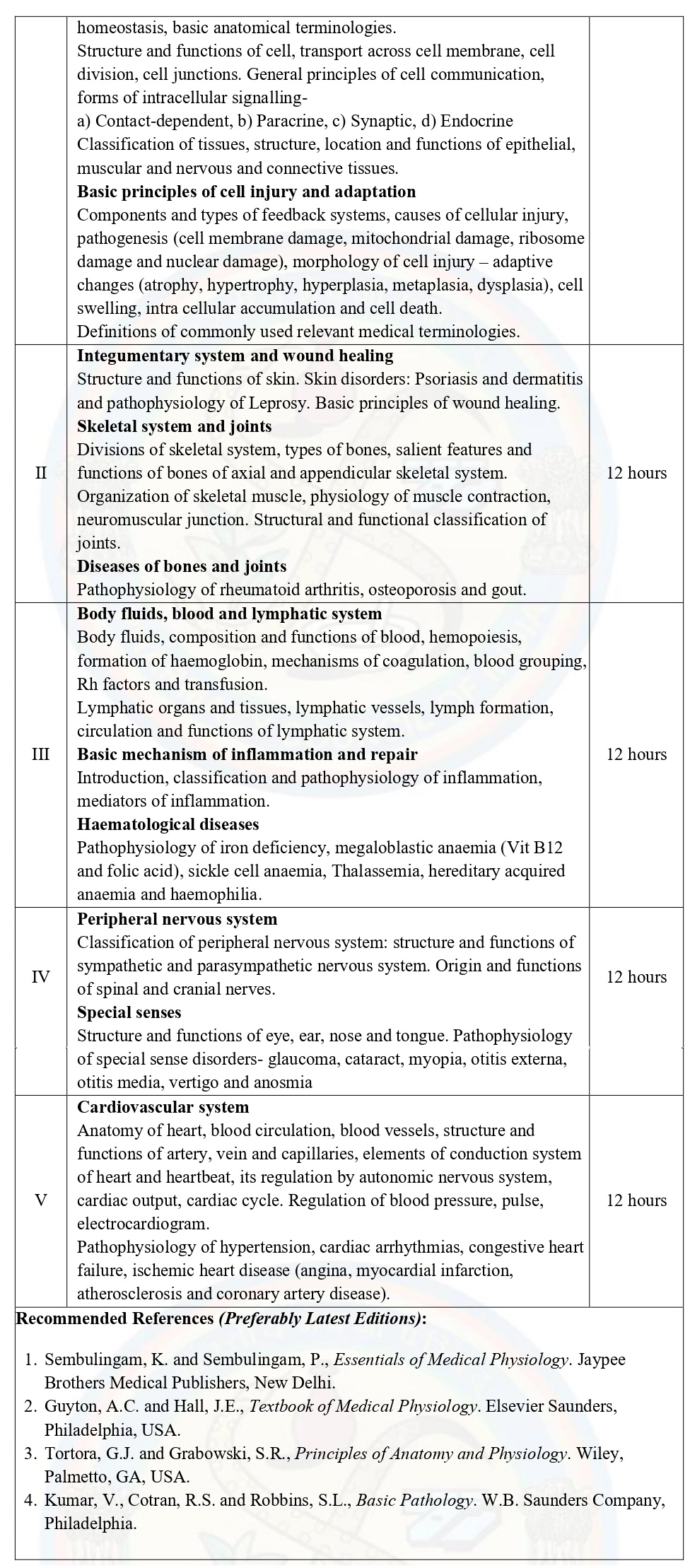
Unit II
Integumentary
system and wound healing
Structure and functions
of skin. Skin disorders: Psoriasis and dermatitis and pathophysiology of
Leprosy. Basic principles of wound healing.
Skeletal system and
joints
Divisions of skeletal
system, types of bones, salient features and functions of bones of axial and
appendicular skeletal system.
Organization of
skeletal muscle, physiology of muscle contraction, neuromuscular junction.
Structural and functional classification of joints.
Diseases of bones
and joints
Pathophysiology of
rheumatoid arthritis, osteoporosis and gout.
Unit III
Body fluids, blood
and lymphatic system
Body fluids,
composition and functions of blood, hemopoiesis, formation of haemoglobin,
mechanisms of coagulation, blood grouping, Rh factors and transfusion.
Lymphatic organs and
tissues, lymphatic vessels, lymph formation, circulation and functions of
lymphatic system.
Basic mechanism of
inflammation and repair
Introduction,
classification and pathophysiology of inflammation, mediators of inflammation.
Haematological
diseases
Pathophysiology of
iron deficiency, megaloblastic anaemia (Vit B12 and folic acid), sickle cell
anaemia, Thalassemia, hereditary acquired anaemia and haemophilia.
Unit IV
Peripheral nervous
system
Classification of
peripheral nervous system: structure and functions of sympathetic and
parasympathetic nervous system. Origin and functions of spinal and cranial
nerves.
Special senses
Structure and
functions of eye, ear, nose and tongue. Pathophysiology of special sense
disorders- glaucoma, cataract, myopia, otitis externa, otitis media, vertigo
and anosmia
Unit V
Cardiovascular
system
Anatomy of heart,
blood circulation, blood vessels, structure and functions of artery, vein and
capillaries, elements of conduction system of heart and heartbeat, its
regulation by autonomic nervous system, cardiac output, cardiac cycle.
Regulation of blood pressure, pulse, electrocardiogram.
Pathophysiology of
hypertension, cardiac arrhythmias, congestive heart failure, ischemic heart
disease (angina, myocardial infarction, atherosclerosis and coronary artery
disease).
Recommended
References (Preferably Latest Editions):
1. Sembulingam, K.
and Sembulingam, P., Essentials of Medical Physiology. Jaypee Brothers Medical
Publishers, New Delhi.
2. Guyton, A.C. and
Hall, J.E., Textbook of Medical Physiology. Elsevier Saunders, Philadelphia,
USA.
3. Tortora, G.J. and
Grabowski, S.R., Principles of Anatomy and Physiology. Wiley, Palmetto, GA,
USA.
4. Kumar, V., Cotran,
R.S. and Robbins, S.L., Basic Pathology. W.B. Saunders Company, Philadelphia.