Human Anatomy, Physiology and Pathophysiology II
[ Bpharm (Bachelor of Pharmacy) ]
Under Class: | 2nd Semester (Bpharm) |
Human Anatomy, Physiology and Pathophysiology II - Question Papers, Lecture Notes, Study Material Download PDF
Pharmacy - Bachelor of Pharmacy (Bpharm) - 2nd Semester - 1st Year - Name of Subject: Human Anatomy, Physiology and Pathophysiology II (BP203T) - Lecture Notes, Study Material, Question Papers Download PDF
Essentials of Anatomy and Physiology
Organization and General Plan of the Body:
• Organization and General Plan of the Body
• Levels of Organization
• Metabolism and Homeostasis
• Terminology and General Plan of the Body
Some Basic Chemistry:
• Elements
• Atoms
• Chemical Bonds
• Chemical Reactions
• Inorganic Compounds of Importance
• Organic Compounds of Importance
• Carbohydrates
• Lipids
• Proteins
• Enzymes
• Nucleic Acids
Cells:
• Cells
• Cell Structure
• Cell Membrane
• Nucleus - Cells
• Cytoplasm and Cell Organelles
• Cellular Transport Mechanisms
• The Genetic Code and Protein Synthesis
• Cell Division
• Aging and Cells
Tissues and Membranes:
• Epithelial Tissue
• Connective Tissue
• Muscle Tissue
• Nerve Tissue
• Membranes: Epithelial and Connective, serous and mucous Membranes
• Aging and Tissues
The Integumentary System:
• Skin - Anatomy and Physiology
• Outer epidermis - Skin
• Inner dermis - Skin
• Subcutaneous Tissue
• Aging and the Integumentary System
The Skeletal System:
• Skeletal System
• Functions of the Skeleton
• Types of Bone Tissue
• Classification of Bones
• Embryonic Growth of Bone
• Factors That Affect Bone Growth and Maintenance
• The Skeleton
• Skull - Skeleton
• Vertebral Column - Skeleton
• Rib Cage - Skeleton
• Shoulder And Arm - Skeleton
• Hip and Leg - Skeleton
• Joints-Articulations
• Aging and the Skeletal System
The Muscular System:
• The Muscular System
• Muscle Structure
• Muscle Tone
• Muscle Sense
• Energy Sources for Muscle Contraction
• Muscle Fiber- Microscopic Structure
• Contraction-The Sliding Filament Mechanism
• Responses to Exercise-Maintaining Homeostasis
• Aging and the Muscular System
• Major Muscles of the Body
The Nervous System:
• The Nervous System
• Nervous System Divisions
• Nerve Tissue
• Types of Neurons
• Nerves and Nerve Tracts
• The Nerve Impulse
• Spinal Cord
• Spinal Nerves
• Spinal Cord Reflexes
• The Brain - Anatomy and Physiology
• Meninges and Cerebrospinal Fluid
• Cranial Nerves
• Autonomic Nervous System
• Aging and the Nervous System
The Senses:
• Sensory Pathway
• Characteristics of Sensations
• Cutaneous Senses
• Muscle Sense
• Sense of Taste
• Sense of Smell
• Hunger and Thirst
• The Eye - Structure, Anatomy and Physiology
• Eyeball: Layers and Cavities of the Eyeball
• Physiology of Vision - Eye
• The Ear: Anatomy and Physiology
• Arterial Receptors
• Aging and the Senses
The Endocrine System:
• The Endocrine System
• Chemistry of Hormones
• Regulation of Hormone Secretion
• The Pituitary Gland - Anatomy and Physiology
• Posterior Pituitary Gland
• Anterior Pituitary Gland
• Thyroid Gland - Anatomy and Physiology
• Parathyroid Glands and Parathyroid hormone (PTH)
• Pancreas - Anatomy and Physiology
• Adrenal Glands - Anatomy and Physiology
• Adrenal Medulla: Epinephrine and Norepinephrine
• Adrenal Cortex: Aldosterone, Cortisol
• Ovaries
• Testes
• Melatonin
• Prostaglandins (PGs)
• Mechanisms of Hormone Action
• Aging and the Endocrine System
Blood:
• Characteristics of Blood
• Plasma
• Red Blood Cells: Function, Production and Maturation, Life Span, Blood Types
• White Blood Cells: Classification and Function
• Platelets: Function
• Prevention of Abnormal Clotting
The Heart:
• Location and Pericardial Membranes
• Heart Chambers-Vessels and Valves
• Coronary Vessels
• Cardiac Cycle and Heart Sounds
• Cardiac Conduction Pathway
• Heart Rate
• Cardiac Output
• Regulation of Heart Rate
• Aging and the Heart
The Vascular System:
• Arteries - Anatomy and Physiology
• Veins - Anatomy and Physiology
• Capillaries - Anatomy and Physiology
• Pathways of Circulation
• Velocity of Blood Flow
• Blood Pressure
• Maintenance of Systemic Blood Pressure
• Distribution of Blood Flow
• Regulation of Blood Pressure
• Aging and the Vascular System
The Lymphatic System and Immunity:
• Lymph - Anatomy and Physiology
• Lymph Vessels
• Lymphatic Tissue
• Lymph Nodes and Nodules
• Spleen
• Thymus
• Immunity
• Innate Immunity
• Adaptive Immunity
• Types of Immunity
• Aging and the Lymphatic System
The Respiratory System:
• Divisions of the Respiratory System
• Mechanism of Breathing
• Pulmonary Volumes
• Exchange of Gases - The Respiratory System
• Transport of Gases in the Blood
• Regulation of Respiration: Nervous and Chemical Regulation
• Respiration and Acid-Base Balance
• Aging and the Respiratory System
The Digestive System:
• Divisions of the Digestive System
• Types of Digestion
• Oral Cavity
• Pharynx
• Esophagus
• Structural Layers of the Alimentary Tube
• Stomach - Anatomy and Physiology
• Small Intestine - Anatomy and Physiology
• Liver - Anatomy and Physiology
• Gallbladder - Anatomy and Physiology
• Pancreas
• Completion of Digestion and Absorption
• Large Intestine - Anatomy and Physiology
• Functions of the Liver
• Aging and the Digestive System
Body Temperature and Metabolism:
• Body Temperature
• Heat Production - Body Temperature
• Heat Loss - Body Temperature
• Regulation of Body Temperature
• Fever - Body Temperature
• Metabolism
• Cell Respiration
• Synthesis Uses Of Foods - Metabolism
• Metabolism: Vitamins and Minerals
• Metabolic Rate
• Aging and Metabolism
The Urinary System:
• The Urinary System
• Kidneys - Anatomy and Physiology
• Internal Structure of the Kidney
• Nephron - Anatomy and Physiology
• Blood Vessels of the Kidney
• Formation of Urine
• Glomerular Filtration - Formation of Urine
• Tubular Reabsorption - Formation of Urine
• Tubular Secretion - Formation of Urine
• Hormones that Influence Reabsorption of Water - Formation of Urine
• Kidneys and Acid-Base Balance
• Functions of the Kidneys
• Elimination of Urine
• Characteristics of Urine
• Aging and the Urinary System
Fluid Electrolyte and Acid Base Balance:
• Water Compartments in Human body
• Water Intake and Output in Human body
• Electrolytes in Human body
• Acid-Base Balance in Human body
• Aging and Fluid and pH Regulation
The Reproductive Systems:
• Meiosis - Human Reproductive Systems
• Male Reproductive System in Human
• Female Reproductive System in Human
• Menstrual Cycle in Human
• Aging and the Reproductive Systems
• Testes - Anatomy and Physiology
• Urethra-Penis
• Semen
• Ovaries - Anatomy and Physiology
• Fallopian Tubes
• Uterus - Anatomy and Physiology
• Vagina - Anatomy and Physiology
• External Genitals - Anatomy and Physiology
• Mammary Glands - Anatomy and Physiology
Human Development and Genetics:
• Human Development
• Embryo And Embryonic Membranes
• Placenta and Umbilical Cord
• Parturition and Labor
• Infant at Birth
• Genetics
An Introduction to Microbiology and Human Disease:
• Classification of Microorganisms
• Normal Flora
• Infectious Disease
• Epidemiology
• Methods of Control of Microbes
• The Pathogens and its List
Pathology
Fundamentals of Pathology:
• Overview of Pathology
Cellular Injury and Adaptation:
• Causes of Cellular Injury
• Cellular Changes During Injury
• Cell Death
• Cellular Adaptive Responses to Injury
• Other Cellular Alterations During Injury
Inflammation:
• Acute Inflammation
• Chronic Inflammation
• Tissue Responses to Infectious Agents
Tissue Repair:
• Regeneration and Healing
• Aberrations in Wound Healing
Circulatory Pathology:
• EDEMA
• Hemostasis and Bleeding Disorders
• Thrombosis
• Embolism
• Infarction
• Shock
Genetic Disorders:
• Disorders Involving an Extra Autosome
• Disorders Involving Chromosomal Deletions
• Disorders Involving Sex Chromosomes
• Disorders of Sexual Development (DSD)
• Mendelian Disorders
• Autosomal Recessive Disorders
• Autosomal Dominant Disorders
• X-Linked Recessive Conditions
• X-Linked Dominant Conditions
• Triplet Repeat Mutations
• Genomic Imprinting
• Mitochondrial DNA Disorders
• Multifactorial Inheritance
Immunopathology:
• Hypersensitivity Reactions
• Autoimmune Diseases
• Primary Immune Deficiency Syndromes
• Secondary Immune Deficiency Syndromes
• Acquired Immunodeficiency Syndrome (AIDS)
• Immunology of Transplant Rejection
Amyloidosis:
• Composition of Amyloid
• Systemic Types of Amyloid
• Localized Types of Amyloid
• Amyloidosis: Clinical Features
Principles of Neoplasia:
• Principles of Neoplasia: Definition, Epidemiology
• Carcinogenic Agents
• Carcinogenesis
• Diagnosis of Cancer
Skin Pathology:
• Disorders of Pigmentation
• Melanocytic Tumors
• Epidermal and Dermal Lesions
• Malignant Tumors
Red Blood Cell Pathology Anemias:
• Red Blood Cell Morphology
• Anemias
• Microcytic Anemias
• Normocytic Anemias
• Macrocytic Anemias
• Polycythemia Vera
Vascular Pathology:
• The Vasculitides
• Raynaud Disease Versus Phenomenon
• Arteriosclerosis
• Hypertension (HTN)
• Aneurysms and Arteriovenous Fistulas
• Venous Disease
• Vascular Neoplasms
Cardiac Pathology:
• Ischemic Heart Disease
• Congestive Heart Failure
• Valvular Heart Disease
• Myocarditis
• Congenital Heart Disease
• Primary Cardiomyopathies (Diagnosis of Exclusion)
• Carcinoid Heart Disease
• Cardiac Tumors
• Pericardial Disease
Respiratory Pathology:
• Congenital Cystic Lung Lesions
• Atelectasis
• Pulmonary Infections
• Sarcoidosis
• Obstructive Pulmonary Disease
• Infiltrative Restrictive Lung Diseases(Diffuse Interstitial Diseases)
• Vascular Disorders
• Pulmonary Neoplasia
• Laryngeal Cancer
• Diseases of the Pleural Cavity
Renal Pathology:
• Congenital Anomalies of the Kidney
• Cystic Disease
• Glomerular Diseases
• Primary Glomerulopathies (Nephritic Syndrome)
• Primary Glomerulopathies (Nephrotic)
• Secondary Glomerulonephritis
• Chronic Glomerulonephritis
• Tubulointerstitial Nephritis
• Acute Tubular Injury
• Urolithiasis
• Chronic Renal Failure
• Vascular Disorders of the Kidney
• Tumors of the Kidney
• Obstructive Disorders of the Urinary System
• Ureteral Disorders
• Urinary Bladder Pathology
Gastrointestinal Tract Pathology:
• Esophagus
• Pathology: Stomach
• Small and Large Intestines
Pancreatic Pathology:
• Congenital Anomalies of the Pancreas
• Inflammation of the Pancreas
• Pancreatic Tumors
Gallbladder and Biliary Tract Pathology:
• Gallstones (Cholelithiasis)
• Gallbladder: Inflammatory Conditions
• Gallbladder: Miscellaneous Conditions
• Biliary Tract Cancer
Liver Pathology:
• Liver Dysfunction
• Jaundice
• Cirrhosis
• Viral Hepatitis
• Amebic Liver Abscess
• Alcoholic Liver Disease
• Metabolic Liver Disease
• Hemodynamic Liver Diseases
• Liver Tumors
Central Nervous System Pathology:
• Infections - Central Nervous System
• Cerebrovascular Disease
• CNS Trauma And Herniations
• Developmental Abnormalities and Perinatal Brain Injury
• Demyelinating Disorders
• Degenerative and Dementing Disorders
• CNS Tumors
Hematopoetic Pathology White Blood Cell Disorders and Lymphoid and Myeloid Neoplasms:
• Reactive Changes in White Blood Cells
• Lymphoid Neoplasms
• Mature B-Cell Neoplasms
• Peripheral T-Cell and Natural Killer Cell Neoplasms
• Hodgkin Lymphoma
• Acute Leukemias
• B and T Lymphoblastic Lymphoma/Leukemia
• Myeloid Neoplasms
• Diseases of Histiocytes and Dendritic Cells
• Mast Cell Diseases
• Diseases of the Spleen and Thymus
Female Genital Pathology:
• Vulva - Pathology
• Vagina - Pathology
• Cervix - Pathology
• Uterus - Pathology
• Ovary - Pathology
• Placenta - Pathology
Breast Pathology:
• Mastitis
• Fibrocystic Changes
• Benign Neoplasms
• Malignant Neoplasms
• Gynecomastia - Pathology
Male Pathology:
• Penis - Pathology
• Testes - Pathology
• Testicular Cancer
• Prostate
Endocrine Pathology:
• Thyroid Gland - Pathology
• Parathyroid Glands - Pathology
• Pituitary Gland, Hypothalamus, and Pineal Gland - Pathology
• Adrenal Gland - Pathology
• Multiple Endocrine Neoplasia Syndromes
• Diabetes Mellitus
Bone Pathology:
• Normal Bone - Pathology
• Hereditary Bone Disorders
• Paget Disease
• Osteoporosis
• Osteomalacia and Rickets
• Osteomyelitis
• Miscellaneous Bone Disorders
• Benign Tumors of Bone
• Malignant Tumors of Bone
Joint Pathology:
• Osteoarthritis
• Rheumatoid Arthritis
• Seronegative Spondyloarthropathies
• Arthritis Related to Crystal Deposition
• Infectious Arthritis
• Neuropathic Arthropathy (Charcot Joint)
Skeletal Muscle and Peripheral Nerve Pathology:
• Inflammatory Myopathies
• Myasthenic Syndromes
• Muscular Dystrophy
• Inflammatory Neuropathy
• Soft Tissue and Peripheral Nerve Tumors
Anatomy and Physiology Health Education (APHE)
SECTION I: LEVELS OF ORGANIZATION:
Chapter 1: Introduction to Human Anatomy and Physiology:
• Introduction to Human Anatomy and Physiology
• Organization Levels of the Body
• Essentials for Life
• Homeostasis
• Organization of the Body
• Summary
Chapter 2: Chemical Basics of Life:
• Chemical Basics of Life
• Basic Chemistry
• Atoms, Molecules, and Chemical Bonds
• Atomic Structure
• Molecules and Compounds
• Chemical Bonds
• Chemical Reactions
• Acids, Bases, and the pH Scale
• Biochemistry
• Inorganic Substances
• Organic Substances
• Proteins
• Nucleic Acids
• Enzymes and Enzyme Characteristics
• Adenosine Triphosphate
• Summary
Chapter 3: Cells:
• Cells
• Cell Membrane - Structure of the Cell
• Membrane Lipids and Membrane Proteins
• Cytoplasm (Cytosol, Organelles) Structure
• Structure of Endomembrane System and Cytoskeleton
• Structure of Nucleus
• Passive Cell Mechanisms
• Active Cell Mechanisms
• Cell Cycle
• Cell Cycle: Interphase
• Cell Cycle: Cell Division and Cytoplasmic Division
• Cell Cycle: Differentiation
• Cell Cycle: Cell Division and Cancer
• Summary
Chapter 4: Cellular Metabolism:
• Cellular Metabolism
• Metabolic Reactions
• Control of Metabolic Reactions
• Oxidation Reduction Reactions
• Chemical Energy
• Cellular Respiration and Metabolism of Carbohydrates
• Citric Acid Cycle (Krebs Cycle)
• Metabolic Pathways
• Glycogenesis
• Glycogenolysis
• Gluconeogenesis
• Metabolism of Lipids
• Metabolism of Proteins
• Summary
Chapter 5: Tissues:
• Tissues
• Types of Tissues
• Epithelial Tissues
• Connective Tissues
• Classifications of Connective Tissue
• Muscle Tissues
• Nervous or Neural Tissues
• Tissue Membranes
• Tissue Repair
• Effects of Aging on Various Tissues
• Summary on Tissues
SECTION II: SUPPORT AND MOVEMENT:
Chapter 6: Integumentary System:
• Integumentary System
• Skin
• Dermis - Skin
• Nails
• Hairs
• Glands in the Skin
• Functions of the Integumentary System
• Response of the Integument to Injuries and Wounds
• Effects of Aging on the Integumentary System
• Skin Cancer
• Burns
• Summary - Integumentary System
Chapter 7: Bone Tissues and the Skeletal System:
• Bone Tissues and the Skeletal System
• Classifications of Bones
• Structures of Bones
• Microscopic Anatomy (Bone Cells)
• Chemical Composition of Bone
• Growth and Development of Bones
• Functions of Bones
• Bone Homeostasis
• Bone Homeostatic Imbalance
• Axial Skeleton
• Pectoral Girdle - Appendicular Skeleton
• Pelvic Girdle - Appendicular Skeleton
• Effects of Aging on the Skeletal System
• Summary
Chapter 8: Articulations:
• Articulations
• Functional Classifications of Joints
• Fibrous Joints
• Cartilaginous Joints
• Synovial Joints
• Bursae and Tendon Sheaths
• Types of Synovial Joints
• Shoulder Joints
• Elbow Joints
• Hip Joints
• Knee Joints
• Temporomandibular Joints (TMJ)
• Types of Joint Movements
• Intervertebral Joints
• Intervertebral Ligaments
• Joint Injuries
• Effects of Aging on the Joints
• Summary
Chapter 9: Muscle Tissue:
• Muscle Tissue
• Classification of Muscle Tissues
• Characteristics of Muscle Tissue
• Functions of the Muscles
• Coverings of Connective Tissue
• Blood Supply and Nerve Attachments
• Structure of Skeletal Muscle Fibers
• Contraction Stimulus
• Neuromuscular Junction
• Action Potential
• Sarcoplasmic Reticulum and Transverse Tubules
• Somatic Motor Neurons
• Motor Units
• Muscle Twitch
• Energy Sources for Contraction
• Smooth Muscle
• Effects of Aging on Muscle Tissue
• Summary on Muscle Tissue
Chapter 10: Muscular System:
• Muscular System
• Classification of the Muscle Fibers
• Types of Fibers
• Lever Systems
• Effects of Aging on the Muscular System
• Summary
SECTION III: Control and Coordination:
Chapter 11: Neural Tissue:
• Neural Tissue
• Divisions of the Nervous System
• Cells of the Nervous System
• Classification of Nerve Fibers
• Cell Membrane Potential
• Nerve Impulses
• Synapses
• Processing of Impulses
• Effects of Aging on the Nervous System
• Summary
Chapter 12: Central Nervous System:
• Central Nervous System
• The Brain
• Higher Brain Functions
• Brain Protection
• Spinal Cord
• Spinal Neuronal Pathways
• Imbalances of the CNS
• Effects of Aging on the Brain
• Summary
Chapter 13: Peripheral Nervous System and Reflex Activity:
• Peripheral Nervous System and Reflex Activity
• Sensory Receptors
• General Senses
• Peripheral Nerves:Cranial, Spinal Nerves
• Cranial Nerves
• Spinal Nerves
• Peripheral Motor Endings
• Somatic Nervous System
• Imbalances of the PNS (Peripheral Nervous System)
• Effects of Aging on the PNS (Peripheral Nervous System)
• Summary
Chapter 14: Autonomic Nervous System (ANS):
• Autonomic Nervous System (ANS)
• Comparison of the Somatic Nervous System and Autonomic Nervous System
• Major ANS(Autonomic Nervous System) Neurotransmitters
• Autonomic Nerve Fibers
• Divisions of the Autonomic Nervous System (ANS)
• Differences Between the Sympathetic and Parasympathetic Divisions
• Cholinergic Receptors
• Adrenergic Receptors
• Control of Autonomic Activity
• Somatic and Autonomic Function Overlap
• Higher Levels of Autonomic Control
• Imbalances of the ANS (Autonomic Nervous System)
• Effects of Aging on the Autonomic Nervous System (ANS)
• Summary
Chapter 15: Special Senses:
• Special Senses
• Sense of Smell
• Sense of Taste
• Sense of Hearing
• Sense of Equilibrium
• Sense of Sight
• Effects of Aging on the Senses
• Summary
Chapter 16: Endocrine System:
• Endocrine System
• Hormones
• Control of Hormones
• Pituitary Gland
• Thyroid Gland
• Parathyroid Glands
• Adrenal Glands
• Pineal Gland
• Other Glands, Organs, or Tissues
• Stress
• Effects of Aging on the Endocrine System
• Summary
SECTION IV: Transport:
Chapter 17: Blood:
• Blood
• Blood Functions
• Blood Components
• Plasma
• Erythrocytes
• Disorders of Erythrocytes
• Leukocytes or white blood cells (WBCs)
• Platelets or thrombocytes
• Hemostasis
• Blood Types and Transfusions
• Diagnostic Blood Tests
• Effects of Aging on the Blood
• Summary
Chapter 18: The Heart:
• The Heart
• Blood Circulation
• Structures of the Heart
• Functions of the Heart
• Effects of Aging on the Cardiovascular System
• Summary
Chapter 19: Vascular System:
• Vascular System
• Blood Vessel Structure
• Arterial System
• Capillaries
• Venous System
• Vascular Anastomoses
• Blood Circulation
• Blood Pressure
• Neural Controls of Blood Vessels
• Blood Vessel Pathways and Divisions
• Aorta and Its Branches
• Veins and Their Branches
• Effects of Aging on the Vascular System
• Summary
Chapter 20: Lymphatic System and Immunity:
• Lymphatic System and Immunity
• Organization of the Lymphatic System
• Body Defenses and Fighting Infection
• Innate (Nonspecific) Defenses
• Adaptive (Specific) Defenses
• B and T Lymphocytes Related to the Adaptive Immune Response
• Humoral Immune Response
• Antibodies
• Cellular Immune Response
• Major Effector T Cells
• Imbalance of Immune System Homeostasis
• Hypersensitivities
• Effects of Aging on the Lymphatic System and Immunity
• Summary
SECTION V: Environmental Exchange:
Chapter 21: Respiratory System:
• Respiratory System
• Respiratory System Functions
• Organization of the Respiratory System
• Nose and Paranasal Sinuses
• Pharynx
• Larynx
• Trachea
• Gross Anatomy of the Lungs
• The Pleural Cavities and Pleural Membranes
• The Respiratory Muscles
• Gas Exchange
• Control of Breathing
• Factors of Respiratory Rate and Depth
• Effects of Aging on the Respiratory System
• Summary
Chapter 22: Urinary System:
• Urinary System
• Anatomy of the Kidneys
• Internal Kidney Anatomy
• Structures of the Nephron
• Formation of Urine
• Glomerular Filtration
• Tubular Reabsorption
• Tubular Secretion
• Composition of Urine
• Ureters
• Urinary Bladder
• Urethra
• Effects of Aging on the Urinary System
• Summary
Chapter 23: Fluid, Electrolyte, and Acid Base Balance:
• Fluid, Electrolyte, and Acid Base Balance
• Body Fluid Distribution
• Fluid Balance
• Fluid Intake and Output
• Electrolyte Balance
• Acid-Base Balance
• Acid-Base Imbalances
• Effects of Aging on Water, Electrolyte, and Acid-Base Balance
• Summary
Chapter 24: Digestive System:
• Digestive System
• Alimentary Canal
• Functions of the Digestive System
• Movement of Digestive Materials
• Mouth
• Salivary Glands
• Teeth
• Esophagus
• Stomach
• Small Intestine
• Liver
• Gallbladder
• Pancreas
• Large Intestine
• Digestion and Absorption of Nutrients
• Effects of Aging on the Digestive System
• Summary
SECTION VI: Continuity of Life:
Chapter 25: Reproductive System:
• Reproductive System
• Anatomy of the Male Reproductive System
• Physiology of the Male Reproductive System
• Anatomy of the Female Reproductive System
• Physiology of the Female Reproductive System
• Sexually Transmitted Infections (STI)
• Effects of Aging on the Reproductive System
• Summary
Chapter 26: Pregnancy and Development:
• Pregnancy and Development
• Fertilization
• Prenatal Development
• Parturition (Birth)
• Postnatal Development: Lactation
• Summary
Chapter 27: Heredity:
• Heredity
• Genes
• Genetic Variation
• Patterns of Inheritance
• Heredity: Environmental Factors
• Heredity: Gender-Related Factors
• Genetic Screening
• Summary
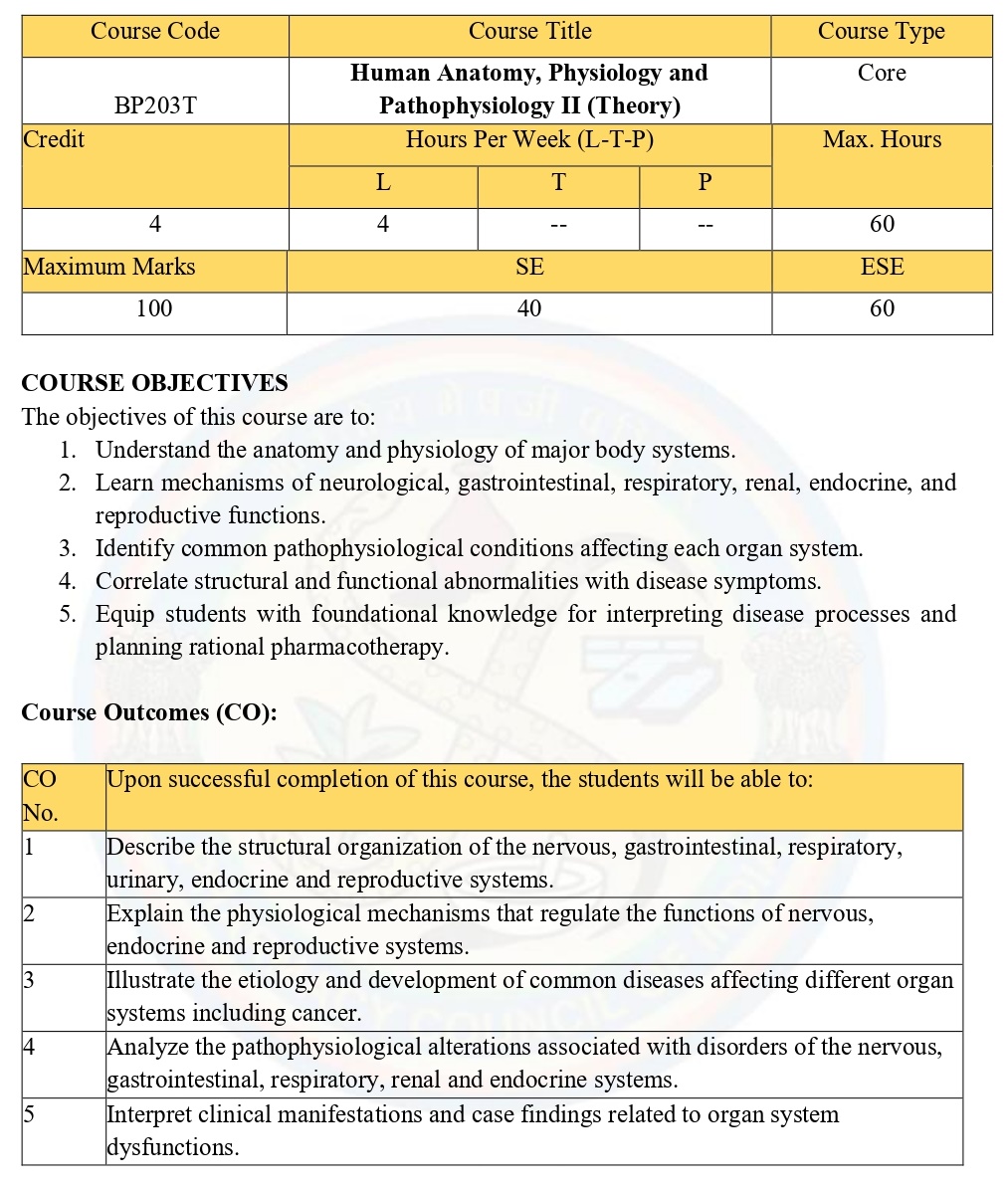
BP203T:
Human Anatomy,
Physiology and Pathophysiology II (Theory)
COURSE OBJECTIVES
The objectives of
this course are to:
1. Understand the
anatomy and physiology of major body systems.
2. Learn mechanisms
of neurological, gastrointestinal, respiratory, renal, endocrine, and
reproductive functions.
3. Identify common
pathophysiological conditions affecting each organ system.
4. Correlate
structural and functional abnormalities with disease symptoms.
5. Equip students
with foundational knowledge for interpreting disease processes and planning
rational pharmacotherapy.
Course Outcomes
(CO):
Upon successful
completion of this course, the students will be able to:
1. Describe the
structural organization of the nervous, gastrointestinal, respiratory, urinary,
endocrine and reproductive systems.
2. Explain the
physiological mechanisms that regulate the functions of nervous, endocrine and
reproductive systems.
3. Illustrate the
etiology and development of common diseases affecting different organ systems
including cancer.
4. Analyze the
pathophysiological alterations associated with disorders of the nervous,
gastrointestinal, respiratory, renal and endocrine systems.
5. Interpret clinical
manifestations and case findings related to organ system dysfunctions.
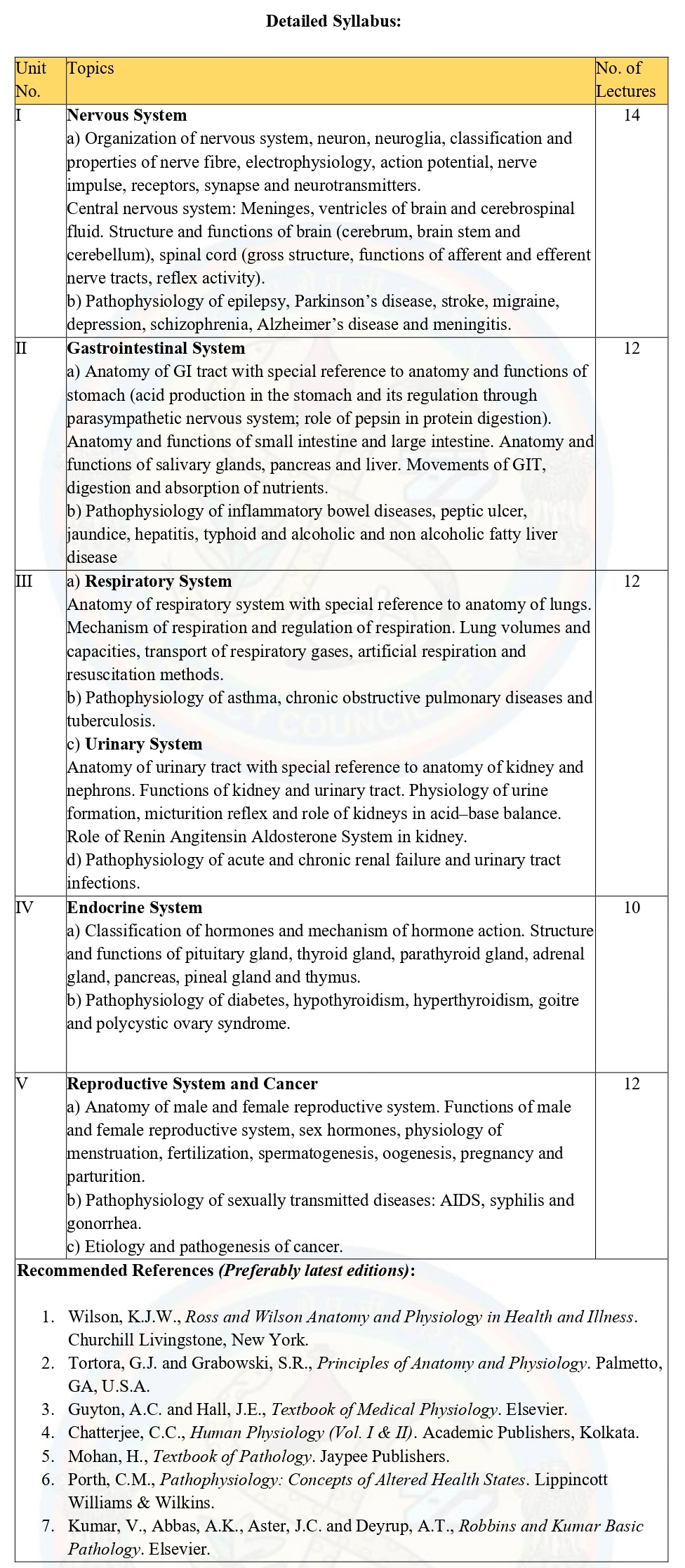
Detailed Syllabus:
Unit I
Nervous System
a) Organization of
nervous system, neuron, neuroglia, classification and properties of nerve
fibre, electrophysiology, action potential, nerve impulse, receptors, synapse
and neurotransmitters.
Central nervous
system: Meninges, ventricles of brain and cerebrospinal fluid. Structure and
functions of brain (cerebrum, brain stem and cerebellum), spinal cord (gross
structure, functions of afferent and efferent nerve tracts, reflex activity).
b) Pathophysiology of
epilepsy, Parkinson’s disease, stroke, migraine, depression, schizophrenia,
Alzheimer’s disease and meningitis.
Unit II
Gastrointestinal
System
a) Anatomy of GI
tract with special reference to anatomy and functions of stomach (acid
production in the stomach and its regulation through parasympathetic nervous
system; role of pepsin in protein digestion). Anatomy and functions of small
intestine and large intestine. Anatomy and functions of salivary glands,
pancreas and liver. Movements of GIT, digestion and absorption of nutrients.
b) Pathophysiology of
inflammatory bowel diseases, peptic ulcer, jaundice, hepatitis, typhoid and
alcoholic and non alcoholic fatty liver disease
Unit III
a) Respiratory
System
Anatomy of
respiratory system with special reference to anatomy of lungs. Mechanism of
respiration and regulation of respiration. Lung volumes and capacities,
transport of respiratory gases, artificial respiration and resuscitation
methods.
b) Pathophysiology of
asthma, chronic obstructive pulmonary diseases and tuberculosis.
c) Urinary System
Anatomy of urinary
tract with special reference to anatomy of kidney and nephrons. Functions of
kidney and urinary tract. Physiology of urine formation, micturition reflex and
role of kidneys in acid–base balance.
Role of Renin
Angitensin Aldosterone System in kidney.
d) Pathophysiology of
acute and chronic renal failure and urinary tract infections.
Unit IV
Endocrine System
a) Classification of
hormones and mechanism of hormone action. Structure and functions of pituitary
gland, thyroid gland, parathyroid gland, adrenal gland, pancreas, pineal gland
and thymus.
b) Pathophysiology of
diabetes, hypothyroidism, hyperthyroidism, goiter and polycystic ovary
syndrome.
Unit V
Reproductive System
and Cancer
a) Anatomy of male
and female reproductive system. Functions of male and female reproductive
system, sex hormones, physiology of menstruation, fertilization,
spermatogenesis, oogenesis, pregnancy and parturition.
b) Pathophysiology of
sexually transmitted diseases: AIDS, syphilis and gonorrhea.
c) Etiology and
pathogenesis of cancer.
Recommended
References (Preferably latest editions):
1. Wilson, K.J.W.,
Ross and Wilson Anatomy and Physiology in Health and Illness. Churchill
Livingstone, New York.
2. Tortora, G.J. and
Grabowski, S.R., Principles of Anatomy and Physiology. Palmetto, GA, U.S.A.
3. Guyton, A.C. and
Hall, J.E., Textbook of Medical Physiology. Elsevier.
4. Chatterjee, C.C.,
Human Physiology (Vol. I & II). Academic Publishers, Kolkata.
5. Mohan, H.,
Textbook of Pathology. Jaypee Publishers.
6. Porth, C.M.,
Pathophysiology: Concepts of Altered Health States. Lippincott Williams &
Wilkins.
7. Kumar, V., Abbas, A.K., Aster, J.C. and Deyrup, A.T., Robbins and Kumar Basic Pathology. Elsevier.